

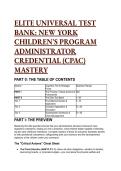
ELITE UNIVERSAL TEST
BANK: NEW YORK
CHILDREN'S PROGRAM
ADMINISTRATOR
CREDENTIAL (CPAC)
MASTERY
PART 0: THE TABLE OF CONTENTS
Section Cognitive Tier & Strategic Question Range
Focus
PART I The Preview: Critical Axioms & N/A
Frameworks
PART II The Elite Test Bank 1–30
Tier 1 Foundational Syntax & 1–10
Application
Tier 2 Complex Application & 11–20
Simulation
Tier 3 Grandmaster Synthesis & 21–30
Crisis Management
PART I: THE PREVIEW
Mastering this elite gauntlet ensures that your administrative decisions transcend mere
regulatory compliance, forging you into a proactive, crisis-resilient leader capable of directing
top-tier early childhood institutions. Complete mastery of these 30 scenarios translates directly
to elite operational competence, safeguarding both your licensure and the developmental
trajectory of the children under your command.
The "Critical Axioms" Cheat Sheet
● The Prime Directive (NAEYC P-1.1): Above all other obligations—whether to families,
sponsoring boards, or corporate budgets—you must place the physical welfare and
, psychological safety of children FIRST.
● The Baseline Ratios (OCFS Part 418-1): Administrative compliance requires adherence
to both the ratio multiplier and the hard ceiling of maximum group size within a single
physical space.
Age Demographic Minimum Teacher/Child Ratio Absolute Maximum Group Size
6 weeks to 18 months 1:4 8
18 months to 36 months 1:5 12
3 years 1:7 18
4 years 1:8 21
5 years 1:9 24
6 years through 9 years 1:10 20
● The Evaluation Mandate: International credentials are fundamentally invalid within the
Aspire Registry workforce system unless they are subjected to a rigorous
course-by-course evaluation by a NACES, AICE, or DCAS-approved organization.
● The Drill Protocol: Evacuation drills must be executed monthly for each specific shift of
care to ensure all staff build physiological memory. Shelter-in-place drills are strictly
required exactly twice annually.
● The MAT Imperative: Medication Administration Training (MAT) requires three
non-negotiable pillars: a written competency exam, a physical skills demonstration, and
explicit sign-off by a licensed Health Care Consultant on the facility's Health Care Plan.
PART II: THE ELITE TEST BANK
Q1: A New York State child day care center operates a classroom for toddlers aged 18 months
to 36 months. Due to an unexpected staff absence, the classroom currently has 13 children and
two lead teachers. Based on the principles of the OCFS Part 418-1 regulations, which
action/conclusion is the MOST ACCURATE? A) The classroom is compliant because the 1:7
ratio for mixed toddler groups allows up to 14 children with two teachers. B) The classroom is
compliant because two teachers maintain a 1:6.5 ratio, which is legally permitted during
emergency staff absences. C) The classroom is non-compliant; the maximum group size for this
age demographic cannot exceed 12 children, regardless of the number of teachers present. D)
The classroom is non-compliant solely because a third teacher is required to meet the strict 1:5
staff-to-child ratio.
● The Answer: C (The classroom is non-compliant; the maximum group size for this age
demographic cannot exceed 12 children, regardless of the number of teachers present.)
● Distractor Analysis:
○ A is incorrect: The 1:7 supervision ratio is strictly reserved for preschool classrooms
serving 3-year-olds, not toddlers aged 18 to 36 months, rendering this calculation
fundamentally illegal.
○ B is incorrect: OCFS regulations do not permit emergency ratio dilution to 1:6.5 for
this vulnerable age group; the absolute ratio remains 1:5 regardless of unexpected
absences.
○ D is incorrect: While adding a third teacher would mathematically fix a ratio violation
for 15 children, OCFS Part 418-1 strictly caps the absolute maximum group size for
18-36 months at 12 children within a single physical space.
The Mentor's Analysis: Regulatory syntax in early childhood administration operates on a
binary compliance matrix: you must satisfy both the teacher-to-child ratio and the maximum
, group size limitations simultaneously. When facing a sudden staffing deficit, the immediate
priority is redistributing children to maintain absolute maximum group sizes across the facility.
By utilizing Part 418-1 Maximum Capacity Thresholds, you bypass the common novice trap of
assuming that adding more adult bodies infinitely scales a classroom's legal capacity.
Professional/Academic Intuition: Never attempt to out-staff a maximum group size
violation; the physical room limit established by the state is an absolute ceiling.
Q2: A highly experienced educator from Germany applies for an Educational Director position at
a CUNY SPS-affiliated early childhood center. She presents an original, translated, and
notarized Master’s diploma in Early Childhood Education from a Berlin university. Based on the
principles of the Aspire Registry verification standards, which action is the MOST ACCURATE?
A) Accept the diploma because it is notarized and translated by a certified entity. B) Accept the
diploma provisionally for 90 days while the candidate begins a formal Plan of Study. C) Reject
the diploma until it is subjected to a course-by-course evaluation by a NACES, AICE, or
DCAS-approved organization. D) Reject the diploma entirely, as international degrees cannot
satisfy the NYS Children's Program Administrator Credential prerequisites.
● The Answer: C (Reject the diploma until it is subjected to a course-by-course evaluation
by a NACES, AICE, or DCAS-approved organization.)
● Distractor Analysis:
○ A is incorrect: The Aspire Registry explicitly states that unevaluated international
transcripts are labeled "Not Accepted," even if they are perfectly translated into
English and notarized by a legal entity.
○ B is incorrect: An OCFS Plan of Study is a specific legal mechanism for domestic
degree completion and credential tracking , not a substitute for international
credential verification.
○ D is incorrect: International degrees are perfectly valid within the New York State
administrative ecosystem, provided they undergo the mandatory credential
equivalency evaluation process.
The Mentor's Analysis: Verifying global talent requires standardizing their academic
background against domestic accreditation metrics to ensure parity in educational foundations.
When facing international documentation, the immediate priority is establishing U.S.
equivalency through a recognized evaluation body. By utilizing a NACES-Approved Evaluator,
you bypass the common trap of equating a notarized linguistic translation with actual academic
accreditation. Professional/Academic Intuition: Translation is merely linguistic; evaluation
is academic. Only NACES, AICE, or DCAS confer U.S. regulatory validity.
Q3: During a heated fiscal dispute, a Corporate Sponsoring Board demands that the center
Administrator increase the preschool (4-year-old) enrollment to 24 children per room with two
teachers to maximize revenue, despite the physical square footage being dangerously cramped.
Based on the principles of the NAEYC Code of Ethical Conduct, which action is the MOST
ACCURATE? A) Implement the policy but document a formal protest in the administrative log to
shield the center from future liability. B) Negotiate a compromise of 22 children to incrementally
meet the Board's fiscal demands while attempting to maintain safety. C) Refuse the mandate,
explicitly prioritizing the welfare and safety of the children above obligations to the sponsoring
board. D) Request an OCFS waiver to legally bypass the spatial requirements for the 4-year-old
cohort to satisfy the board.
● The Answer: C (Refuse the mandate, explicitly prioritizing the welfare and safety of the
children above obligations to the sponsoring board.)
● Distractor Analysis:
○ A is incorrect: Passive documentation of a physically dangerous policy violates the
BANK: NEW YORK
CHILDREN'S PROGRAM
ADMINISTRATOR
CREDENTIAL (CPAC)
MASTERY
PART 0: THE TABLE OF CONTENTS
Section Cognitive Tier & Strategic Question Range
Focus
PART I The Preview: Critical Axioms & N/A
Frameworks
PART II The Elite Test Bank 1–30
Tier 1 Foundational Syntax & 1–10
Application
Tier 2 Complex Application & 11–20
Simulation
Tier 3 Grandmaster Synthesis & 21–30
Crisis Management
PART I: THE PREVIEW
Mastering this elite gauntlet ensures that your administrative decisions transcend mere
regulatory compliance, forging you into a proactive, crisis-resilient leader capable of directing
top-tier early childhood institutions. Complete mastery of these 30 scenarios translates directly
to elite operational competence, safeguarding both your licensure and the developmental
trajectory of the children under your command.
The "Critical Axioms" Cheat Sheet
● The Prime Directive (NAEYC P-1.1): Above all other obligations—whether to families,
sponsoring boards, or corporate budgets—you must place the physical welfare and
, psychological safety of children FIRST.
● The Baseline Ratios (OCFS Part 418-1): Administrative compliance requires adherence
to both the ratio multiplier and the hard ceiling of maximum group size within a single
physical space.
Age Demographic Minimum Teacher/Child Ratio Absolute Maximum Group Size
6 weeks to 18 months 1:4 8
18 months to 36 months 1:5 12
3 years 1:7 18
4 years 1:8 21
5 years 1:9 24
6 years through 9 years 1:10 20
● The Evaluation Mandate: International credentials are fundamentally invalid within the
Aspire Registry workforce system unless they are subjected to a rigorous
course-by-course evaluation by a NACES, AICE, or DCAS-approved organization.
● The Drill Protocol: Evacuation drills must be executed monthly for each specific shift of
care to ensure all staff build physiological memory. Shelter-in-place drills are strictly
required exactly twice annually.
● The MAT Imperative: Medication Administration Training (MAT) requires three
non-negotiable pillars: a written competency exam, a physical skills demonstration, and
explicit sign-off by a licensed Health Care Consultant on the facility's Health Care Plan.
PART II: THE ELITE TEST BANK
Q1: A New York State child day care center operates a classroom for toddlers aged 18 months
to 36 months. Due to an unexpected staff absence, the classroom currently has 13 children and
two lead teachers. Based on the principles of the OCFS Part 418-1 regulations, which
action/conclusion is the MOST ACCURATE? A) The classroom is compliant because the 1:7
ratio for mixed toddler groups allows up to 14 children with two teachers. B) The classroom is
compliant because two teachers maintain a 1:6.5 ratio, which is legally permitted during
emergency staff absences. C) The classroom is non-compliant; the maximum group size for this
age demographic cannot exceed 12 children, regardless of the number of teachers present. D)
The classroom is non-compliant solely because a third teacher is required to meet the strict 1:5
staff-to-child ratio.
● The Answer: C (The classroom is non-compliant; the maximum group size for this age
demographic cannot exceed 12 children, regardless of the number of teachers present.)
● Distractor Analysis:
○ A is incorrect: The 1:7 supervision ratio is strictly reserved for preschool classrooms
serving 3-year-olds, not toddlers aged 18 to 36 months, rendering this calculation
fundamentally illegal.
○ B is incorrect: OCFS regulations do not permit emergency ratio dilution to 1:6.5 for
this vulnerable age group; the absolute ratio remains 1:5 regardless of unexpected
absences.
○ D is incorrect: While adding a third teacher would mathematically fix a ratio violation
for 15 children, OCFS Part 418-1 strictly caps the absolute maximum group size for
18-36 months at 12 children within a single physical space.
The Mentor's Analysis: Regulatory syntax in early childhood administration operates on a
binary compliance matrix: you must satisfy both the teacher-to-child ratio and the maximum
, group size limitations simultaneously. When facing a sudden staffing deficit, the immediate
priority is redistributing children to maintain absolute maximum group sizes across the facility.
By utilizing Part 418-1 Maximum Capacity Thresholds, you bypass the common novice trap of
assuming that adding more adult bodies infinitely scales a classroom's legal capacity.
Professional/Academic Intuition: Never attempt to out-staff a maximum group size
violation; the physical room limit established by the state is an absolute ceiling.
Q2: A highly experienced educator from Germany applies for an Educational Director position at
a CUNY SPS-affiliated early childhood center. She presents an original, translated, and
notarized Master’s diploma in Early Childhood Education from a Berlin university. Based on the
principles of the Aspire Registry verification standards, which action is the MOST ACCURATE?
A) Accept the diploma because it is notarized and translated by a certified entity. B) Accept the
diploma provisionally for 90 days while the candidate begins a formal Plan of Study. C) Reject
the diploma until it is subjected to a course-by-course evaluation by a NACES, AICE, or
DCAS-approved organization. D) Reject the diploma entirely, as international degrees cannot
satisfy the NYS Children's Program Administrator Credential prerequisites.
● The Answer: C (Reject the diploma until it is subjected to a course-by-course evaluation
by a NACES, AICE, or DCAS-approved organization.)
● Distractor Analysis:
○ A is incorrect: The Aspire Registry explicitly states that unevaluated international
transcripts are labeled "Not Accepted," even if they are perfectly translated into
English and notarized by a legal entity.
○ B is incorrect: An OCFS Plan of Study is a specific legal mechanism for domestic
degree completion and credential tracking , not a substitute for international
credential verification.
○ D is incorrect: International degrees are perfectly valid within the New York State
administrative ecosystem, provided they undergo the mandatory credential
equivalency evaluation process.
The Mentor's Analysis: Verifying global talent requires standardizing their academic
background against domestic accreditation metrics to ensure parity in educational foundations.
When facing international documentation, the immediate priority is establishing U.S.
equivalency through a recognized evaluation body. By utilizing a NACES-Approved Evaluator,
you bypass the common trap of equating a notarized linguistic translation with actual academic
accreditation. Professional/Academic Intuition: Translation is merely linguistic; evaluation
is academic. Only NACES, AICE, or DCAS confer U.S. regulatory validity.
Q3: During a heated fiscal dispute, a Corporate Sponsoring Board demands that the center
Administrator increase the preschool (4-year-old) enrollment to 24 children per room with two
teachers to maximize revenue, despite the physical square footage being dangerously cramped.
Based on the principles of the NAEYC Code of Ethical Conduct, which action is the MOST
ACCURATE? A) Implement the policy but document a formal protest in the administrative log to
shield the center from future liability. B) Negotiate a compromise of 22 children to incrementally
meet the Board's fiscal demands while attempting to maintain safety. C) Refuse the mandate,
explicitly prioritizing the welfare and safety of the children above obligations to the sponsoring
board. D) Request an OCFS waiver to legally bypass the spatial requirements for the 4-year-old
cohort to satisfy the board.
● The Answer: C (Refuse the mandate, explicitly prioritizing the welfare and safety of the
children above obligations to the sponsoring board.)
● Distractor Analysis:
○ A is incorrect: Passive documentation of a physically dangerous policy violates the


