

Accounting II Exam 2: Chapter 17, 18,
19, 20, 21 Questions and Answers with
Verified Solutions | Latest Updated 2026
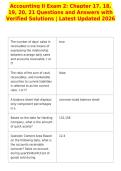
The number of days' sales in true
receivables is one means of
expressing the relationship
between average daily sales
and accounts receivable. t or
f?
The ratio of the sum of cash, false
receivables, and marketable
securities to current liabilities
is referred to as the current
ratio. t or f?
A balance sheet that displays common-sized balence sheet
only component percentages
is a
Based on the data for Harding 131,156
Company, what is the amount
of quick assets?
Question Content Area Based 12.4
on the following data, what is
the accounts receivable
turnover? Sales on account
during year$546,041Cost of
goods sold during
, year208,000Accounts
receivable, beginning of
year40,787Accounts
receivable, end of
year47,093Inventory,
beginning of
year96,059Inventory, end of
year119,918
In the vertical analysis of an False
income statement, each item
is generally stated as a
percentage of total assets. t or
f
In a vertical analysis, the base sales
for cost of goods sold is
On a common-sized balance total assets
sheet, 100% is
The percent of fixed assets to vertical analysis
total assets is an example of
The numerator in calculating sales
the accounts receivable
turnover is
Horizontal analysis is a a. over a period of time
technique for evaluating
financial statement data
19, 20, 21 Questions and Answers with
Verified Solutions | Latest Updated 2026
The number of days' sales in true
receivables is one means of
expressing the relationship
between average daily sales
and accounts receivable. t or
f?
The ratio of the sum of cash, false
receivables, and marketable
securities to current liabilities
is referred to as the current
ratio. t or f?
A balance sheet that displays common-sized balence sheet
only component percentages
is a
Based on the data for Harding 131,156
Company, what is the amount
of quick assets?
Question Content Area Based 12.4
on the following data, what is
the accounts receivable
turnover? Sales on account
during year$546,041Cost of
goods sold during
, year208,000Accounts
receivable, beginning of
year40,787Accounts
receivable, end of
year47,093Inventory,
beginning of
year96,059Inventory, end of
year119,918
In the vertical analysis of an False
income statement, each item
is generally stated as a
percentage of total assets. t or
f
In a vertical analysis, the base sales
for cost of goods sold is
On a common-sized balance total assets
sheet, 100% is
The percent of fixed assets to vertical analysis
total assets is an example of
The numerator in calculating sales
the accounts receivable
turnover is
Horizontal analysis is a a. over a period of time
technique for evaluating
financial statement data


