

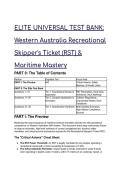
ELITE UNIVERSAL TEST BANK:
Western Australia Recreational
Skipper's Ticket (RST) &
Maritime Mastery
PART 0: The Table of Contents
Section Cognitive Tier Focus Area
PART I: The Preview N/A Critical Axioms, Safety
Matrices, & Kinetic Limits
PART II: The Elite Test Bank
Questions 1–10 Tier 1: Foundational Syntax & RST Parameters, Hard Deck
Application Definitions, IALA Markings
Questions 11–20 Tier 2: Complex Application & Collision Regulations,
Simulation Unprotected Waters, Gear
Transitions
Questions 21–30 Tier 3: Grandmaster Synthesis Multi-Variable Scenarios,
High-Stakes Compliance,
Survival
PART I: The Preview
Mastering this exact sequence of maritime protocols translates directly into elite operational
competence on Western Australian (WA) waters. This document strips away rudimentary theory
to forge an automatic, high-level synthesis of current navigational law, dynamic safety
mandates, and critical survival procedures required for the Recreational Skipper's Ticket (RST).
The "Critical Axioms" Cheat Sheet
● The RST Power Threshold: An RST is legally mandated for any skipper operating a
recreational vessel with a motor exceeding 6 horsepower (4.5 kW).
● The 8-Knot Absolute Perimeter: Vessel speed is strictly restricted to under 8 knots
when operating in depths under 3 metres, within 15 metres of an underway vessel, or
, within 50 metres of moored vessels, jetties, shorelines, or persons in the water.
● The IALA System A Paradigm: When navigating upstream, port marks (red cans)
remain on the port side, and starboard marks (green cones) remain on the starboard side.
Cardinal marks dictate safe passage via compass coordinates aligned to specific flashing
light rhythms.
● The Diver Exclusion Protocol: All vessels must maintain a 50-metre clearance from any
active Alpha flag. If draft or channel constraints make this impossible, vessels must
proceed at the absolute slowest steerage speed while maintaining a rigorous lookout.
● The Tandem Cognition Towing Rule: Ski operations demand bifurcated awareness; the
skipper must be at least 17 years of age (with an RST) focusing entirely forward, while the
observer must be at least 14 years of age focusing entirely aft.
Strategic Equipment & Speed Parameters
Operational Zone Vessel Length Core Safety Mandate Phase-Out / Transition
Deadline
Unprotected Waters Under 4.8m Level 100+ Lifejacket N/A
(>400m) MUST BE WORN by
all.
Unprotected Waters All lengths GPS-enabled EPIRB or Non-GPS models
(>400m) worn GPS PLB. illegal after Sept 1,
2028.
Unprotected Waters All lengths 2 Red Hand-held + 2 Parachute flares illegal
(>400m) Orange Hand-held after Sept 1, 2026.
Flares.
Unprotected Waters All lengths VHF or HF Marine 27-MHz analogue
(>4nm) Radio. illegal after Sept 1,
2028.
PART II: THE ELITE TEST BANK
Tier 1: Foundational Syntax & Application
Q1: A 15-year-old operator holding a valid Recreational Skipper’s Ticket (RST) assumes
command of a 4.5-metre vessel equipped with a 20hp outboard motor. Based on the
Department of Transport regulations, which operational constraint is MOST ACCURATE
regarding this specific skipper? A) The operator may pilot the vessel at any safe speed,
provided the operation occurs strictly during daylight hours. B) The operator is legally prohibited
from operating any vessel with a motor exceeding 6hp until they reach 16 years of age. C) The
operator may pilot the vessel only during daylight hours and strictly at a speed not exceeding 8
knots. D) The operator may pilot the vessel at night, provided they are directly supervised by an
adult holding a valid RST.
● The Answer: C (The operator may pilot the vessel only during daylight hours and strictly
at a speed not exceeding 8 knots.)
● Distractor Analysis:
○ A is incorrect: This distracts by ignoring the kinetic speed restriction. Youth
operators under 16 are capped at 8 knots regardless of the ambient lighting
conditions.
, ○ B is incorrect: Individuals 14 years and older are legally permitted to hold an RST
and operate vessels over 6hp, subject to specific constraints.
○ D is incorrect: Night operation is strictly prohibited for RST holders under 16 years
of age, regardless of adult supervision onboard the vessel.
The Mentor's Analysis: Statutory age limits impose dual operational restrictions to mitigate the
high-risk variables associated with inexperienced operators. When an RST holder is between 14
and 16 years of age, their operating parameters are physically bounded by both ambient light
(daylight only) and kinetic energy (less than 8 knots). This ensures they remain in
low-complexity environments. Professional/Academic Intuition: Age dictates the
operational perimeter; motor power dictates the certification requirement.
Q2: When navigating an inland estuarine waterway in Western Australia, you observe a
navigation mark topped with a red can shape. According to the IALA Buoyage System A, how
must you FIRST interpret this marker if you are travelling upstream from the ocean? A) It is an
Isolated Danger mark indicating a submerged wreck and must be bypassed on the starboard
side. B) It is a Port Lateral mark and must be kept on the port (left) side of your vessel to remain
in the channel. C) It is a Starboard Lateral mark and must be kept on the starboard (right) side
of your vessel to avoid shoaling. D) It is a Safe Water mark indicating the deepest centre line of
the navigable channel.
● The Answer: B (It is a Port Lateral mark and must be kept on the port (left) side of your
vessel to remain in the channel.)
● Distractor Analysis:
○ A is incorrect: Isolated Danger marks are characterized by black with red horizontal
bands and two black spheres, not solid red can shapes.
○ C is incorrect: Starboard marks under the IALA Region A protocol are green with a
triangular or conical top mark.
○ D is incorrect: Safe Water marks feature red and white vertical stripes, often topped
with a single red sphere, distinguishing them from lateral boundaries.
The Mentor's Analysis: The IALA System A utilizes the "Coming In, Going Out" paradigm for
lateral channel definition. When heading upstream (entering a harbour or river from the open
sea), you must keep red port marks to your port side and green starboard marks to your
starboard side to remain within the dredged or naturally deep channel. Professional/Academic
Intuition: Rely on the global upstream navigation axiom: "There is some red port left in
the bottle."
Q3: Under current Western Australian maritime legislation, where is the MOST APPROPRIATE
placement for a registrable vessel's annual registration sticker? A) On the starboard side of the
forward hull, immediately aft of the alphanumeric registration numbers. B) On the port side of
the exterior hull, adjacent to the painted or decaled registration number. C) Affixed clearly to the
vessel's starboard windshield or central steering console for operator visibility. D) Placed
internally on the rear transom, positioned directly alongside the Hull Identification Number (HIN).
● The Answer: B (On the port side of the exterior hull, adjacent to the painted or decaled
registration number.)
● Distractor Analysis:
○ A is incorrect: The statutory requirement designates the port side, specifically
prohibiting starboard side placement for the sticker.
○ C is incorrect: Windshield or console placement is invalid; the sticker must be
adjacent to the external hull registration numbers.
○ D is incorrect: Internal placement fails the visual requirement for marine compliance
officers conducting high-speed, on-water identification checks.
Western Australia Recreational
Skipper's Ticket (RST) &
Maritime Mastery
PART 0: The Table of Contents
Section Cognitive Tier Focus Area
PART I: The Preview N/A Critical Axioms, Safety
Matrices, & Kinetic Limits
PART II: The Elite Test Bank
Questions 1–10 Tier 1: Foundational Syntax & RST Parameters, Hard Deck
Application Definitions, IALA Markings
Questions 11–20 Tier 2: Complex Application & Collision Regulations,
Simulation Unprotected Waters, Gear
Transitions
Questions 21–30 Tier 3: Grandmaster Synthesis Multi-Variable Scenarios,
High-Stakes Compliance,
Survival
PART I: The Preview
Mastering this exact sequence of maritime protocols translates directly into elite operational
competence on Western Australian (WA) waters. This document strips away rudimentary theory
to forge an automatic, high-level synthesis of current navigational law, dynamic safety
mandates, and critical survival procedures required for the Recreational Skipper's Ticket (RST).
The "Critical Axioms" Cheat Sheet
● The RST Power Threshold: An RST is legally mandated for any skipper operating a
recreational vessel with a motor exceeding 6 horsepower (4.5 kW).
● The 8-Knot Absolute Perimeter: Vessel speed is strictly restricted to under 8 knots
when operating in depths under 3 metres, within 15 metres of an underway vessel, or
, within 50 metres of moored vessels, jetties, shorelines, or persons in the water.
● The IALA System A Paradigm: When navigating upstream, port marks (red cans)
remain on the port side, and starboard marks (green cones) remain on the starboard side.
Cardinal marks dictate safe passage via compass coordinates aligned to specific flashing
light rhythms.
● The Diver Exclusion Protocol: All vessels must maintain a 50-metre clearance from any
active Alpha flag. If draft or channel constraints make this impossible, vessels must
proceed at the absolute slowest steerage speed while maintaining a rigorous lookout.
● The Tandem Cognition Towing Rule: Ski operations demand bifurcated awareness; the
skipper must be at least 17 years of age (with an RST) focusing entirely forward, while the
observer must be at least 14 years of age focusing entirely aft.
Strategic Equipment & Speed Parameters
Operational Zone Vessel Length Core Safety Mandate Phase-Out / Transition
Deadline
Unprotected Waters Under 4.8m Level 100+ Lifejacket N/A
(>400m) MUST BE WORN by
all.
Unprotected Waters All lengths GPS-enabled EPIRB or Non-GPS models
(>400m) worn GPS PLB. illegal after Sept 1,
2028.
Unprotected Waters All lengths 2 Red Hand-held + 2 Parachute flares illegal
(>400m) Orange Hand-held after Sept 1, 2026.
Flares.
Unprotected Waters All lengths VHF or HF Marine 27-MHz analogue
(>4nm) Radio. illegal after Sept 1,
2028.
PART II: THE ELITE TEST BANK
Tier 1: Foundational Syntax & Application
Q1: A 15-year-old operator holding a valid Recreational Skipper’s Ticket (RST) assumes
command of a 4.5-metre vessel equipped with a 20hp outboard motor. Based on the
Department of Transport regulations, which operational constraint is MOST ACCURATE
regarding this specific skipper? A) The operator may pilot the vessel at any safe speed,
provided the operation occurs strictly during daylight hours. B) The operator is legally prohibited
from operating any vessel with a motor exceeding 6hp until they reach 16 years of age. C) The
operator may pilot the vessel only during daylight hours and strictly at a speed not exceeding 8
knots. D) The operator may pilot the vessel at night, provided they are directly supervised by an
adult holding a valid RST.
● The Answer: C (The operator may pilot the vessel only during daylight hours and strictly
at a speed not exceeding 8 knots.)
● Distractor Analysis:
○ A is incorrect: This distracts by ignoring the kinetic speed restriction. Youth
operators under 16 are capped at 8 knots regardless of the ambient lighting
conditions.
, ○ B is incorrect: Individuals 14 years and older are legally permitted to hold an RST
and operate vessels over 6hp, subject to specific constraints.
○ D is incorrect: Night operation is strictly prohibited for RST holders under 16 years
of age, regardless of adult supervision onboard the vessel.
The Mentor's Analysis: Statutory age limits impose dual operational restrictions to mitigate the
high-risk variables associated with inexperienced operators. When an RST holder is between 14
and 16 years of age, their operating parameters are physically bounded by both ambient light
(daylight only) and kinetic energy (less than 8 knots). This ensures they remain in
low-complexity environments. Professional/Academic Intuition: Age dictates the
operational perimeter; motor power dictates the certification requirement.
Q2: When navigating an inland estuarine waterway in Western Australia, you observe a
navigation mark topped with a red can shape. According to the IALA Buoyage System A, how
must you FIRST interpret this marker if you are travelling upstream from the ocean? A) It is an
Isolated Danger mark indicating a submerged wreck and must be bypassed on the starboard
side. B) It is a Port Lateral mark and must be kept on the port (left) side of your vessel to remain
in the channel. C) It is a Starboard Lateral mark and must be kept on the starboard (right) side
of your vessel to avoid shoaling. D) It is a Safe Water mark indicating the deepest centre line of
the navigable channel.
● The Answer: B (It is a Port Lateral mark and must be kept on the port (left) side of your
vessel to remain in the channel.)
● Distractor Analysis:
○ A is incorrect: Isolated Danger marks are characterized by black with red horizontal
bands and two black spheres, not solid red can shapes.
○ C is incorrect: Starboard marks under the IALA Region A protocol are green with a
triangular or conical top mark.
○ D is incorrect: Safe Water marks feature red and white vertical stripes, often topped
with a single red sphere, distinguishing them from lateral boundaries.
The Mentor's Analysis: The IALA System A utilizes the "Coming In, Going Out" paradigm for
lateral channel definition. When heading upstream (entering a harbour or river from the open
sea), you must keep red port marks to your port side and green starboard marks to your
starboard side to remain within the dredged or naturally deep channel. Professional/Academic
Intuition: Rely on the global upstream navigation axiom: "There is some red port left in
the bottle."
Q3: Under current Western Australian maritime legislation, where is the MOST APPROPRIATE
placement for a registrable vessel's annual registration sticker? A) On the starboard side of the
forward hull, immediately aft of the alphanumeric registration numbers. B) On the port side of
the exterior hull, adjacent to the painted or decaled registration number. C) Affixed clearly to the
vessel's starboard windshield or central steering console for operator visibility. D) Placed
internally on the rear transom, positioned directly alongside the Hull Identification Number (HIN).
● The Answer: B (On the port side of the exterior hull, adjacent to the painted or decaled
registration number.)
● Distractor Analysis:
○ A is incorrect: The statutory requirement designates the port side, specifically
prohibiting starboard side placement for the sticker.
○ C is incorrect: Windshield or console placement is invalid; the sticker must be
adjacent to the external hull registration numbers.
○ D is incorrect: Internal placement fails the visual requirement for marine compliance
officers conducting high-speed, on-water identification checks.


