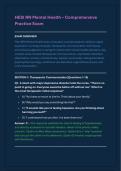
HESI RN Mental Health – Comprehensive
Practice Exam
EXAM OVERVIEW
The HESI Mental Health exam evaluates nursing students' ability to apply
psychiatric nursing principles, therapeutic communication techniques,
and clinical judgment in caring for clients with mental health disorders. Key
content areas include therapeutic communication, psychiatric disorders
(depression, anxiety, schizophrenia, bipolar, personality, eating disorders),
psychopharmacology, substance use disorders, legal/ethical issues, and
crisis intervention .
SECTION 1: Therapeutic Communication (Questions 1-15)
Q1. A client with major depressive disorder tells the nurse, "There's no
point in going on. Everyone would be better off without me." Which is
the most therapeutic initial response?
• A) "You have so much to live for. Think about your family."
• B) "Why would you say something like that?"
• C) "It sounds like you're feeling hopeless. Are you thinking about
harming yourself?"
• D) "I understand how you feel. I've been there too."
Answer: C – This response validates the client's feeling of hopelessness
and directly assesses for suicidal ideation, which is the priority safety
concern. Option A offers false reassurance. Option B is a "why" question
that can put the client on the defensive. Option D involves inappropriate
self-disclosure .
,Q2. A client with schizophrenia tells the nurse, "The FBI is monitoring
my thoughts through a chip in my tooth." Which is the most therapeutic
response?
• A) "That sounds frightening. I don't believe the FBI is monitoring
you, but I understand you believe that."
• B) "You're being paranoid. Nobody is monitoring you."
• C) "The FBI has no interest in you."
• D) "Let's talk about something else."
Answer: A – This response validates the client's emotional experience
(feeling frightened) without reinforcing the delusion. It acknowledges the
client's belief while stating the nurse's different reality. Option B is
confrontational and judgmental. Option C dismisses the client's
experience. Option D avoids the issue .
Q3. A client tells the nurse, "I don't think I want to take my medication
anymore. It makes me feel like a zombie." Which is the most
therapeutic response?
• A) "You must take your medication as prescribed."
• B) "Tell me more about how the medication makes you feel like a
zombie."
• C) "That's a common side effect. You'll get used to it."
• D) "If you don't take your medication, you'll end up back in the
hospital."
Answer: B – This response uses an open-ended statement to explore the
client's concerns and side effects, which may be addressed with dosage
adjustment or medication change. Option A is authoritarian. Option C
dismisses the client's concern. Option D uses a threat .
,Q4. A client with anxiety disorder states, "I can't go to the grocery store.
I'm terrified I'll have a panic attack." Which response demonstrates
empathy?
• A) "Everyone gets nervous sometimes. You just need to push through
it."
• B) "I understand you're scared. Many people with anxiety feel that
way. Let's talk about coping strategies."
• C) "There's nothing to be afraid of at the grocery store."
• D) "You need to take your PRN medication before you go."
Answer: B – Empathy involves understanding and validating the client's
feelings without judgment. Option B acknowledges the fear and offers
support. Option A minimizes the client's experience. Option C offers false
reassurance .
Q5. A client with borderline personality disorder tells the nurse, "You're
the only staff member who actually cares about me. Everyone else is
horrible." Which is the most therapeutic response?
• A) "Thank you. I try to care about all my clients."
• B) "It sounds like you're seeing things in extremes. Tell me more
about what's happening."
• C) "I think you're being unfair to the other staff."
• D) "That's not true. Everyone here cares about you."
Answer: B – This response addresses the splitting defense mechanism
(black-and-white thinking) common in borderline personality disorder
without reinforcing the distorted perception. Splitting involves viewing
people as all good or all bad .
, Q6. During an admission interview, a female client is extremely anxious
and states she is worried about the sun coming up the next day. What
intervention is most important for the RN to implement?
• A) Assist the client in developing alternative coping skills.
• B) Remain calm and use a matter-of-fact approach.
• C) Ask the client why she is so anxious.
• D) Administer a PRN sedative to help relieve her anxiety.
Answer: B – Remaining calm and using a matter-of-fact approach provides
a sense of security and reduces anxiety in the client during admission.
Asking "why" questions can increase anxiety. Sedation should not be the
first intervention .
Q7. A male client approaches the RN with an angry expression and
raises his voice, saying, "My roommate is the most selfish, self-
centered, angry person I have ever met. If he loses his temper one more
time with me, I am going to punch him out!" The RN recognizes that the
client is using which defense mechanism?
• A) Denial
• B) Projection
• C) Rationalization
• D) Splitting
Answer: B – Projection involves attributing one's own unacceptable
feelings or impulses to another person. The client is projecting his own
anger onto his roommate. Denial is refusing to acknowledge reality.
Rationalization involves creating logical excuses .
Q8. A client with alcohol use disorder states, "I only drink because my
job is so stressful. If I had a different job, I wouldn't need to drink."
Which defense mechanism is the client using?
Practice Exam
EXAM OVERVIEW
The HESI Mental Health exam evaluates nursing students' ability to apply
psychiatric nursing principles, therapeutic communication techniques,
and clinical judgment in caring for clients with mental health disorders. Key
content areas include therapeutic communication, psychiatric disorders
(depression, anxiety, schizophrenia, bipolar, personality, eating disorders),
psychopharmacology, substance use disorders, legal/ethical issues, and
crisis intervention .
SECTION 1: Therapeutic Communication (Questions 1-15)
Q1. A client with major depressive disorder tells the nurse, "There's no
point in going on. Everyone would be better off without me." Which is
the most therapeutic initial response?
• A) "You have so much to live for. Think about your family."
• B) "Why would you say something like that?"
• C) "It sounds like you're feeling hopeless. Are you thinking about
harming yourself?"
• D) "I understand how you feel. I've been there too."
Answer: C – This response validates the client's feeling of hopelessness
and directly assesses for suicidal ideation, which is the priority safety
concern. Option A offers false reassurance. Option B is a "why" question
that can put the client on the defensive. Option D involves inappropriate
self-disclosure .
,Q2. A client with schizophrenia tells the nurse, "The FBI is monitoring
my thoughts through a chip in my tooth." Which is the most therapeutic
response?
• A) "That sounds frightening. I don't believe the FBI is monitoring
you, but I understand you believe that."
• B) "You're being paranoid. Nobody is monitoring you."
• C) "The FBI has no interest in you."
• D) "Let's talk about something else."
Answer: A – This response validates the client's emotional experience
(feeling frightened) without reinforcing the delusion. It acknowledges the
client's belief while stating the nurse's different reality. Option B is
confrontational and judgmental. Option C dismisses the client's
experience. Option D avoids the issue .
Q3. A client tells the nurse, "I don't think I want to take my medication
anymore. It makes me feel like a zombie." Which is the most
therapeutic response?
• A) "You must take your medication as prescribed."
• B) "Tell me more about how the medication makes you feel like a
zombie."
• C) "That's a common side effect. You'll get used to it."
• D) "If you don't take your medication, you'll end up back in the
hospital."
Answer: B – This response uses an open-ended statement to explore the
client's concerns and side effects, which may be addressed with dosage
adjustment or medication change. Option A is authoritarian. Option C
dismisses the client's concern. Option D uses a threat .
,Q4. A client with anxiety disorder states, "I can't go to the grocery store.
I'm terrified I'll have a panic attack." Which response demonstrates
empathy?
• A) "Everyone gets nervous sometimes. You just need to push through
it."
• B) "I understand you're scared. Many people with anxiety feel that
way. Let's talk about coping strategies."
• C) "There's nothing to be afraid of at the grocery store."
• D) "You need to take your PRN medication before you go."
Answer: B – Empathy involves understanding and validating the client's
feelings without judgment. Option B acknowledges the fear and offers
support. Option A minimizes the client's experience. Option C offers false
reassurance .
Q5. A client with borderline personality disorder tells the nurse, "You're
the only staff member who actually cares about me. Everyone else is
horrible." Which is the most therapeutic response?
• A) "Thank you. I try to care about all my clients."
• B) "It sounds like you're seeing things in extremes. Tell me more
about what's happening."
• C) "I think you're being unfair to the other staff."
• D) "That's not true. Everyone here cares about you."
Answer: B – This response addresses the splitting defense mechanism
(black-and-white thinking) common in borderline personality disorder
without reinforcing the distorted perception. Splitting involves viewing
people as all good or all bad .
, Q6. During an admission interview, a female client is extremely anxious
and states she is worried about the sun coming up the next day. What
intervention is most important for the RN to implement?
• A) Assist the client in developing alternative coping skills.
• B) Remain calm and use a matter-of-fact approach.
• C) Ask the client why she is so anxious.
• D) Administer a PRN sedative to help relieve her anxiety.
Answer: B – Remaining calm and using a matter-of-fact approach provides
a sense of security and reduces anxiety in the client during admission.
Asking "why" questions can increase anxiety. Sedation should not be the
first intervention .
Q7. A male client approaches the RN with an angry expression and
raises his voice, saying, "My roommate is the most selfish, self-
centered, angry person I have ever met. If he loses his temper one more
time with me, I am going to punch him out!" The RN recognizes that the
client is using which defense mechanism?
• A) Denial
• B) Projection
• C) Rationalization
• D) Splitting
Answer: B – Projection involves attributing one's own unacceptable
feelings or impulses to another person. The client is projecting his own
anger onto his roommate. Denial is refusing to acknowledge reality.
Rationalization involves creating logical excuses .
Q8. A client with alcohol use disorder states, "I only drink because my
job is so stressful. If I had a different job, I wouldn't need to drink."
Which defense mechanism is the client using?