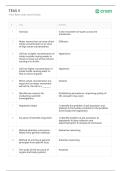
TEAS V
From flash cards and ATI book
# Term Definition
1 Osmosis Is the movement of water across the
membrane.
2 Water moves from an area of low Diffusion
solute concentration to an area
of high solute concentration.
3 Cell has a higher concentration of Hypertonic
solute outside causing water to
move to move out of the cell and
causing it to shrink.
4 Cell has higher concentration of Hypotonic
solute inside causing water to
flow in and to expand.
5 When solute concentration are Isotonic
equal and no water movement
will ochre, the cell is a ________.
6 Identify two reasons for Establishing procedures, improving quality of
conducting scientific life. (answers may vary)
investigations.
7 Hypothesis Steps 1) identify the problem 2) ask questions and
attempt to formulate a solution to the problem
3) formulate the hypothesis
8 Six parts of Scientific Argument 1) identify problem 2) ask questions 3)
hypothesis 4) data collection and
experimentation 5) analysis 6) conclusion
9 Method whereby conclusions Deductive reasoning
follow from general methods.
10 Method of arriving at general Inductive reasoning
principles from specific facts.
11 The study of the structure of Anatomy
organs and body systems
,TEAS V
# Term Definition
12 The study of the function of the Physiology
organs and body systems
13 What are the smallest parts of Atom
elements that still retain all the
original properties of the
element?
14 What is a chemical bonding of Molecule
atoms that possesses it's own
characteristics independent of
the atoms?
15 What is the basic unit of life? The cell
16 Cell combine in terms of function Tissues
and type to form _________.
17 Molecules combine to form _____. Cells
18 At what level does two or more Organ level
tissues types work together to
perform a specific function?
19 When organs work together to An organ system.
perform a task the result is____.
20 How many organ systems in the 11
body?
21 What is the highest level of The organism
organization?
22 What is the result of all organ The organism
systems working together within
the body?
23 What is the Hierarchy of the Organism Organ systems Organs Tissues Cells
structure of the human body? Molecules Atoms
24 What are the four basic tissue 1) epithelial 2) connective 3) muscular 4)
types in humans? nervous
, TEAS V
# Term Definition
25 It provides covering or produce Epithelial tissue
secretions.
26 What type of tissue does not Epithelial tissue
have it's own blood supply?
27 What type of tissue is dependent Epithelial tissue
on diffusion from nearby
capillaries for food and oxygen?
28 What type of tissue can Epithelial tissue
regenerate easily if well
nourished?
29 Epithelial tissues are classified Number of layers and cell shape.
according to two criteria: ________
and ________.
30 What type of tissue contains one Simple epithelium
layer of cells and is found in body
structures where absorption,
secretion and filtration occur?
31 What type of tissue has more Stratified epithelium
than one layer of cells and serves
as protection?
32 What are the shapes of epithelial Squamous, cuboidal and columnar
cell?
33 What type of tissue is found Connective tissue
throughout the body?
34 What type of tissue serves to Connective tissue
connect different structures of
the body?
35 What type of tissue commonly Connective tissue
has it's own blood supply?
36 What types of connective tissue Ligaments
does not have it's own blood
supply?
From flash cards and ATI book
# Term Definition
1 Osmosis Is the movement of water across the
membrane.
2 Water moves from an area of low Diffusion
solute concentration to an area
of high solute concentration.
3 Cell has a higher concentration of Hypertonic
solute outside causing water to
move to move out of the cell and
causing it to shrink.
4 Cell has higher concentration of Hypotonic
solute inside causing water to
flow in and to expand.
5 When solute concentration are Isotonic
equal and no water movement
will ochre, the cell is a ________.
6 Identify two reasons for Establishing procedures, improving quality of
conducting scientific life. (answers may vary)
investigations.
7 Hypothesis Steps 1) identify the problem 2) ask questions and
attempt to formulate a solution to the problem
3) formulate the hypothesis
8 Six parts of Scientific Argument 1) identify problem 2) ask questions 3)
hypothesis 4) data collection and
experimentation 5) analysis 6) conclusion
9 Method whereby conclusions Deductive reasoning
follow from general methods.
10 Method of arriving at general Inductive reasoning
principles from specific facts.
11 The study of the structure of Anatomy
organs and body systems
,TEAS V
# Term Definition
12 The study of the function of the Physiology
organs and body systems
13 What are the smallest parts of Atom
elements that still retain all the
original properties of the
element?
14 What is a chemical bonding of Molecule
atoms that possesses it's own
characteristics independent of
the atoms?
15 What is the basic unit of life? The cell
16 Cell combine in terms of function Tissues
and type to form _________.
17 Molecules combine to form _____. Cells
18 At what level does two or more Organ level
tissues types work together to
perform a specific function?
19 When organs work together to An organ system.
perform a task the result is____.
20 How many organ systems in the 11
body?
21 What is the highest level of The organism
organization?
22 What is the result of all organ The organism
systems working together within
the body?
23 What is the Hierarchy of the Organism Organ systems Organs Tissues Cells
structure of the human body? Molecules Atoms
24 What are the four basic tissue 1) epithelial 2) connective 3) muscular 4)
types in humans? nervous
, TEAS V
# Term Definition
25 It provides covering or produce Epithelial tissue
secretions.
26 What type of tissue does not Epithelial tissue
have it's own blood supply?
27 What type of tissue is dependent Epithelial tissue
on diffusion from nearby
capillaries for food and oxygen?
28 What type of tissue can Epithelial tissue
regenerate easily if well
nourished?
29 Epithelial tissues are classified Number of layers and cell shape.
according to two criteria: ________
and ________.
30 What type of tissue contains one Simple epithelium
layer of cells and is found in body
structures where absorption,
secretion and filtration occur?
31 What type of tissue has more Stratified epithelium
than one layer of cells and serves
as protection?
32 What are the shapes of epithelial Squamous, cuboidal and columnar
cell?
33 What type of tissue is found Connective tissue
throughout the body?
34 What type of tissue serves to Connective tissue
connect different structures of
the body?
35 What type of tissue commonly Connective tissue
has it's own blood supply?
36 What types of connective tissue Ligaments
does not have it's own blood
supply?