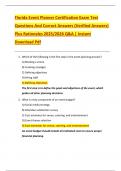
TCFP PLANS EXAMINER I PRACTICE TEST QUESTIONS AND CORRECT ANSWERS (VERIFIED
ANSWERS) PLUS RATIONALES 2026 Q&A | INSTANT DOWNLOAD PDF
Core Domains
Fire code interpretation and application
Plan review procedures and documentation
Building construction and occupancy classification
Fire protection systems and life safety features
Regulatory compliance and permitting requirements
Ethics, professionalism, and impartial review standards
Structural and site plan analysis
Risk identification and corrective action recommendations
Introduction
This practice test is designed to assess the knowledge and decision-making required for TCFP Plans Examiner
I certification. It measures understanding of fire code fundamentals, construction documents, occupancy
requirements, fire protection systems, and compliance review procedures. The questions combine multiple-
choice and scenario-based formats to reflect the practical judgment expected in plan review work. Emphasis
is placed on applying standards to real-world drawings, identifying deficiencies, and selecting defensible
corrective actions in a professional review environment.
,Section One: Questions 1–100
,. Which is the primary purpose of a plans examiner’s review?
A. To redesign the project for the architect
B. To verify compliance with adopted codes and standards
C. To approve financing for construction
D. To inspect only completed buildings
🟢 Correct answer: B
🔴 RATIONALE: A plans examiner reviews submitted documents to determine whether the proposed work
complies with adopted codes and standards.
. A basic fire alarm submittal should first be checked for:
A. Correct sheet numbering only
B. System designer qualifications and required components
C. Paint colors in the lobby
D. Furniture placement in offices
🟢 Correct answer: B
🔴 RATIONALE: A submittal should verify the designer’s qualifications and that the required system
components are included.
. When a code conflict exists between a local amendment and the base code, the examiner should generally
follow:
A. The local amendment if properly adopted
B. The contractor’s preference
C. The least restrictive interpretation
D. No code at all
🟢 Correct answer: A
🔴 RATIONALE: Properly adopted local amendments control over the base code within that jurisdiction.
, . An occupancy used for storing ordinary combustibles in quantities greater than allowed in another use group is
most likely:
A. Business occupancy
B. Storage occupancy
C. Educational occupancy
D. Assembly occupancy
🟢 Correct answer: B
🔴 RATIONALE: Storage occupancies are specifically intended for storing materials in quantities beyond
ordinary incidental storage.
. A plan reviewer’s best response to missing fire sprinkler hydraulic calculations is to:
A. Approve the plans if the contractor is experienced
B. Request the missing calculations before approval
C. Ignore the omission if the building is small
D. Rewrite the calculations personally
🟢 Correct answer: B
🔴 RATIONALE: Required technical documents must be submitted before approval can be granted.
. The safest way to identify the correct occupancy classification is to review:
A. The owner’s marketing brochure
B. The code definition and actual intended use
C. The contractor’s estimate
D. The building’s exterior color
🟢 Correct answer: B
🔴 RATIONALE: Occupancy classification depends on the code definition and the actual proposed use.
ANSWERS) PLUS RATIONALES 2026 Q&A | INSTANT DOWNLOAD PDF
Core Domains
Fire code interpretation and application
Plan review procedures and documentation
Building construction and occupancy classification
Fire protection systems and life safety features
Regulatory compliance and permitting requirements
Ethics, professionalism, and impartial review standards
Structural and site plan analysis
Risk identification and corrective action recommendations
Introduction
This practice test is designed to assess the knowledge and decision-making required for TCFP Plans Examiner
I certification. It measures understanding of fire code fundamentals, construction documents, occupancy
requirements, fire protection systems, and compliance review procedures. The questions combine multiple-
choice and scenario-based formats to reflect the practical judgment expected in plan review work. Emphasis
is placed on applying standards to real-world drawings, identifying deficiencies, and selecting defensible
corrective actions in a professional review environment.
,Section One: Questions 1–100
,. Which is the primary purpose of a plans examiner’s review?
A. To redesign the project for the architect
B. To verify compliance with adopted codes and standards
C. To approve financing for construction
D. To inspect only completed buildings
🟢 Correct answer: B
🔴 RATIONALE: A plans examiner reviews submitted documents to determine whether the proposed work
complies with adopted codes and standards.
. A basic fire alarm submittal should first be checked for:
A. Correct sheet numbering only
B. System designer qualifications and required components
C. Paint colors in the lobby
D. Furniture placement in offices
🟢 Correct answer: B
🔴 RATIONALE: A submittal should verify the designer’s qualifications and that the required system
components are included.
. When a code conflict exists between a local amendment and the base code, the examiner should generally
follow:
A. The local amendment if properly adopted
B. The contractor’s preference
C. The least restrictive interpretation
D. No code at all
🟢 Correct answer: A
🔴 RATIONALE: Properly adopted local amendments control over the base code within that jurisdiction.
, . An occupancy used for storing ordinary combustibles in quantities greater than allowed in another use group is
most likely:
A. Business occupancy
B. Storage occupancy
C. Educational occupancy
D. Assembly occupancy
🟢 Correct answer: B
🔴 RATIONALE: Storage occupancies are specifically intended for storing materials in quantities beyond
ordinary incidental storage.
. A plan reviewer’s best response to missing fire sprinkler hydraulic calculations is to:
A. Approve the plans if the contractor is experienced
B. Request the missing calculations before approval
C. Ignore the omission if the building is small
D. Rewrite the calculations personally
🟢 Correct answer: B
🔴 RATIONALE: Required technical documents must be submitted before approval can be granted.
. The safest way to identify the correct occupancy classification is to review:
A. The owner’s marketing brochure
B. The code definition and actual intended use
C. The contractor’s estimate
D. The building’s exterior color
🟢 Correct answer: B
🔴 RATIONALE: Occupancy classification depends on the code definition and the actual proposed use.