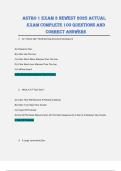
AMPP/NACE COATING INSPECTOR PROGRAM LEVEL 2 EXAM PRACTICE TEST QUESTIONS
AND CORRECT ANSWERS (VERIFIED ANSWERS) PLUS RATIONALES 2026 Q&A | INSTANT
DOWNLOAD PDF
(Front Matter — Centered and Italicized)
Core Domains
- Safety and Health in Coating Operations
*- Surface Preparation and Blast/Wet Methods*
*- Coating Materials, Selection, and Application*
*- Inspection Techniques and Test Instruments*
*- Corrosion Mechanisms and Control*
*- Standards, Specifications, and Documentation*
*- Specialized Coatings and Concrete/Lining Systems*
*- Ethics, Professional Practice, and Project Management*
Introduction
, * This practice exam is designed to evaluate readiness for the AMPP/NACE Level 2 Coating Inspector
certification by testing advanced technical knowledge and applied inspection skills. The questions assess
theoretical understanding, practical instrument use, decision-making, and adherence to standards required of a
Level 2 inspector. The format uses multiple-choice and scenario-based items that reflect typical workplace
challenges, including specification interpretation, non-destructive testing, and failure analysis. Real-world
application, safety judgment, and professional ethics are emphasized to mirror the responsibilities expected of
certified inspectors.*
Section One: Questions 1–100
. An inspector observes a steel substrate with tightly adherent mill scale remaining after hand-tool cleaning; the
specification requires SSPC-SP 3 for the area. What should the inspector do?
A. Accept the surface as-is because mill scale is tightly adherent.
B. Request further surface preparation to achieve the specified cleanliness.
C. Apply a primer designed for unprepared surfaces.
D. Document and approve with a reduced film thickness.
🟢 Correct answer (placed before the correct option ONLY)
🟢 B. Request further surface preparation to achieve the specified cleanliness.
🔴 RATIONALE: The inspector must enforce the specified standard; SSPC-SP 3 requires removal of loose mill
scale and corrosion products, so additional preparation is needed to meet contractual requirements.
. Which instrument is most appropriate for measuring dry film thickness on a metallic substrate with ferrous
base material?
A. Eddy current gauge
B. Calibrated micrometer
C. Magnetic pull-off tester
D. Magnetic induction gauge
, 🟢 Correct answer
🟢 D. Magnetic induction gauge
🔴 RATIONALE: Magnetic induction gauges are designed to measure dry film thickness on ferrous substrates
accurately and are the standard non-destructive choice for this application.
. During a humidity-controlled coating application, the dew point is rising toward surface temperature. What is
the inspector’s immediate action?
A. Continue application; monitor relative humidity only.
B. Stop application and initiate corrective controls to avoid condensation.
C. Add an accelerated curing additive to the coating.
D. Increase spray pressure to dry the surface faster.
🟢 Correct answer
🟢 B. Stop application and initiate corrective controls to avoid condensation.
🔴 RATIONALE: Application must stop when condensation is imminent because moisture on the surface
compromises adhesion and film integrity; controlling environmental conditions is required.
. A pipeline lining shows undercutting corrosion at coating holidays detected during a holiday detector survey.
What should the inspector recommend first?
A. Recoat entire pipeline immediately.
B. Repair holidays and perform localized corrosion mitigation assessment.
C. Ignore small holidays under 1 mm.
D. Increase coating thickness to compensate.
🟢 Correct answer
🟢 B. Repair holidays and perform localized corrosion mitigation assessment.
🔴 RATIONALE: Holidays must be repaired and the underlying metal evaluated for corrosion; blanket
recoating may be unnecessary and thickness increase does not address localized discontinuities.
, . Which standard provides guidance for soluble salt contamination limits on steel prior to coating?
A. ISO 8502 series
B. ASTM D3359
C. NACE RP0487
D. SSPC-PA 2
🟢 Correct answer
🟢 A. ISO 8502 series
🔴 RATIONALE: ISO 8502 covers methods for sampling and assessment of soluble salts on surfaces; it is the
recognized standard for salt contamination evaluation.
. A shop-applied thermoset powder coating requires an oven temperature profile. The inspector notes substrate
peak temperature reached for a shorter time than specified. What is the likely consequence?
A. Improved adhesion due to faster cure.
B. Under-cured coating with reduced mechanical properties.
C. No effect if surface looks glossy.
D. Increased film thickness.
🟢 Correct answer
🟢 B. Under-cured coating with reduced mechanical properties.
🔴 RATIONALE: Insufficient time at peak temperature prevents full cure of thermoset powders, leading to
deficient chemical and mechanical properties and potential premature failure.
. Which test is most appropriate to verify adhesion of a thick protective lining on concrete?
A. Pull-off adhesion test (dolly test)
B. Cross-cut tape test
C. Pencil hardness test
D. Wet adhesion immersion test
AND CORRECT ANSWERS (VERIFIED ANSWERS) PLUS RATIONALES 2026 Q&A | INSTANT
DOWNLOAD PDF
(Front Matter — Centered and Italicized)
Core Domains
- Safety and Health in Coating Operations
*- Surface Preparation and Blast/Wet Methods*
*- Coating Materials, Selection, and Application*
*- Inspection Techniques and Test Instruments*
*- Corrosion Mechanisms and Control*
*- Standards, Specifications, and Documentation*
*- Specialized Coatings and Concrete/Lining Systems*
*- Ethics, Professional Practice, and Project Management*
Introduction
, * This practice exam is designed to evaluate readiness for the AMPP/NACE Level 2 Coating Inspector
certification by testing advanced technical knowledge and applied inspection skills. The questions assess
theoretical understanding, practical instrument use, decision-making, and adherence to standards required of a
Level 2 inspector. The format uses multiple-choice and scenario-based items that reflect typical workplace
challenges, including specification interpretation, non-destructive testing, and failure analysis. Real-world
application, safety judgment, and professional ethics are emphasized to mirror the responsibilities expected of
certified inspectors.*
Section One: Questions 1–100
. An inspector observes a steel substrate with tightly adherent mill scale remaining after hand-tool cleaning; the
specification requires SSPC-SP 3 for the area. What should the inspector do?
A. Accept the surface as-is because mill scale is tightly adherent.
B. Request further surface preparation to achieve the specified cleanliness.
C. Apply a primer designed for unprepared surfaces.
D. Document and approve with a reduced film thickness.
🟢 Correct answer (placed before the correct option ONLY)
🟢 B. Request further surface preparation to achieve the specified cleanliness.
🔴 RATIONALE: The inspector must enforce the specified standard; SSPC-SP 3 requires removal of loose mill
scale and corrosion products, so additional preparation is needed to meet contractual requirements.
. Which instrument is most appropriate for measuring dry film thickness on a metallic substrate with ferrous
base material?
A. Eddy current gauge
B. Calibrated micrometer
C. Magnetic pull-off tester
D. Magnetic induction gauge
, 🟢 Correct answer
🟢 D. Magnetic induction gauge
🔴 RATIONALE: Magnetic induction gauges are designed to measure dry film thickness on ferrous substrates
accurately and are the standard non-destructive choice for this application.
. During a humidity-controlled coating application, the dew point is rising toward surface temperature. What is
the inspector’s immediate action?
A. Continue application; monitor relative humidity only.
B. Stop application and initiate corrective controls to avoid condensation.
C. Add an accelerated curing additive to the coating.
D. Increase spray pressure to dry the surface faster.
🟢 Correct answer
🟢 B. Stop application and initiate corrective controls to avoid condensation.
🔴 RATIONALE: Application must stop when condensation is imminent because moisture on the surface
compromises adhesion and film integrity; controlling environmental conditions is required.
. A pipeline lining shows undercutting corrosion at coating holidays detected during a holiday detector survey.
What should the inspector recommend first?
A. Recoat entire pipeline immediately.
B. Repair holidays and perform localized corrosion mitigation assessment.
C. Ignore small holidays under 1 mm.
D. Increase coating thickness to compensate.
🟢 Correct answer
🟢 B. Repair holidays and perform localized corrosion mitigation assessment.
🔴 RATIONALE: Holidays must be repaired and the underlying metal evaluated for corrosion; blanket
recoating may be unnecessary and thickness increase does not address localized discontinuities.
, . Which standard provides guidance for soluble salt contamination limits on steel prior to coating?
A. ISO 8502 series
B. ASTM D3359
C. NACE RP0487
D. SSPC-PA 2
🟢 Correct answer
🟢 A. ISO 8502 series
🔴 RATIONALE: ISO 8502 covers methods for sampling and assessment of soluble salts on surfaces; it is the
recognized standard for salt contamination evaluation.
. A shop-applied thermoset powder coating requires an oven temperature profile. The inspector notes substrate
peak temperature reached for a shorter time than specified. What is the likely consequence?
A. Improved adhesion due to faster cure.
B. Under-cured coating with reduced mechanical properties.
C. No effect if surface looks glossy.
D. Increased film thickness.
🟢 Correct answer
🟢 B. Under-cured coating with reduced mechanical properties.
🔴 RATIONALE: Insufficient time at peak temperature prevents full cure of thermoset powders, leading to
deficient chemical and mechanical properties and potential premature failure.
. Which test is most appropriate to verify adhesion of a thick protective lining on concrete?
A. Pull-off adhesion test (dolly test)
B. Cross-cut tape test
C. Pencil hardness test
D. Wet adhesion immersion test