

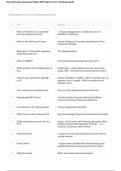
Nursing Health Assessment Notes RN Program First Test Study Guide
NURSING HEALTH ASSESSMENT NOTES
RN program first test on health assessments.
# Term Definition
1 What are the areas to consider 1. Physical Apperance 2. Body Structure 3.
during a general survey? Mobility 4. Behavior
2 What is the Nurisng Process Assess Diagnose Outcome identification Plan
Interpret Evaluate
3 What part of the brain regulates The Hypothalamus
body temperature?
4 What is PQRST? Provoke Quantity Radiate Severity Time
5 Differentiate use of diaphragm vs. Diaphragm - High pitched sounds; heart and
bell. lungs. Bell - low pitched sounds; blood vessels.
6 How do you select the right BP Rubber Bladder's: Width = 40% circumference of
cuff? patient's arm. Length = 80% circumfernce of
patient's arm.
7 Four influences on body temp. Diurnal Cycle Age Menstration Exercise
8 Physiologial BP Factors Cardiac Output Vascular Resistance Blood
Volume Viscocity (Thickness) Elasticity
9 Consideration for Aging Adults Posture Apperance Mobility
10 Other factors that influence BP. Age Race Weight Gender Stress/Emotional State
11 Differentiate Acute and Chronic Acute - short term; self limiting; dissipates after
Pain healed; predictable trajectory Chronic - >/ 6
months, continues after healed
12 Pulse Pressure = systolic minus diastolic pressure and reflects
stroke volume
13 Pulse Deficit = Apical minus Radial Rate Performed by two
people Indicates weak ventrical contraction
14 Objective Data What was observed and assessed.
NURSING HEALTH ASSESSMENT NOTES
RN program first test on health assessments.
# Term Definition
1 What are the areas to consider 1. Physical Apperance 2. Body Structure 3.
during a general survey? Mobility 4. Behavior
2 What is the Nurisng Process Assess Diagnose Outcome identification Plan
Interpret Evaluate
3 What part of the brain regulates The Hypothalamus
body temperature?
4 What is PQRST? Provoke Quantity Radiate Severity Time
5 Differentiate use of diaphragm vs. Diaphragm - High pitched sounds; heart and
bell. lungs. Bell - low pitched sounds; blood vessels.
6 How do you select the right BP Rubber Bladder's: Width = 40% circumference of
cuff? patient's arm. Length = 80% circumfernce of
patient's arm.
7 Four influences on body temp. Diurnal Cycle Age Menstration Exercise
8 Physiologial BP Factors Cardiac Output Vascular Resistance Blood
Volume Viscocity (Thickness) Elasticity
9 Consideration for Aging Adults Posture Apperance Mobility
10 Other factors that influence BP. Age Race Weight Gender Stress/Emotional State
11 Differentiate Acute and Chronic Acute - short term; self limiting; dissipates after
Pain healed; predictable trajectory Chronic - >/ 6
months, continues after healed
12 Pulse Pressure = systolic minus diastolic pressure and reflects
stroke volume
13 Pulse Deficit = Apical minus Radial Rate Performed by two
people Indicates weak ventrical contraction
14 Objective Data What was observed and assessed.


