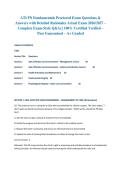
ATI PN Fundamentals
OBJECTIVE ASSESSMENT - EXAM
ATI PN Fundamentals Proctored
Exam | Questions And Answers
(Verified Answers) With Detailed
Rationales, 100% Guaranteed Pass ||
Complete A+ Guide
Professional Nursing Certification Exam
100 100%
QUESTIONS VERIFIED ANSWERS EDITION
TOPICS COVERED
Vital Signs & Physical Assessment Patient Safety & Fall Prevention
Medication Administration & Calculations Nutrition & Therapeutic Diets
Infection Control & Standard Precautions Fluid & Electrolyte Balance
COVER PAGE - 1
,SECTION 1 | Basic Nursing Care | Q1-Q20 | ATI PN Fundamentals Proctored Exam | Questions And Answers
(Verified Answers) With Detailed Rationales, 100% Guaranteed Pass || Complete A+ Guide
Q1 Question 1 of 100
A 78-year-old client is admitted to a long-term care facility with decreased mobility.
The nurse is preparing to perform a head-to-toe physical assessment. Which action
should the nurse prioritize first?
A. Inspect the skin for breakdown and color changes
B. Palpate peripheral pulses bilaterally
C. Auscultate lung sounds in all fields
D. Measure vital signs and level of consciousness
Correct Answer: D
Rationale:
The first step in any physical assessment is to establish baseline vital signs and level of consciousness, as
these provide immediate information about the client's overall stability. While skin inspection, pulse
palpation, and lung auscultation are all important components, they are performed after the initial baseline is
obtained. Starting with vitals and LOC ensures any acute changes are identified promptly.
Q2 Question 2 of 100
A nurse is caring for a client who requires assistance with activities of daily living
following a stroke. When planning morning hygiene, which intervention best promotes
the client's independence and dignity?
A. Perform all hygiene tasks for the client to ensure thoroughness
B. Encourage the client to complete as much of the bathing as possible while supervising
C. Schedule hygiene only when the client requests it to avoid forcing care
D. Have the family member perform hygiene to maintain client-nurse boundaries
Correct Answer: B
Rationale:
Encouraging the client to complete as much of the bathing as possible promotes independence, preserves
dignity, and supports rehabilitation goals after a stroke. Performing all tasks for the client fosters
dependence, while scheduling only on request may lead to hygiene neglect. Family members can assist but
should not replace therapeutic nursing interventions aimed at restoring function.
Q3 Question 3 of 100
,A 45-year-old client reports difficulty sleeping in the hospital. The nurse reviews the
client's evening routine and notes frequent caffeine intake after 4 PM and exposure to
bright overhead lights until bedtime. Which nursing intervention is most appropriate?
A. Administer a sedative-hypnotic medication every night at bedtime
B. Encourage the client to limit caffeine after noon and dim lights 1 hour before sleep
C. Suggest the client nap frequently during the day to compensate for lost sleep
D. Recommend the client watch television in bed to relax before falling asleep
Correct Answer: B
Rationale:
Limiting caffeine after noon and dimming lights before bedtime addresses modifiable environmental and
dietary factors that disrupt sleep hygiene. Sedative-hypnotics should be avoided as first-line interventions
due to dependency risk. Daytime napping can further disrupt the sleep-wake cycle, and television exposure
before bed increases mental stimulation rather than promoting relaxation.
Q4 Question 4 of 100
A nurse is documenting care for a client with a new indwelling urinary catheter. Which
documentation entry best demonstrates appropriate nursing practice?
A. 'Client has Foley catheter. Output appears normal.'
B. 'Indwelling catheter inserted per provider order. 10 mL sterile water instilled into balloon.
Urine clear yellow, 250 mL in first hour. Client denies pain or discomfort.'
C. 'Foley placed. Client doing fine. Will continue to monitor.'
D. 'Catheter inserted. No problems noted. See chart for details.'
Correct Answer: B
Rationale:
Thorough documentation includes the intervention performed, amount of balloon inflation, characteristics
and quantity of output, and the client's subjective response. Vague entries such as 'appears normal,' 'doing
fine,' or 'no problems noted' fail to meet legal and professional standards for accurate, objective nursing
documentation.
Q5 Question 5 of 100
, A client with diabetes mellitus is learning to perform self-monitoring of blood glucose.
The nurse observes the client washing hands with soap and water, drying thoroughly,
and using the side of the fingertip for the lancet puncture. Which additional
instruction is most important for the nurse to provide?
A. Apply a warm compress to the finger for 5 minutes before testing
B. Ensure the test strip is fully inserted into the meter before obtaining the blood sample
C. Milk the finger aggressively to produce a large drop of blood
D. Use alcohol swabs instead of soap and water for hand cleansing
Correct Answer: B
Rationale:
Ensuring the test strip is fully inserted into the meter before obtaining the blood sample is essential for an
accurate reading; inserting after blood application or with poor contact yields erroneous results. Warm
compresses are unnecessary, aggressive milking can cause tissue damage and inaccurate readings, and
alcohol swabs are not superior to soap and water for this purpose.
Q6 Question 6 of 100
A nurse is caring for a client who is on contact precautions for a methicillin-resistant
Staphylococcus aureus (MRSA) wound infection. The nurse needs to obtain the
client's temperature. Which action is appropriate?
A. Use a disposable temporal artery thermometer and leave it in the client's room
B. Use the same electronic oral thermometer used for all clients on the unit
C. Obtain a tympanic temperature with the unit's shared ear thermometer probe cover
D. Document the temperature as 'deferred' to avoid entering the room
Correct Answer: A
Rationale:
A disposable temporal artery thermometer designated for the client's room prevents cross-contamination
while allowing accurate temperature monitoring. Shared oral or tympanic thermometers violate contact
precautions, and deferring an essential assessment is inappropriate and neglectful of nursing duty.
Q7 Question 7 of 100
OBJECTIVE ASSESSMENT - EXAM
ATI PN Fundamentals Proctored
Exam | Questions And Answers
(Verified Answers) With Detailed
Rationales, 100% Guaranteed Pass ||
Complete A+ Guide
Professional Nursing Certification Exam
100 100%
QUESTIONS VERIFIED ANSWERS EDITION
TOPICS COVERED
Vital Signs & Physical Assessment Patient Safety & Fall Prevention
Medication Administration & Calculations Nutrition & Therapeutic Diets
Infection Control & Standard Precautions Fluid & Electrolyte Balance
COVER PAGE - 1
,SECTION 1 | Basic Nursing Care | Q1-Q20 | ATI PN Fundamentals Proctored Exam | Questions And Answers
(Verified Answers) With Detailed Rationales, 100% Guaranteed Pass || Complete A+ Guide
Q1 Question 1 of 100
A 78-year-old client is admitted to a long-term care facility with decreased mobility.
The nurse is preparing to perform a head-to-toe physical assessment. Which action
should the nurse prioritize first?
A. Inspect the skin for breakdown and color changes
B. Palpate peripheral pulses bilaterally
C. Auscultate lung sounds in all fields
D. Measure vital signs and level of consciousness
Correct Answer: D
Rationale:
The first step in any physical assessment is to establish baseline vital signs and level of consciousness, as
these provide immediate information about the client's overall stability. While skin inspection, pulse
palpation, and lung auscultation are all important components, they are performed after the initial baseline is
obtained. Starting with vitals and LOC ensures any acute changes are identified promptly.
Q2 Question 2 of 100
A nurse is caring for a client who requires assistance with activities of daily living
following a stroke. When planning morning hygiene, which intervention best promotes
the client's independence and dignity?
A. Perform all hygiene tasks for the client to ensure thoroughness
B. Encourage the client to complete as much of the bathing as possible while supervising
C. Schedule hygiene only when the client requests it to avoid forcing care
D. Have the family member perform hygiene to maintain client-nurse boundaries
Correct Answer: B
Rationale:
Encouraging the client to complete as much of the bathing as possible promotes independence, preserves
dignity, and supports rehabilitation goals after a stroke. Performing all tasks for the client fosters
dependence, while scheduling only on request may lead to hygiene neglect. Family members can assist but
should not replace therapeutic nursing interventions aimed at restoring function.
Q3 Question 3 of 100
,A 45-year-old client reports difficulty sleeping in the hospital. The nurse reviews the
client's evening routine and notes frequent caffeine intake after 4 PM and exposure to
bright overhead lights until bedtime. Which nursing intervention is most appropriate?
A. Administer a sedative-hypnotic medication every night at bedtime
B. Encourage the client to limit caffeine after noon and dim lights 1 hour before sleep
C. Suggest the client nap frequently during the day to compensate for lost sleep
D. Recommend the client watch television in bed to relax before falling asleep
Correct Answer: B
Rationale:
Limiting caffeine after noon and dimming lights before bedtime addresses modifiable environmental and
dietary factors that disrupt sleep hygiene. Sedative-hypnotics should be avoided as first-line interventions
due to dependency risk. Daytime napping can further disrupt the sleep-wake cycle, and television exposure
before bed increases mental stimulation rather than promoting relaxation.
Q4 Question 4 of 100
A nurse is documenting care for a client with a new indwelling urinary catheter. Which
documentation entry best demonstrates appropriate nursing practice?
A. 'Client has Foley catheter. Output appears normal.'
B. 'Indwelling catheter inserted per provider order. 10 mL sterile water instilled into balloon.
Urine clear yellow, 250 mL in first hour. Client denies pain or discomfort.'
C. 'Foley placed. Client doing fine. Will continue to monitor.'
D. 'Catheter inserted. No problems noted. See chart for details.'
Correct Answer: B
Rationale:
Thorough documentation includes the intervention performed, amount of balloon inflation, characteristics
and quantity of output, and the client's subjective response. Vague entries such as 'appears normal,' 'doing
fine,' or 'no problems noted' fail to meet legal and professional standards for accurate, objective nursing
documentation.
Q5 Question 5 of 100
, A client with diabetes mellitus is learning to perform self-monitoring of blood glucose.
The nurse observes the client washing hands with soap and water, drying thoroughly,
and using the side of the fingertip for the lancet puncture. Which additional
instruction is most important for the nurse to provide?
A. Apply a warm compress to the finger for 5 minutes before testing
B. Ensure the test strip is fully inserted into the meter before obtaining the blood sample
C. Milk the finger aggressively to produce a large drop of blood
D. Use alcohol swabs instead of soap and water for hand cleansing
Correct Answer: B
Rationale:
Ensuring the test strip is fully inserted into the meter before obtaining the blood sample is essential for an
accurate reading; inserting after blood application or with poor contact yields erroneous results. Warm
compresses are unnecessary, aggressive milking can cause tissue damage and inaccurate readings, and
alcohol swabs are not superior to soap and water for this purpose.
Q6 Question 6 of 100
A nurse is caring for a client who is on contact precautions for a methicillin-resistant
Staphylococcus aureus (MRSA) wound infection. The nurse needs to obtain the
client's temperature. Which action is appropriate?
A. Use a disposable temporal artery thermometer and leave it in the client's room
B. Use the same electronic oral thermometer used for all clients on the unit
C. Obtain a tympanic temperature with the unit's shared ear thermometer probe cover
D. Document the temperature as 'deferred' to avoid entering the room
Correct Answer: A
Rationale:
A disposable temporal artery thermometer designated for the client's room prevents cross-contamination
while allowing accurate temperature monitoring. Shared oral or tympanic thermometers violate contact
precautions, and deferring an essential assessment is inappropriate and neglectful of nursing duty.
Q7 Question 7 of 100