

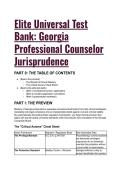
Elite Universal Test
Bank: Georgia
Professional Counselor
Jurisprudence
PART 0: THE TABLE OF CONTENTS
● (#part-i-the-preview)
○ The Mission & Clinical Mastery
○ The Critical Axioms Cheat Sheet
● (#part-ii-the-elite-test-bank)
○ (#tier-1-foundational-syntax--application)
○ (#tier-2-complex-application--simulation)
○ (#tier-3-grandmaster-synthesis)
PART I: THE PREVIEW
Mastery of Georgia jurisprudence separates procedural technicians from elite clinical strategists,
translating rote legal compliance into an impenetrable shield against civil and criminal liability.
By systematically dismantling these regulatory frameworks, you forge clinical precision that
aligns with top-tier global university standards while honoring the strict mandates of the Georgia
Composite Board.
The "Critical Axioms" Cheat Sheet
Axiom Framework Statutory / Regulatory Basis Raw Actionable Data
The Privilege Mandate O.C.G.A. § 24-5-501 Psychotherapy communications
are absolutely privileged;
subpoenas do not inherently
override this protection without
a court order or client waiver.
The Protection Standard Bradley Center v. Wessner Georgia enforces a duty to
protect identifiable third parties
,Axiom Framework Statutory / Regulatory Basis Raw Actionable Data
when the clinician exercises
control, superseding
generalized, unidentifiable
duties to warn.
The Liability Shield O.C.G.A. § 51-1-29.7 (HB Mental health providers are
1409) protected from civil liability
absent clear proof of gross
negligence; punitive damages
require willful or wanton
misconduct.
The TMH Directive Board Rule 135-11-.01 Requires 6 specialized
continuing education (CE)
hours and mandatory,
documented verbal and written
consent prior to initiating any
Telemental Health service.
The Reporting Imperative O.C.G.A. § 19-7-5 & § 30-5-4 Suspected child and elder
abuse reporting is mandatory,
immediate, and based solely on
reasonable cause, bypassing
all clinical confidentiality.
PART II: THE ELITE TEST BANK
Tier 1: Foundational Syntax & Application
Q1: A Georgia Licensed Professional Counselor (LPC) receives a subpoena from a defense
attorney demanding the clinical records of a current adult client. The client has not signed a
release of information. Based on O.C.G.A. § 24-5-501, which action is MOST APPROPRIATE?
A) Immediately surrender the records to comply with the legal subpoena. B) Provide a redacted
summary of the records to satisfy the attorney. C) Assert psychotherapist-patient privilege and
refuse to release the records absent a court order or client waiver. D) Contact the defense
attorney to negotiate which specific session notes are released.
● The Answer: C (Assert psychotherapist-patient privilege and refuse to release the
records absent a court order or client waiver.)
● Distractor Analysis:
○ A is incorrect: A subpoena alone does not compel the release of privileged mental
health records in Georgia; it requires a judge's order or client waiver.
○ B is incorrect: Redaction does not bypass the statutory requirement of privilege.
○ D is incorrect: Negotiating with opposing counsel breaches confidentiality
regardless of what is released.
The Mentor's Analysis: A subpoena is merely a request for documents, not an abrogation of
statutory privilege. When facing a third-party demand for records, the immediate priority is
asserting O.C.G.A. § 24-5-501 to prevent unlawful disclosure. By utilizing
psychotherapist-patient privilege, you bypass the common trap of equating a lawyer's subpoena
with a judicial mandate. Professional/Academic Intuition: Privilege belongs exclusively to
the client; only the client's explicit waiver or a direct court order from a judge can pierce
, it.
Q2: An Associate Professional Counselor (APC) suspects a minor client is being physically
abused. Based on O.C.G.A. § 19-7-5, what is the FIRST legal obligation of the APC? A)
Investigate the claim to confirm the abuse before reporting. B) Discuss the suspicion with the
clinical supervisor at the next scheduled meeting. C) Immediately report the suspected abuse to
child protective services or law enforcement. D) Obtain the minor's consent before breaching
confidentiality to make a report.
● The Answer: C (Immediately report the suspected abuse to child protective services or
law enforcement.)
● Distractor Analysis:
○ A is incorrect: Clinicians are mandated reporters, not investigators. "Reasonable
cause" triggers the mandate immediately.
○ B is incorrect: While supervision is required for APCs, the mandate to report is
immediate and non-transferable.
○ D is incorrect: Mandatory reporting supersedes clinical confidentiality and does not
require client consent.
The Mentor's Analysis: Mandated reporting laws are absolute and immediate. When facing
suspected abuse, the immediate priority is notifying state authorities to trigger external
protective services. By utilizing reasonable cause reporting, you bypass the common trap of
delaying protection for administrative supervision or clinical certainty. Professional/Academic
Intuition: Reasonable cause is the sole threshold for mandated reporting; clinicians must
report, never investigate.
Q3: A fully licensed LPC wishes to incorporate secure video sessions into their practice.
According to Board Rule 135-11-.01, what must the LPC complete BEFORE delivering
Telemental Health (TMH) services? A) Obtain 10 CE hours in digital ethics. B) Obtain 6 CE
hours specifically in Telemental Health. C) Register their TMH platform with the Composite
Board. D) Notify their liability insurance carrier within 30 days.
● The Answer: B (Obtain 6 CE hours specifically in Telemental Health.)
● Distractor Analysis:
○ A is incorrect: The specific requirement is 6 hours, not 10.
○ C is incorrect: The Board does not register or endorse specific technological
platforms.
○ D is incorrect: While good practice, this is not a regulatory requirement under Rule
135-11-.01.
The Mentor's Analysis: Technological modalities require specific, documented competencies
prior to utilization. When facing the integration of TMH, the immediate priority is fulfilling
educational mandates to ensure clinical equivalence across digital mediums. By utilizing the
6-hour TMH CE requirement, you bypass the common trap of unlicensed modality practice.
Professional/Academic Intuition: Technology-assisted media delivery requires specific,
documented pre-training prior to clinical execution.
Q4: Under the Georgia Composite Board Rules for license renewal (Rule 135-9-.01), how many
continuing education hours must be dedicated specifically to ethics, and in what format must
they be obtained? A) 5 hours; may be asynchronous or synchronous. B) 3 hours; synchronous
only. C) 5 hours; synchronous only. D) 10 hours; asynchronous only.
● The Answer: C (5 hours; synchronous only.)
● Distractor Analysis:
○ A is incorrect: Ethics hours cannot be asynchronous in Georgia; they demand live
interaction.
Bank: Georgia
Professional Counselor
Jurisprudence
PART 0: THE TABLE OF CONTENTS
● (#part-i-the-preview)
○ The Mission & Clinical Mastery
○ The Critical Axioms Cheat Sheet
● (#part-ii-the-elite-test-bank)
○ (#tier-1-foundational-syntax--application)
○ (#tier-2-complex-application--simulation)
○ (#tier-3-grandmaster-synthesis)
PART I: THE PREVIEW
Mastery of Georgia jurisprudence separates procedural technicians from elite clinical strategists,
translating rote legal compliance into an impenetrable shield against civil and criminal liability.
By systematically dismantling these regulatory frameworks, you forge clinical precision that
aligns with top-tier global university standards while honoring the strict mandates of the Georgia
Composite Board.
The "Critical Axioms" Cheat Sheet
Axiom Framework Statutory / Regulatory Basis Raw Actionable Data
The Privilege Mandate O.C.G.A. § 24-5-501 Psychotherapy communications
are absolutely privileged;
subpoenas do not inherently
override this protection without
a court order or client waiver.
The Protection Standard Bradley Center v. Wessner Georgia enforces a duty to
protect identifiable third parties
,Axiom Framework Statutory / Regulatory Basis Raw Actionable Data
when the clinician exercises
control, superseding
generalized, unidentifiable
duties to warn.
The Liability Shield O.C.G.A. § 51-1-29.7 (HB Mental health providers are
1409) protected from civil liability
absent clear proof of gross
negligence; punitive damages
require willful or wanton
misconduct.
The TMH Directive Board Rule 135-11-.01 Requires 6 specialized
continuing education (CE)
hours and mandatory,
documented verbal and written
consent prior to initiating any
Telemental Health service.
The Reporting Imperative O.C.G.A. § 19-7-5 & § 30-5-4 Suspected child and elder
abuse reporting is mandatory,
immediate, and based solely on
reasonable cause, bypassing
all clinical confidentiality.
PART II: THE ELITE TEST BANK
Tier 1: Foundational Syntax & Application
Q1: A Georgia Licensed Professional Counselor (LPC) receives a subpoena from a defense
attorney demanding the clinical records of a current adult client. The client has not signed a
release of information. Based on O.C.G.A. § 24-5-501, which action is MOST APPROPRIATE?
A) Immediately surrender the records to comply with the legal subpoena. B) Provide a redacted
summary of the records to satisfy the attorney. C) Assert psychotherapist-patient privilege and
refuse to release the records absent a court order or client waiver. D) Contact the defense
attorney to negotiate which specific session notes are released.
● The Answer: C (Assert psychotherapist-patient privilege and refuse to release the
records absent a court order or client waiver.)
● Distractor Analysis:
○ A is incorrect: A subpoena alone does not compel the release of privileged mental
health records in Georgia; it requires a judge's order or client waiver.
○ B is incorrect: Redaction does not bypass the statutory requirement of privilege.
○ D is incorrect: Negotiating with opposing counsel breaches confidentiality
regardless of what is released.
The Mentor's Analysis: A subpoena is merely a request for documents, not an abrogation of
statutory privilege. When facing a third-party demand for records, the immediate priority is
asserting O.C.G.A. § 24-5-501 to prevent unlawful disclosure. By utilizing
psychotherapist-patient privilege, you bypass the common trap of equating a lawyer's subpoena
with a judicial mandate. Professional/Academic Intuition: Privilege belongs exclusively to
the client; only the client's explicit waiver or a direct court order from a judge can pierce
, it.
Q2: An Associate Professional Counselor (APC) suspects a minor client is being physically
abused. Based on O.C.G.A. § 19-7-5, what is the FIRST legal obligation of the APC? A)
Investigate the claim to confirm the abuse before reporting. B) Discuss the suspicion with the
clinical supervisor at the next scheduled meeting. C) Immediately report the suspected abuse to
child protective services or law enforcement. D) Obtain the minor's consent before breaching
confidentiality to make a report.
● The Answer: C (Immediately report the suspected abuse to child protective services or
law enforcement.)
● Distractor Analysis:
○ A is incorrect: Clinicians are mandated reporters, not investigators. "Reasonable
cause" triggers the mandate immediately.
○ B is incorrect: While supervision is required for APCs, the mandate to report is
immediate and non-transferable.
○ D is incorrect: Mandatory reporting supersedes clinical confidentiality and does not
require client consent.
The Mentor's Analysis: Mandated reporting laws are absolute and immediate. When facing
suspected abuse, the immediate priority is notifying state authorities to trigger external
protective services. By utilizing reasonable cause reporting, you bypass the common trap of
delaying protection for administrative supervision or clinical certainty. Professional/Academic
Intuition: Reasonable cause is the sole threshold for mandated reporting; clinicians must
report, never investigate.
Q3: A fully licensed LPC wishes to incorporate secure video sessions into their practice.
According to Board Rule 135-11-.01, what must the LPC complete BEFORE delivering
Telemental Health (TMH) services? A) Obtain 10 CE hours in digital ethics. B) Obtain 6 CE
hours specifically in Telemental Health. C) Register their TMH platform with the Composite
Board. D) Notify their liability insurance carrier within 30 days.
● The Answer: B (Obtain 6 CE hours specifically in Telemental Health.)
● Distractor Analysis:
○ A is incorrect: The specific requirement is 6 hours, not 10.
○ C is incorrect: The Board does not register or endorse specific technological
platforms.
○ D is incorrect: While good practice, this is not a regulatory requirement under Rule
135-11-.01.
The Mentor's Analysis: Technological modalities require specific, documented competencies
prior to utilization. When facing the integration of TMH, the immediate priority is fulfilling
educational mandates to ensure clinical equivalence across digital mediums. By utilizing the
6-hour TMH CE requirement, you bypass the common trap of unlicensed modality practice.
Professional/Academic Intuition: Technology-assisted media delivery requires specific,
documented pre-training prior to clinical execution.
Q4: Under the Georgia Composite Board Rules for license renewal (Rule 135-9-.01), how many
continuing education hours must be dedicated specifically to ethics, and in what format must
they be obtained? A) 5 hours; may be asynchronous or synchronous. B) 3 hours; synchronous
only. C) 5 hours; synchronous only. D) 10 hours; asynchronous only.
● The Answer: C (5 hours; synchronous only.)
● Distractor Analysis:
○ A is incorrect: Ethics hours cannot be asynchronous in Georgia; they demand live
interaction.


