

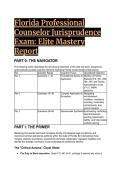
Florida Professional
Counselor Jurisprudence
Exam: Elite Mastery
Report
PART 0: THE NAVIGATOR
The following matrix delineates the structural architecture of this elite test bank, designed to
systematically escalate cognitive demand regarding Florida mental health jurisprudence.
Tier Question Range Cognitive Focus Operational Objective
Tier 1 Questions 1–15 Foundational Syntax & Mastery of Florida
Application Statutes (F.S. 491, 456,
394, 397) and Florida
Administrative Code
(F.A.C. 64B4)
baselines.
Tier 2 Questions 16–35 Complex Application & Navigating
Simulation mid-treatment
variables, mandatory
reporting, involuntary
commitments, and
record requests.
Tier 3 Questions 36–60 Grandmaster Synthesis Synthesizing conflicting
legal frameworks,
averting catastrophic
liability, and high-stakes
problem-solving.
PART I: THE PRIMER
Mastering this specific test bank translates directly into flawless legal compliance and
maximized clinical operational authority within the state of Florida. By internalizing these
complex statutory boundaries, practitioners eliminate catastrophic regulatory liabilities and
elevate the strategic command of psychotherapeutic healthcare delivery.
The "Critical Axioms" Cheat Sheet
● The Duty to Warn Imperative: Under F.S. 491.0147, privilege is waived only when a
, specific threat of serious bodily injury/death to an identified victim exists; the practitioner
MUST notify BOTH the potential victim and law enforcement, which grants civil/criminal
immunity.
● The Involuntary Commitment Matrix:
Statute Colloquial Name Primary Target Initial Examination/Hold
Duration
F.S. 394.463 Baker Act Psychiatric Emergency Up to 72 hours
(Certificate valid for 48
hours post-exam)
F.S. 397.6811 Marchman Act Substance Abuse Up to 5 days
Emergency
● The Records Retention & Access Doctrine: F.A.C. 64B4-9 mandates a 7-year record
retention post-termination. Under F.S. 456.057, practitioners may furnish a summary
report in lieu of actual psychiatric/psychotherapeutic records when requested by a patient.
● The Sexual Misconduct Perimeter: F.A.C. 64B4-10 dictates the psychotherapist-client
relationship extends a minimum of 2 years post-termination, but sexual contact is
permanently prohibited if it exploits the prior relationship's trust; the prohibition strictly
includes the client's immediate family.
● The Minor Consent Threshold: F.S. 394.4784 permits minors aged 13 or older to
consent to outpatient diagnostic, evaluative, and crisis intervention mental health services
without parental consent.
PART II: THE ELITE TEST BANK
Tier 1 - Foundational Syntax & Application
Q1: According to F.S. 491.004, the Board of Clinical Social Work, Marriage and Family Therapy,
and Mental Health Counseling is composed of nine members. Based on the principles of
regulatory oversight, which composition is MOST ACCURATE? A) Five licensed mental health
professionals and four citizens. B) Six licensed mental health professionals and three citizens
who have never been licensed in the profession. C) Nine licensed mental health professionals
appointed by the Governor. D) Four licensed clinical social workers, four mental health
counselors, and one layperson.
● The Answer: B (Six licensed mental health professionals and three citizens who have
never been licensed in the profession)
● Distractor Analysis:
○ A is incorrect: F.S. 491.004 explicitly mandates a six-to-three ratio.
○ C is incorrect: The board requires public citizen representation to ensure consumer
protection against professional monopolies.
○ D is incorrect: The six licensed members must be equally divided: two LCSWs, two
LMFTs, and two LMHCs.
The Mentor's Analysis: Regulatory boards balance peer review with public accountability.
Historically, pure peer-review boards shielded their own, prompting Florida to mandate civilian
oversight. When identifying board composition, the immediate priority is verifying the statutory
6-to-3 professional-to-layperson ratio. By utilizing F.S. 491.004, the practitioner bypasses the
common trap of assuming homogeneous professional control. Professional/Academic
Intuition: The Board always maintains exactly three independent consumer members.
, Q2: A licensed mental health counselor receives a subpoena from a former patient requesting
full copies of their psychotherapeutic progress notes. Based on F.S. 456.057, which action is
MOST APPROPRIATE? A) The counselor must furnish the complete, unedited file within 14
days. B) The counselor may provide a report of examination and treatment in lieu of copies of
records. C) The counselor must surrender the records only to the patient's legal representative.
D) The counselor must refuse the request under HIPAA psychotherapy notes protection.
● The Answer: B (The counselor may provide a report of examination and treatment in lieu
of copies of records)
● Distractor Analysis:
○ A is incorrect: Florida law uniquely allows an alternative to full record duplication for
mental health professionals.
○ C is incorrect: The patient directly holds the right to request access.
○ D is incorrect: State law demands patient access; an outright refusal violates F.S.
456.057.
The Mentor's Analysis: Mental health records require specialized handling to prevent clinical
harm to the patient upon review. When facing a patient record request, the immediate priority is
assessing if a summary best serves the clinical outcome. By utilizing the Report in Lieu of
Records Exception, the practitioner bypasses the trap of mandatory raw data exposure which
could trigger decompensation. Professional/Academic Intuition: F.S. 456.057 grants
psychotherapists the unique authority to substitute a clinical summary for raw records.
Q3: Under F.S. 394.463 (The Baker Act), a mental health counselor may execute a certificate
initiating an involuntary examination. To be valid, the counselor MUST have examined the
patient within what specific timeframe prior to execution? A) 12 hours B) 24 hours C) 48 hours
D) 72 hours
● The Answer: C (48 hours)
● Distractor Analysis:
○ A is incorrect: 12 hours is the timeframe within which an examination must be
initiated for a minor upon facility arrival.
○ B is incorrect: 24 hours relates to the physical examination requirement at the
receiving facility.
○ D is incorrect: 72 hours is the maximum duration of the involuntary hold itself, not
the pre-certification exam window.
The Mentor's Analysis: Involuntary commitment restricts constitutional liberties and demands
temporal relevance. When executing a Baker Act certificate, the immediate priority is ensuring
the clinical data is current. By utilizing the 48-Hour Examination Rule, the practitioner bypasses
the trap of initiating commitments based on stale behavioral data. Professional/Academic
Intuition: A Baker Act certificate expires if the underlying clinical examination occurred
more than 48 hours ago.
Q4: A registered mental health counselor intern has completed all required post-master's clinical
hours. According to Florida statutes regarding intern registration (F.S. 491.0045), how long is
the intern registration valid before it expires? A) 24 months B) 36 months C) 60 months D)
Indefinitely, until full licensure is achieved.
● The Answer: C (60 months)
● Distractor Analysis:
○ A is incorrect: 24 months applies to the validity of a provisional license, not an intern
registration.
○ B is incorrect: This represents an arbitrary timeframe not supported by Florida
statute.
Counselor Jurisprudence
Exam: Elite Mastery
Report
PART 0: THE NAVIGATOR
The following matrix delineates the structural architecture of this elite test bank, designed to
systematically escalate cognitive demand regarding Florida mental health jurisprudence.
Tier Question Range Cognitive Focus Operational Objective
Tier 1 Questions 1–15 Foundational Syntax & Mastery of Florida
Application Statutes (F.S. 491, 456,
394, 397) and Florida
Administrative Code
(F.A.C. 64B4)
baselines.
Tier 2 Questions 16–35 Complex Application & Navigating
Simulation mid-treatment
variables, mandatory
reporting, involuntary
commitments, and
record requests.
Tier 3 Questions 36–60 Grandmaster Synthesis Synthesizing conflicting
legal frameworks,
averting catastrophic
liability, and high-stakes
problem-solving.
PART I: THE PRIMER
Mastering this specific test bank translates directly into flawless legal compliance and
maximized clinical operational authority within the state of Florida. By internalizing these
complex statutory boundaries, practitioners eliminate catastrophic regulatory liabilities and
elevate the strategic command of psychotherapeutic healthcare delivery.
The "Critical Axioms" Cheat Sheet
● The Duty to Warn Imperative: Under F.S. 491.0147, privilege is waived only when a
, specific threat of serious bodily injury/death to an identified victim exists; the practitioner
MUST notify BOTH the potential victim and law enforcement, which grants civil/criminal
immunity.
● The Involuntary Commitment Matrix:
Statute Colloquial Name Primary Target Initial Examination/Hold
Duration
F.S. 394.463 Baker Act Psychiatric Emergency Up to 72 hours
(Certificate valid for 48
hours post-exam)
F.S. 397.6811 Marchman Act Substance Abuse Up to 5 days
Emergency
● The Records Retention & Access Doctrine: F.A.C. 64B4-9 mandates a 7-year record
retention post-termination. Under F.S. 456.057, practitioners may furnish a summary
report in lieu of actual psychiatric/psychotherapeutic records when requested by a patient.
● The Sexual Misconduct Perimeter: F.A.C. 64B4-10 dictates the psychotherapist-client
relationship extends a minimum of 2 years post-termination, but sexual contact is
permanently prohibited if it exploits the prior relationship's trust; the prohibition strictly
includes the client's immediate family.
● The Minor Consent Threshold: F.S. 394.4784 permits minors aged 13 or older to
consent to outpatient diagnostic, evaluative, and crisis intervention mental health services
without parental consent.
PART II: THE ELITE TEST BANK
Tier 1 - Foundational Syntax & Application
Q1: According to F.S. 491.004, the Board of Clinical Social Work, Marriage and Family Therapy,
and Mental Health Counseling is composed of nine members. Based on the principles of
regulatory oversight, which composition is MOST ACCURATE? A) Five licensed mental health
professionals and four citizens. B) Six licensed mental health professionals and three citizens
who have never been licensed in the profession. C) Nine licensed mental health professionals
appointed by the Governor. D) Four licensed clinical social workers, four mental health
counselors, and one layperson.
● The Answer: B (Six licensed mental health professionals and three citizens who have
never been licensed in the profession)
● Distractor Analysis:
○ A is incorrect: F.S. 491.004 explicitly mandates a six-to-three ratio.
○ C is incorrect: The board requires public citizen representation to ensure consumer
protection against professional monopolies.
○ D is incorrect: The six licensed members must be equally divided: two LCSWs, two
LMFTs, and two LMHCs.
The Mentor's Analysis: Regulatory boards balance peer review with public accountability.
Historically, pure peer-review boards shielded their own, prompting Florida to mandate civilian
oversight. When identifying board composition, the immediate priority is verifying the statutory
6-to-3 professional-to-layperson ratio. By utilizing F.S. 491.004, the practitioner bypasses the
common trap of assuming homogeneous professional control. Professional/Academic
Intuition: The Board always maintains exactly three independent consumer members.
, Q2: A licensed mental health counselor receives a subpoena from a former patient requesting
full copies of their psychotherapeutic progress notes. Based on F.S. 456.057, which action is
MOST APPROPRIATE? A) The counselor must furnish the complete, unedited file within 14
days. B) The counselor may provide a report of examination and treatment in lieu of copies of
records. C) The counselor must surrender the records only to the patient's legal representative.
D) The counselor must refuse the request under HIPAA psychotherapy notes protection.
● The Answer: B (The counselor may provide a report of examination and treatment in lieu
of copies of records)
● Distractor Analysis:
○ A is incorrect: Florida law uniquely allows an alternative to full record duplication for
mental health professionals.
○ C is incorrect: The patient directly holds the right to request access.
○ D is incorrect: State law demands patient access; an outright refusal violates F.S.
456.057.
The Mentor's Analysis: Mental health records require specialized handling to prevent clinical
harm to the patient upon review. When facing a patient record request, the immediate priority is
assessing if a summary best serves the clinical outcome. By utilizing the Report in Lieu of
Records Exception, the practitioner bypasses the trap of mandatory raw data exposure which
could trigger decompensation. Professional/Academic Intuition: F.S. 456.057 grants
psychotherapists the unique authority to substitute a clinical summary for raw records.
Q3: Under F.S. 394.463 (The Baker Act), a mental health counselor may execute a certificate
initiating an involuntary examination. To be valid, the counselor MUST have examined the
patient within what specific timeframe prior to execution? A) 12 hours B) 24 hours C) 48 hours
D) 72 hours
● The Answer: C (48 hours)
● Distractor Analysis:
○ A is incorrect: 12 hours is the timeframe within which an examination must be
initiated for a minor upon facility arrival.
○ B is incorrect: 24 hours relates to the physical examination requirement at the
receiving facility.
○ D is incorrect: 72 hours is the maximum duration of the involuntary hold itself, not
the pre-certification exam window.
The Mentor's Analysis: Involuntary commitment restricts constitutional liberties and demands
temporal relevance. When executing a Baker Act certificate, the immediate priority is ensuring
the clinical data is current. By utilizing the 48-Hour Examination Rule, the practitioner bypasses
the trap of initiating commitments based on stale behavioral data. Professional/Academic
Intuition: A Baker Act certificate expires if the underlying clinical examination occurred
more than 48 hours ago.
Q4: A registered mental health counselor intern has completed all required post-master's clinical
hours. According to Florida statutes regarding intern registration (F.S. 491.0045), how long is
the intern registration valid before it expires? A) 24 months B) 36 months C) 60 months D)
Indefinitely, until full licensure is achieved.
● The Answer: C (60 months)
● Distractor Analysis:
○ A is incorrect: 24 months applies to the validity of a provisional license, not an intern
registration.
○ B is incorrect: This represents an arbitrary timeframe not supported by Florida
statute.


