

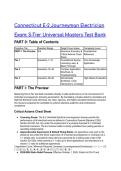
Connecticut E-2 Journeyman Electrician
Exam: S-Tier Universal Mastery Test Bank
PART 0: Table of Contents
Cognitive Tier Question Range Target Focus Areas Complexity Level
PART I: The Preview N/A Executive Summary & Foundational
Critical Axioms Cheat Reference
Sheet
Tier 1 Questions 1–15 Foundational Syntax, Core Knowledge
Licensing Laws, & Application
Basic Formulas
Tier 2 Questions 16–35 Complex Application, Intermediate Simulation
Directives, &
Troubleshooting
Tier 3 Questions 36–60 Grandmaster High-Stakes Evaluation
Synthesis, Code
Intersections, & Design
PART I: The Preview
Mastering this S-Tier test bank translates directly to elite performance on the Connecticut E-2
Unlimited Journeyperson licensing examination. By translating complex statutory mandates and
National Electrical Code directives into clear, rigorous, and highly simulated technical scenarios,
this resource prepares the candidate to achieve absolute academic and professional
compliance.
Critical Axioms Cheat Sheet
● Licensing Scope: The E-2 Unlimited Electrical Journeyperson license permits the
performance of all electrical work as defined in Connecticut General Statutes (CGS)
Section 20-330, but only under the employment of a properly licensed E-1 Unlimited
Electrical Contractor. The E-2 license holder is strictly prohibited from pulling permits or
operating independently.
● Apprenticeship Supervision & Default Hiring Ratios: An apprentice must work in the
presence and under the direct supervision of a licensed journeyperson or contractor at a
1:1 jobsite ratio. Cumulative hiring ratios are governed by a sliding scale under CGS
Section 20-332b, which permits a 1:1 ratio up to three apprentices, and transitions to a
stricter 1:3 ratio for additional apprentices.
| Apprentice Count | Minimum Required Licensees (Journeypersons/Contractors) | | :--- | :--- | | 1
| 1 | | 2 | 2 | | 3 | 3 | | 4 | 6 | | 5 | 9 | | 6 | 12 | | 7 | 15 | | 8 | 18 |
● 2025/2026 Ratio Relief Process: Effective October 1, 2025, Public Act 25-47 and
, Department of Consumer Protection (DCP) regulations permit an approved
Apprenticeship Sponsor (APSP) with 4 or more licensees to obtain streamlined "ratio
relief" up to a strict 1:1 ratio for up to 8 apprentices, bypassing the Department of Labor
(DOL) queue, and mandating a DCP decision within 10 business days.
● Enforcement & Non-Compliance Penalties: Performing electrical work without a license
or willfully employing an unlicensed individual constitutes a Class B misdemeanor,
carrying criminal penalties of up to 6 months in jail, a fine of up to $1,000, or both. Civil
penalties range from $1,000 for a first offense up to $3,000 for subsequent offenses.
● Code Baseline: As of the 2022 Connecticut State Building Code (CSBC) adoption, the
state-enforced standard is the 2020 National Electrical Code (NFPA 70) with unique
Connecticut Specific Amendments.
PART II: The S-Tier Test Bank
Tier 1: Foundational Syntax & Application (Questions 1–15)
Q1: An individual holding an E-2 Unlimited Electrical Journeyperson license in the State of
Connecticut is planning to perform commercial wiring alterations on an office building. Under
Connecticut General Statutes Section 20-330, which of the following statements MOST
ACCURATELY describes the statutory limits of the individual's E-2 license? A) The E-2 holder
may perform the work as an independent contractor, provided a municipal building permit is
secured in the individual's name. B) The E-2 holder may perform the work, sign permit
applications, and act as the sole principal of an electrical contracting business. C) The E-2
holder may perform the work only while in the employ of a properly licensed E-1 contractor, and
is strictly prohibited from pulling permits. D) The E-2 holder may perform the work
independently, but is restricted to low-voltage systems not exceeding 48 volts or 8 amperes.
● The Answer: C (The E-2 holder may perform the work only while in the employ of a
properly licensed E-1 contractor, and is strictly prohibited from pulling permits.)
● Distractor Analysis:
○ A is incorrect: CGS Section 20-330 strictly prohibits E-2 journeypersons from pulling
permits or performing work as independent contractors.
○ B is incorrect: Signing permit applications and operating a contracting business
requires an E-1 Unlimited Electrical Contractor license.
○ D is incorrect: Low-voltage limits (48V, 8A) apply strictly to C-6/C-5 licenses,
whereas the E-2 license represents unlimited voltage scope but requires
employment.
The Mentor's Analysis: Licensing boundaries are absolute. An E-2 journeyperson possesses
unlimited technical scope but zero administrative autonomy. To legally perform work, the
journeyperson must maintain an active employment relationship with an E-1 contractor.
Professional/Academic Intuition: The E-2 journeyperson possesses unlimited technical scope
but must remain an employee of a licensed contractor and cannot pull permits.
Double-space
Q2: A candidate is applying for the Connecticut E-2 Unlimited Electrical Journeyperson license
examination based on equivalent training and experience. What is the minimum number of
registered on-the-job training (OJT) hours and formal classroom hours required to approve the
application? A) 4,000 OJT hours and 360 classroom hours. B) 8,000 OJT hours and 720
classroom hours. C) 8,000 OJT hours and 576 classroom hours. D) 2,000 OJT hours and 144
, classroom hours.
● The Answer: B (8,000 OJT hours and 720 classroom hours.)
● Distractor Analysis:
○ A is incorrect: 4,000 OJT hours and 360 classroom hours apply to C-6/L-6 limited
licenses.
○ C is incorrect: 576 classroom hours apply to L-2 line journeyperson requirements.
○ D is incorrect: 2,000 OJT hours and 144 classroom hours apply to C-8 limited sign
journeyperson requirements.
The Mentor's Analysis: The E-2 license is the "unlimited" benchmark. It requires a rigorous
4-year equivalent of 8,000 hands-on hours and 720 academic hours. Anything less will trigger
an immediate deficiency letter from the Department of Consumer Protection.
Professional/Academic Intuition: The E-2 equivalent pathway requires exactly 8,000
registered OJT hours paired with 720 accredited classroom hours.
Double-space
Q3: The Department of Consumer Protection discovers an unlicensed worker installing a
commercial service entrance feeder in New Haven. After a formal hearing, what is the maximum
civil penalty that the Examining Board or Commissioner can impose for this first violation? A) Up
to $1,000. B) Up to $1,500. C) Up to $3,000. D) Up to $5,000.
● The Answer: A (Up to $1,000.)
● Distractor Analysis:
○ B is incorrect: $1,500 is the statutory limit for a second violation occurring within
three years.
○ C is incorrect: $3,000 is the statutory limit for a third or subsequent violation
occurring within three years.
○ D is incorrect: $5,000 is the civil penalty limit for willful violations of court-ordered
restraining orders, not standard occupational board fines.
The Mentor's Analysis: State-enforced civil fines follow a progressive tier. The first offense
caps at $1,000. These fines are separate from any criminal misdemeanor charges that the court
system may pursue. Professional/Academic Intuition: First-time violations for working without
a license carry a maximum administrative civil penalty of $1,000.
Double-space
Q4: A local building inspector in Bridgeport reports an unlicensed contractor performing
residential panel replacements. If the Department of Consumer Protection successfully collects
a civil penalty for this violation, what portion of the fine must be remitted to Bridgeport? A) No
portion; all collected funds go directly to the State General Fund. B) One-quarter (25 percent) of
the collected penalty. C) Two-thirds (66.7 percent) of the collected penalty. D) One-half (50
percent) of the collected penalty.
● The Answer: D (One-half [50 percent] of the collected penalty.)
● Distractor Analysis:
○ A is incorrect: Under Connecticut law, municipal notification triggers a statutory
fund-sharing mechanism.
○ B is incorrect: 25 percent is not recognized under any Connecticut licensing fine
distribution statute.
○ C is incorrect: 66.7 percent is incorrect; the statute strictly dictates an equal 50/50
split.
The Mentor's Analysis: To incentivize local enforcement, Connecticut General Statutes require
the Commissioner to split collected civil penalties evenly with the reporting municipality. This
direct financial return keeps local inspectors vigilant. Professional/Academic Intuition: When
Exam: S-Tier Universal Mastery Test Bank
PART 0: Table of Contents
Cognitive Tier Question Range Target Focus Areas Complexity Level
PART I: The Preview N/A Executive Summary & Foundational
Critical Axioms Cheat Reference
Sheet
Tier 1 Questions 1–15 Foundational Syntax, Core Knowledge
Licensing Laws, & Application
Basic Formulas
Tier 2 Questions 16–35 Complex Application, Intermediate Simulation
Directives, &
Troubleshooting
Tier 3 Questions 36–60 Grandmaster High-Stakes Evaluation
Synthesis, Code
Intersections, & Design
PART I: The Preview
Mastering this S-Tier test bank translates directly to elite performance on the Connecticut E-2
Unlimited Journeyperson licensing examination. By translating complex statutory mandates and
National Electrical Code directives into clear, rigorous, and highly simulated technical scenarios,
this resource prepares the candidate to achieve absolute academic and professional
compliance.
Critical Axioms Cheat Sheet
● Licensing Scope: The E-2 Unlimited Electrical Journeyperson license permits the
performance of all electrical work as defined in Connecticut General Statutes (CGS)
Section 20-330, but only under the employment of a properly licensed E-1 Unlimited
Electrical Contractor. The E-2 license holder is strictly prohibited from pulling permits or
operating independently.
● Apprenticeship Supervision & Default Hiring Ratios: An apprentice must work in the
presence and under the direct supervision of a licensed journeyperson or contractor at a
1:1 jobsite ratio. Cumulative hiring ratios are governed by a sliding scale under CGS
Section 20-332b, which permits a 1:1 ratio up to three apprentices, and transitions to a
stricter 1:3 ratio for additional apprentices.
| Apprentice Count | Minimum Required Licensees (Journeypersons/Contractors) | | :--- | :--- | | 1
| 1 | | 2 | 2 | | 3 | 3 | | 4 | 6 | | 5 | 9 | | 6 | 12 | | 7 | 15 | | 8 | 18 |
● 2025/2026 Ratio Relief Process: Effective October 1, 2025, Public Act 25-47 and
, Department of Consumer Protection (DCP) regulations permit an approved
Apprenticeship Sponsor (APSP) with 4 or more licensees to obtain streamlined "ratio
relief" up to a strict 1:1 ratio for up to 8 apprentices, bypassing the Department of Labor
(DOL) queue, and mandating a DCP decision within 10 business days.
● Enforcement & Non-Compliance Penalties: Performing electrical work without a license
or willfully employing an unlicensed individual constitutes a Class B misdemeanor,
carrying criminal penalties of up to 6 months in jail, a fine of up to $1,000, or both. Civil
penalties range from $1,000 for a first offense up to $3,000 for subsequent offenses.
● Code Baseline: As of the 2022 Connecticut State Building Code (CSBC) adoption, the
state-enforced standard is the 2020 National Electrical Code (NFPA 70) with unique
Connecticut Specific Amendments.
PART II: The S-Tier Test Bank
Tier 1: Foundational Syntax & Application (Questions 1–15)
Q1: An individual holding an E-2 Unlimited Electrical Journeyperson license in the State of
Connecticut is planning to perform commercial wiring alterations on an office building. Under
Connecticut General Statutes Section 20-330, which of the following statements MOST
ACCURATELY describes the statutory limits of the individual's E-2 license? A) The E-2 holder
may perform the work as an independent contractor, provided a municipal building permit is
secured in the individual's name. B) The E-2 holder may perform the work, sign permit
applications, and act as the sole principal of an electrical contracting business. C) The E-2
holder may perform the work only while in the employ of a properly licensed E-1 contractor, and
is strictly prohibited from pulling permits. D) The E-2 holder may perform the work
independently, but is restricted to low-voltage systems not exceeding 48 volts or 8 amperes.
● The Answer: C (The E-2 holder may perform the work only while in the employ of a
properly licensed E-1 contractor, and is strictly prohibited from pulling permits.)
● Distractor Analysis:
○ A is incorrect: CGS Section 20-330 strictly prohibits E-2 journeypersons from pulling
permits or performing work as independent contractors.
○ B is incorrect: Signing permit applications and operating a contracting business
requires an E-1 Unlimited Electrical Contractor license.
○ D is incorrect: Low-voltage limits (48V, 8A) apply strictly to C-6/C-5 licenses,
whereas the E-2 license represents unlimited voltage scope but requires
employment.
The Mentor's Analysis: Licensing boundaries are absolute. An E-2 journeyperson possesses
unlimited technical scope but zero administrative autonomy. To legally perform work, the
journeyperson must maintain an active employment relationship with an E-1 contractor.
Professional/Academic Intuition: The E-2 journeyperson possesses unlimited technical scope
but must remain an employee of a licensed contractor and cannot pull permits.
Double-space
Q2: A candidate is applying for the Connecticut E-2 Unlimited Electrical Journeyperson license
examination based on equivalent training and experience. What is the minimum number of
registered on-the-job training (OJT) hours and formal classroom hours required to approve the
application? A) 4,000 OJT hours and 360 classroom hours. B) 8,000 OJT hours and 720
classroom hours. C) 8,000 OJT hours and 576 classroom hours. D) 2,000 OJT hours and 144
, classroom hours.
● The Answer: B (8,000 OJT hours and 720 classroom hours.)
● Distractor Analysis:
○ A is incorrect: 4,000 OJT hours and 360 classroom hours apply to C-6/L-6 limited
licenses.
○ C is incorrect: 576 classroom hours apply to L-2 line journeyperson requirements.
○ D is incorrect: 2,000 OJT hours and 144 classroom hours apply to C-8 limited sign
journeyperson requirements.
The Mentor's Analysis: The E-2 license is the "unlimited" benchmark. It requires a rigorous
4-year equivalent of 8,000 hands-on hours and 720 academic hours. Anything less will trigger
an immediate deficiency letter from the Department of Consumer Protection.
Professional/Academic Intuition: The E-2 equivalent pathway requires exactly 8,000
registered OJT hours paired with 720 accredited classroom hours.
Double-space
Q3: The Department of Consumer Protection discovers an unlicensed worker installing a
commercial service entrance feeder in New Haven. After a formal hearing, what is the maximum
civil penalty that the Examining Board or Commissioner can impose for this first violation? A) Up
to $1,000. B) Up to $1,500. C) Up to $3,000. D) Up to $5,000.
● The Answer: A (Up to $1,000.)
● Distractor Analysis:
○ B is incorrect: $1,500 is the statutory limit for a second violation occurring within
three years.
○ C is incorrect: $3,000 is the statutory limit for a third or subsequent violation
occurring within three years.
○ D is incorrect: $5,000 is the civil penalty limit for willful violations of court-ordered
restraining orders, not standard occupational board fines.
The Mentor's Analysis: State-enforced civil fines follow a progressive tier. The first offense
caps at $1,000. These fines are separate from any criminal misdemeanor charges that the court
system may pursue. Professional/Academic Intuition: First-time violations for working without
a license carry a maximum administrative civil penalty of $1,000.
Double-space
Q4: A local building inspector in Bridgeport reports an unlicensed contractor performing
residential panel replacements. If the Department of Consumer Protection successfully collects
a civil penalty for this violation, what portion of the fine must be remitted to Bridgeport? A) No
portion; all collected funds go directly to the State General Fund. B) One-quarter (25 percent) of
the collected penalty. C) Two-thirds (66.7 percent) of the collected penalty. D) One-half (50
percent) of the collected penalty.
● The Answer: D (One-half [50 percent] of the collected penalty.)
● Distractor Analysis:
○ A is incorrect: Under Connecticut law, municipal notification triggers a statutory
fund-sharing mechanism.
○ B is incorrect: 25 percent is not recognized under any Connecticut licensing fine
distribution statute.
○ C is incorrect: 66.7 percent is incorrect; the statute strictly dictates an equal 50/50
split.
The Mentor's Analysis: To incentivize local enforcement, Connecticut General Statutes require
the Commissioner to split collected civil penalties evenly with the reporting municipality. This
direct financial return keeps local inspectors vigilant. Professional/Academic Intuition: When


