

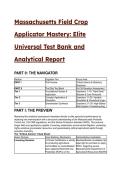
Massachusetts Field Crop
Applicator Mastery: Elite
Universal Test Bank and
Analytical Report
PART 0: THE NAVIGATOR
Section Cognitive Tier Focus Area
PART I The Preview Critical Axioms & Statutory
Directives
PART II The Elite Test Bank Full 30-Question Assessment
Tier 1 Foundational Syntax & Questions 1–10: "Hard Deck"
Application Statutes & Core Protocols
Tier 2 Complex Application & Questions 11–20: Variable
Simulation Simulation & Procedural Logic
Tier 3 Grandmaster Synthesis Questions 21–30: High-Stakes
Multi-System Troubleshooting
PART I: THE PREVIEW
Mastering this analytical assessment translates directly to elite agricultural performance by
replacing rote memorization with a structural understanding of the Massachusetts Pesticide
Control Act, 333 CMR regulations, and the Worker Protection Standard (WPS). This protocol
forges field crop applicators capable of averting catastrophic environmental litigation, protecting
highly sensitive groundwater resources, and guaranteeing optimal agricultural yields through
precision chemistry.
The "Critical Axioms" Cheat Sheet:
Axiom Domain Core Statutory Mechanism Administrative Implication
Licensing Domains A Private Certification is strictly Misclassification invalidates the
for producing agricultural legal right to purchase or apply
commodities on owned/leased RUPs, triggering severe
land; applying Restricted Use Massachusetts Department of
Pesticides (RUPs) on the Agricultural Resources (MDAR)
,Axiom Domain Core Statutory Mechanism Administrative Implication
property of another for hire penalties.
mandates a Commercial
Certification.
WPS Mandates Under the EPA Worker Untrained personnel cannot
Protection Standard, legally touch pesticide
agricultural workers and containers or enter active
pesticide handlers must receive Restricted-Entry Interval (REI)
documented safety training zones without specialized
annually, with zero grace early-entry PPE and briefings.
period.
Statutory Recordkeeping Pursuant to 333 CMR 10.14, Significant accidents or
true and accurate operational pesticide-induced illnesses
records for all pesticide must be reported to MDAR
applications must be immediately, and in no case
maintained for an absolute later than 48 hours.
minimum of three years.
Groundwater Protection Under 333 CMR 12.00, Application is strictly prohibited
applications of listed active without a Department-approved
ingredients (e.g., atrazine, Pesticide Management Plan
simazine) within a Zone II and definitive proof that no
primary recharge area are viable alternative exists.
highly restricted.
The 5940 Constant The universal calibration Deviating from this constant
equation dictates that Gallons guarantees mathematical
Per Minute (GPM) equals failure, resulting in either
(Gallons Per Acre × Miles Per catastrophic phytotoxicity or
Hour × nozzle spacing in costly weed escapes.
inches) divided by 5940.
Pollinator Protection 333 CMR 13.00 prohibits Applicators must provide
applying pesticides with bee 24-hour pre-notification to
warnings to blooming field apiary owners, holding the
crops without a 2.5-mile radius applicator liable for drift onto
apiary check. adjacent blooming forage.
PART II: THE ELITE TEST BANK
Tier 1: Foundational Syntax & Application
Q1: A Massachusetts farm manager intends to purchase and apply a federally Restricted Use
Pesticide (RUP) to control potato leafhoppers on 500 acres of alfalfa situated entirely on land
owned by the farming corporation. Based on the provisions of the Massachusetts Pesticide
Control Act, which credential MUST the applicator possess? A) An Applicator License (Core), as
this serves as the foundational requirement for all corporate agricultural personnel. B) A
Commercial Certification in Category 21, because the massive scale of the operation inherently
defines it as a commercial enterprise. C) A Private Certification, because the application of the
Restricted Use Pesticide occurs on property owned by the employer for the explicit purpose of
, producing an agricultural commodity. D) A Dealer License, as the farm manager is responsible
for the direct procurement and inventory of the restricted chemicals prior to application.
● The Answer: C (A Private Certification, because the application of the Restricted Use
Pesticide occurs on property owned by the employer for the explicit purpose of producing
an agricultural commodity.)
● Distractor Analysis:
○ A is incorrect: An Applicator License (Core) only permits the application of general
use pesticides on the property of another, not RUPs.
○ B is incorrect: A Commercial Certification is specifically required when applying
RUPs on the property of another for hire. Because the land is owned by the
applicator's employer for agricultural production, commercial status is legally
inapplicable.
○ D is incorrect: A Dealer License solely permits the sale of RUPs, not their
application.
The Mentor's Analysis: The regulatory framework divides applicators based on land ownership
and commercial intent. When facing the application of RUPs for the purpose of raising
agricultural commodities on owned or rented land, the immediate priority is securing the correct
statutory classification. By utilizing a Private Certification, the practitioner bypasses the
administrative burden and legal misclassification of a commercial license.
Professional/Academic Intuition: Private Certification is inextricably linked to agricultural
commodity production on proprietary or leased land.
Q2: Under the EPA's revised Agricultural Worker Protection Standard (WPS), what is the
maximum legally permissible grace period for a farm employer to provide pesticide safety
training to a newly hired agricultural handler before they mix, load, or apply crop pesticides? A)
5 days, provided the handler is under the direct line-of-sight supervision of a certified applicator.
B) 15 days, allowing the farm to batch training sessions for multiple seasonal hires. C) 30 days,
which aligns with the statutory definition of a standard agricultural treated area. D) 0 days, as
there is absolutely no grace period permitted for handler training.
● The Answer: D (0 days, as there is absolutely no grace period permitted for handler
training.)
● Distractor Analysis:
○ A is incorrect: Direct supervision does not legally waive the prerequisite safety
training requirement for an uncertified handler manipulating toxic chemicals.
○ B is incorrect: Administrative batching of training is a logistical convenience that
cannot supersede the strict federal mandate prohibiting untrained chemical
handling.
○ C is incorrect: The 30-day metric applies to the definition of a treated area (an area
where a Restricted-Entry Interval has been in effect within the past 30 days), not
training grace periods.
The Mentor's Analysis: Handler tasks present the highest acute exposure risks in agricultural
pesticide use. When onboarding new pesticide handlers, the immediate priority is executing
compliant EPA-approved training prior to any chemical contact. By utilizing the zero grace
period mandate, the practitioner bypasses devastating OSHA and EPA enforcement actions.
Professional/Academic Intuition: Under the revised WPS, training is an absolute prerequisite
to handling; a handler cannot touch a pesticide container without prior documented training.
Q3: A commercial field crop applicator completes a broadcast spray of a restricted-use
herbicide. According to 333 CMR 10.14, for what minimum continuous duration must the true
and accurate operational records of this specific application be retained and made promptly
Applicator Mastery: Elite
Universal Test Bank and
Analytical Report
PART 0: THE NAVIGATOR
Section Cognitive Tier Focus Area
PART I The Preview Critical Axioms & Statutory
Directives
PART II The Elite Test Bank Full 30-Question Assessment
Tier 1 Foundational Syntax & Questions 1–10: "Hard Deck"
Application Statutes & Core Protocols
Tier 2 Complex Application & Questions 11–20: Variable
Simulation Simulation & Procedural Logic
Tier 3 Grandmaster Synthesis Questions 21–30: High-Stakes
Multi-System Troubleshooting
PART I: THE PREVIEW
Mastering this analytical assessment translates directly to elite agricultural performance by
replacing rote memorization with a structural understanding of the Massachusetts Pesticide
Control Act, 333 CMR regulations, and the Worker Protection Standard (WPS). This protocol
forges field crop applicators capable of averting catastrophic environmental litigation, protecting
highly sensitive groundwater resources, and guaranteeing optimal agricultural yields through
precision chemistry.
The "Critical Axioms" Cheat Sheet:
Axiom Domain Core Statutory Mechanism Administrative Implication
Licensing Domains A Private Certification is strictly Misclassification invalidates the
for producing agricultural legal right to purchase or apply
commodities on owned/leased RUPs, triggering severe
land; applying Restricted Use Massachusetts Department of
Pesticides (RUPs) on the Agricultural Resources (MDAR)
,Axiom Domain Core Statutory Mechanism Administrative Implication
property of another for hire penalties.
mandates a Commercial
Certification.
WPS Mandates Under the EPA Worker Untrained personnel cannot
Protection Standard, legally touch pesticide
agricultural workers and containers or enter active
pesticide handlers must receive Restricted-Entry Interval (REI)
documented safety training zones without specialized
annually, with zero grace early-entry PPE and briefings.
period.
Statutory Recordkeeping Pursuant to 333 CMR 10.14, Significant accidents or
true and accurate operational pesticide-induced illnesses
records for all pesticide must be reported to MDAR
applications must be immediately, and in no case
maintained for an absolute later than 48 hours.
minimum of three years.
Groundwater Protection Under 333 CMR 12.00, Application is strictly prohibited
applications of listed active without a Department-approved
ingredients (e.g., atrazine, Pesticide Management Plan
simazine) within a Zone II and definitive proof that no
primary recharge area are viable alternative exists.
highly restricted.
The 5940 Constant The universal calibration Deviating from this constant
equation dictates that Gallons guarantees mathematical
Per Minute (GPM) equals failure, resulting in either
(Gallons Per Acre × Miles Per catastrophic phytotoxicity or
Hour × nozzle spacing in costly weed escapes.
inches) divided by 5940.
Pollinator Protection 333 CMR 13.00 prohibits Applicators must provide
applying pesticides with bee 24-hour pre-notification to
warnings to blooming field apiary owners, holding the
crops without a 2.5-mile radius applicator liable for drift onto
apiary check. adjacent blooming forage.
PART II: THE ELITE TEST BANK
Tier 1: Foundational Syntax & Application
Q1: A Massachusetts farm manager intends to purchase and apply a federally Restricted Use
Pesticide (RUP) to control potato leafhoppers on 500 acres of alfalfa situated entirely on land
owned by the farming corporation. Based on the provisions of the Massachusetts Pesticide
Control Act, which credential MUST the applicator possess? A) An Applicator License (Core), as
this serves as the foundational requirement for all corporate agricultural personnel. B) A
Commercial Certification in Category 21, because the massive scale of the operation inherently
defines it as a commercial enterprise. C) A Private Certification, because the application of the
Restricted Use Pesticide occurs on property owned by the employer for the explicit purpose of
, producing an agricultural commodity. D) A Dealer License, as the farm manager is responsible
for the direct procurement and inventory of the restricted chemicals prior to application.
● The Answer: C (A Private Certification, because the application of the Restricted Use
Pesticide occurs on property owned by the employer for the explicit purpose of producing
an agricultural commodity.)
● Distractor Analysis:
○ A is incorrect: An Applicator License (Core) only permits the application of general
use pesticides on the property of another, not RUPs.
○ B is incorrect: A Commercial Certification is specifically required when applying
RUPs on the property of another for hire. Because the land is owned by the
applicator's employer for agricultural production, commercial status is legally
inapplicable.
○ D is incorrect: A Dealer License solely permits the sale of RUPs, not their
application.
The Mentor's Analysis: The regulatory framework divides applicators based on land ownership
and commercial intent. When facing the application of RUPs for the purpose of raising
agricultural commodities on owned or rented land, the immediate priority is securing the correct
statutory classification. By utilizing a Private Certification, the practitioner bypasses the
administrative burden and legal misclassification of a commercial license.
Professional/Academic Intuition: Private Certification is inextricably linked to agricultural
commodity production on proprietary or leased land.
Q2: Under the EPA's revised Agricultural Worker Protection Standard (WPS), what is the
maximum legally permissible grace period for a farm employer to provide pesticide safety
training to a newly hired agricultural handler before they mix, load, or apply crop pesticides? A)
5 days, provided the handler is under the direct line-of-sight supervision of a certified applicator.
B) 15 days, allowing the farm to batch training sessions for multiple seasonal hires. C) 30 days,
which aligns with the statutory definition of a standard agricultural treated area. D) 0 days, as
there is absolutely no grace period permitted for handler training.
● The Answer: D (0 days, as there is absolutely no grace period permitted for handler
training.)
● Distractor Analysis:
○ A is incorrect: Direct supervision does not legally waive the prerequisite safety
training requirement for an uncertified handler manipulating toxic chemicals.
○ B is incorrect: Administrative batching of training is a logistical convenience that
cannot supersede the strict federal mandate prohibiting untrained chemical
handling.
○ C is incorrect: The 30-day metric applies to the definition of a treated area (an area
where a Restricted-Entry Interval has been in effect within the past 30 days), not
training grace periods.
The Mentor's Analysis: Handler tasks present the highest acute exposure risks in agricultural
pesticide use. When onboarding new pesticide handlers, the immediate priority is executing
compliant EPA-approved training prior to any chemical contact. By utilizing the zero grace
period mandate, the practitioner bypasses devastating OSHA and EPA enforcement actions.
Professional/Academic Intuition: Under the revised WPS, training is an absolute prerequisite
to handling; a handler cannot touch a pesticide container without prior documented training.
Q3: A commercial field crop applicator completes a broadcast spray of a restricted-use
herbicide. According to 333 CMR 10.14, for what minimum continuous duration must the true
and accurate operational records of this specific application be retained and made promptly


