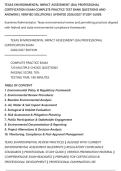
TEXAS ENVIRONMENTAL IMPACT ASSESSMENT (EIA) PROFESSIONAL
CERTIFICATION EXAM COMPLETE PRACTICE TEST BANK QUESTIONS AND
ANSWERS | VERIFIED SOLUTIONS | UPDATED 2026/2027 STUDY GUIDE
Examiner/Administrator: Texas environmental review and permitting practices aligned
with federal and state environmental compliance frameworks
━━━━━━━━━━━━━━━━━━━━━━━━━━━━
TEXAS ENVIRONMENTAL IMPACT ASSESSMENT (EIA) PROFESSIONAL
CERTIFICATION EXAM
2026/2027 EDITION
━━━━━━━━━━━━━━━━━━━━━━━━━━━━
COMPLETE PRACTICE EXAM
120 MULTIPLE-CHOICE QUESTIONS
PASSING SCORE: 70%
TESTING TIME: 180 MINUTES
TABLE OF CONTENT
1. Environmental Policy & Regulatory Framework
2. Environmental Review Procedures
3. Baseline Environmental Analysis
4. Air, Water & Soil Impact Assessment
5. Ecological & Habitat Evaluation
6. Risk Assessment & Mitigation Planning
7. Public Participation & Stakeholder Engagement
8. Environmental Documentation & Reporting
9. Project Alternatives & Decision Analysis
10. Monitoring, Compliance & Post-Approval Management
TEXAS ENVIRONMENTAL REVIEW PRACTICES || ALIGNED WITH CURRENT
ENVIRONMENTAL ASSESSMENT BLUEPRINTS || REGULATORY COMPLIANCE
STANDARDS || PROFESSIONAL STUDY GUIDE || VERIFIED PREPARATION MATERIAL ||
COMPREHENSIVE EXAM READINESS || PREPARED FOR CERTIFICATION &
PROFESSIONAL DEVELOPMENT || PROFESSIONAL EXAMINATION USE
,Questions 1–6 → Environmental Policy & Regulatory Framework
Q1. A proposed industrial expansion in Texas requires environmental review because
federal funding will support site infrastructure. Which principle most directly governs
the requirement to evaluate environmental consequences before approval?
A. Permit-by-rule administration
B. Preventive environmental decision-making
C. Market allocation doctrine
D. Post-construction remediation
Correct Answer: 🔴 B. Preventive environmental decision-making
**Explanation: 🔹 Environmental impact assessment frameworks emphasize evaluating
environmental consequences before irreversible commitments are made. Preventive
decision-making supports early identification of impacts, alternatives, and mitigation
measures. Permit administration addresses authorization processes rather than impact
evaluation, market allocation is unrelated, and remediation occurs after impacts
already exist.
Q2. During project screening, an assessor concludes that multiple minor disturbances
may collectively become significant. Which assessment principle should drive the
determination?
A. Cumulative impact evaluation
B. Administrative deference
C. Cost recovery analysis
D. Single-event accounting
Correct Answer: 🔴 A. Cumulative impact evaluation
**Explanation: 🔹 Environmental review extends beyond isolated impacts and examines
whether incremental effects combine into meaningful environmental change.
Cumulative assessment prevents underestimating long-term or regional impacts. The
remaining choices do not address integrated environmental consequences.
,Q3. A consultant recommends eliminating alternatives analysis to accelerate
approval. What is the strongest professional objection?
A. Alternatives reduce public meetings
B. Alternatives provide comparison for environmentally preferable outcomes
C. Alternatives guarantee lower cost
D. Alternatives eliminate mitigation requirements
Correct Answer: 🔴 B. Alternatives provide comparison for environmentally
preferable outcomes
**Explanation: 🔹 Alternatives analysis is foundational because decision-makers need
comparative options to understand environmental tradeoffs. Alternatives do not
guarantee lower cost or remove mitigation duties; they improve informed decisions.
Q4. Which scenario most likely triggers a higher level of environmental review?
A. Routine office repainting
B. Temporary administrative relocation
C. Large transportation corridor affecting wetlands and communities
D. Internal staffing changes
Correct Answer: 🔴 C. Large transportation corridor affecting wetlands and
communities
**Explanation: 🔹 Major infrastructure with land disturbance and community
interaction presents broader environmental consequences requiring more
comprehensive analysis. Administrative activities generally produce minimal
environmental effects.
Q5. Which statement best reflects environmental significance determination?
A. Significance depends only on project cost
B. Significance combines impact magnitude and context
, C. Significance equals duration alone
D. Significance excludes public concerns
Correct Answer: 🔴 B. Significance combines impact magnitude and context
**Explanation: 🔹 Environmental significance considers severity, scale, duration,
sensitivity of affected resources, and contextual factors. Cost alone is insufficient, and
stakeholder concerns may inform significance evaluation.
Q6. An assessor documents uncertainty in groundwater projections. What is the most
appropriate professional response?
A. Omit uncertain findings
B. Assume no impact
C. Disclose assumptions and evaluate uncertainty ranges
D. Delay assessment indefinitely
Correct Answer: 🔴 C. Disclose assumptions and evaluate uncertainty ranges
**Explanation: 🔹 Transparent documentation of assumptions and uncertainty
strengthens environmental decision quality. Concealing uncertainty reduces reliability
and professional credibility.
Questions 7–12 → Environmental Review Procedures
Q7. The primary objective of project scoping is to:
A. Approve construction schedules
B. Define key environmental issues and assessment boundaries
C. Determine contractor selection
D. Establish tax liability
Correct Answer: 🔴 B. Define key environmental issues and assessment boundaries
**Explanation: 🔹 Scoping focuses resources on significant environmental concerns,
identifies study areas, and establishes analytical depth. It is not a procurement or
CERTIFICATION EXAM COMPLETE PRACTICE TEST BANK QUESTIONS AND
ANSWERS | VERIFIED SOLUTIONS | UPDATED 2026/2027 STUDY GUIDE
Examiner/Administrator: Texas environmental review and permitting practices aligned
with federal and state environmental compliance frameworks
━━━━━━━━━━━━━━━━━━━━━━━━━━━━
TEXAS ENVIRONMENTAL IMPACT ASSESSMENT (EIA) PROFESSIONAL
CERTIFICATION EXAM
2026/2027 EDITION
━━━━━━━━━━━━━━━━━━━━━━━━━━━━
COMPLETE PRACTICE EXAM
120 MULTIPLE-CHOICE QUESTIONS
PASSING SCORE: 70%
TESTING TIME: 180 MINUTES
TABLE OF CONTENT
1. Environmental Policy & Regulatory Framework
2. Environmental Review Procedures
3. Baseline Environmental Analysis
4. Air, Water & Soil Impact Assessment
5. Ecological & Habitat Evaluation
6. Risk Assessment & Mitigation Planning
7. Public Participation & Stakeholder Engagement
8. Environmental Documentation & Reporting
9. Project Alternatives & Decision Analysis
10. Monitoring, Compliance & Post-Approval Management
TEXAS ENVIRONMENTAL REVIEW PRACTICES || ALIGNED WITH CURRENT
ENVIRONMENTAL ASSESSMENT BLUEPRINTS || REGULATORY COMPLIANCE
STANDARDS || PROFESSIONAL STUDY GUIDE || VERIFIED PREPARATION MATERIAL ||
COMPREHENSIVE EXAM READINESS || PREPARED FOR CERTIFICATION &
PROFESSIONAL DEVELOPMENT || PROFESSIONAL EXAMINATION USE
,Questions 1–6 → Environmental Policy & Regulatory Framework
Q1. A proposed industrial expansion in Texas requires environmental review because
federal funding will support site infrastructure. Which principle most directly governs
the requirement to evaluate environmental consequences before approval?
A. Permit-by-rule administration
B. Preventive environmental decision-making
C. Market allocation doctrine
D. Post-construction remediation
Correct Answer: 🔴 B. Preventive environmental decision-making
**Explanation: 🔹 Environmental impact assessment frameworks emphasize evaluating
environmental consequences before irreversible commitments are made. Preventive
decision-making supports early identification of impacts, alternatives, and mitigation
measures. Permit administration addresses authorization processes rather than impact
evaluation, market allocation is unrelated, and remediation occurs after impacts
already exist.
Q2. During project screening, an assessor concludes that multiple minor disturbances
may collectively become significant. Which assessment principle should drive the
determination?
A. Cumulative impact evaluation
B. Administrative deference
C. Cost recovery analysis
D. Single-event accounting
Correct Answer: 🔴 A. Cumulative impact evaluation
**Explanation: 🔹 Environmental review extends beyond isolated impacts and examines
whether incremental effects combine into meaningful environmental change.
Cumulative assessment prevents underestimating long-term or regional impacts. The
remaining choices do not address integrated environmental consequences.
,Q3. A consultant recommends eliminating alternatives analysis to accelerate
approval. What is the strongest professional objection?
A. Alternatives reduce public meetings
B. Alternatives provide comparison for environmentally preferable outcomes
C. Alternatives guarantee lower cost
D. Alternatives eliminate mitigation requirements
Correct Answer: 🔴 B. Alternatives provide comparison for environmentally
preferable outcomes
**Explanation: 🔹 Alternatives analysis is foundational because decision-makers need
comparative options to understand environmental tradeoffs. Alternatives do not
guarantee lower cost or remove mitigation duties; they improve informed decisions.
Q4. Which scenario most likely triggers a higher level of environmental review?
A. Routine office repainting
B. Temporary administrative relocation
C. Large transportation corridor affecting wetlands and communities
D. Internal staffing changes
Correct Answer: 🔴 C. Large transportation corridor affecting wetlands and
communities
**Explanation: 🔹 Major infrastructure with land disturbance and community
interaction presents broader environmental consequences requiring more
comprehensive analysis. Administrative activities generally produce minimal
environmental effects.
Q5. Which statement best reflects environmental significance determination?
A. Significance depends only on project cost
B. Significance combines impact magnitude and context
, C. Significance equals duration alone
D. Significance excludes public concerns
Correct Answer: 🔴 B. Significance combines impact magnitude and context
**Explanation: 🔹 Environmental significance considers severity, scale, duration,
sensitivity of affected resources, and contextual factors. Cost alone is insufficient, and
stakeholder concerns may inform significance evaluation.
Q6. An assessor documents uncertainty in groundwater projections. What is the most
appropriate professional response?
A. Omit uncertain findings
B. Assume no impact
C. Disclose assumptions and evaluate uncertainty ranges
D. Delay assessment indefinitely
Correct Answer: 🔴 C. Disclose assumptions and evaluate uncertainty ranges
**Explanation: 🔹 Transparent documentation of assumptions and uncertainty
strengthens environmental decision quality. Concealing uncertainty reduces reliability
and professional credibility.
Questions 7–12 → Environmental Review Procedures
Q7. The primary objective of project scoping is to:
A. Approve construction schedules
B. Define key environmental issues and assessment boundaries
C. Determine contractor selection
D. Establish tax liability
Correct Answer: 🔴 B. Define key environmental issues and assessment boundaries
**Explanation: 🔹 Scoping focuses resources on significant environmental concerns,
identifies study areas, and establishes analytical depth. It is not a procurement or