

DOMAIN 1: PHYSICAL SCIENCE
CSET Subtest II: Science
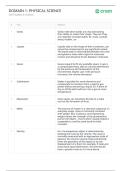
# Term Definition
1 Solids Solids melt when Solids are characterized by
their ability to retain their shape. They are They
are relatively incompressible. Ex: rocks, crystals,
wood, feather, ice
2 Liquids Liquids take on the shape of their containers, yet
cannot be compressed to any significant extent.
The liquid state is intermediate between the solid
and gaseous states with regard to molecular
motion and attractive forces between molecules.
3 Gases Gases expand to fill any available space. A gas is
a compressble flued, wiht its volume determined
by the pressure and temperature of the
environment. Boyles Law: if the pressure
increases, the volume decreases.
4 Sublimation Makes it possible for some elements and
compounds to transition from a solid to gas
phase without becoming a liquid. EX: A block of
dry ice (CO2) which will turn into a gas at room
temperature.
5 Deposition Some gases can transition directly to a solid,
such as the formation of frost.
6 MASS The amount of matter in a chemical substance. In
everyday usage, mass is commonly confused
with weight. But, in physics and engineering,
weight means the strength of the gravitational
pull on the object__ that is which usually makes it
acceptable to use the same word for both
concepts.
7 Density for a homogeneous object is determined by
dividing the mass by the volume. The mass is
normally measured with an appropriate scale of
balance; the volume may be measured directly
(from the geometry of the object) or by the
displacement of a fluid. For example, if steel and
wood have equal dimensions, the steel would
have a greater mass as it is more dense.
CSET Subtest II: Science
# Term Definition
1 Solids Solids melt when Solids are characterized by
their ability to retain their shape. They are They
are relatively incompressible. Ex: rocks, crystals,
wood, feather, ice
2 Liquids Liquids take on the shape of their containers, yet
cannot be compressed to any significant extent.
The liquid state is intermediate between the solid
and gaseous states with regard to molecular
motion and attractive forces between molecules.
3 Gases Gases expand to fill any available space. A gas is
a compressble flued, wiht its volume determined
by the pressure and temperature of the
environment. Boyles Law: if the pressure
increases, the volume decreases.
4 Sublimation Makes it possible for some elements and
compounds to transition from a solid to gas
phase without becoming a liquid. EX: A block of
dry ice (CO2) which will turn into a gas at room
temperature.
5 Deposition Some gases can transition directly to a solid,
such as the formation of frost.
6 MASS The amount of matter in a chemical substance. In
everyday usage, mass is commonly confused
with weight. But, in physics and engineering,
weight means the strength of the gravitational
pull on the object__ that is which usually makes it
acceptable to use the same word for both
concepts.
7 Density for a homogeneous object is determined by
dividing the mass by the volume. The mass is
normally measured with an appropriate scale of
balance; the volume may be measured directly
(from the geometry of the object) or by the
displacement of a fluid. For example, if steel and
wood have equal dimensions, the steel would
have a greater mass as it is more dense.


