

WGU C846
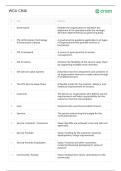
# Term Definition
1 Governance Enables the organization to maintain the
alignment of its operations with the strategic
direction determined by its governing body.
2 ITIL (Information Technology A good-practice guidance applicable to all types
Infrastructure Library) of organizations that provide services to
businesses.
3 ITIL Framework A source of good practice in service
management.
4 ITIL Practices Enhance the flexibility of the service value chain
by supporting multiple chain activities.
5 SVS (service value system) Describes how the components and activities of
an organization interact to create value through
IT-enabled services.
6 The ITIL Service Value Chain A flexible model for the creation, delivery, and
continual improvement of services.
7 Customer The person or organization who defines service
requirements and takes responsibility for the
outcome of service consumption.
8 User Someone who uses the provided services.
9 Sponsor The person authorizing the budget for the
consumed service.
10 Service Customer / Consumer Value: Benefits are achieved; costs and risks are
optimized.
11 Service Provider Value: Funding by the customer; business
development; image improvement.
12 Service Provider Employees Value: Financial and other incentives;
career/professional development; sense of
purpose.
13 Community / Society Value: Employment; taxes; contribution to the
community.
, WGU C846
# Term Definition
14 Charitable Organizations Financial and other contributions from other
organizations.
15 Shareholders Financial benefits (e.g. dividends); sense of
assurance and stability.
16 Utility The functionality offered by a product or service
to meet a particular need. Fit for purpose.
17 Warranty The assurance that a product or service meets
the agreed-upon requirements. Fit for use.
18 Cost The amount of money spent on a specific activity
or resource.
19 Organization A person or group with its internal functions, and
with its own set of responsibilities, authorities,
and relationships necessary to achieve its
objectives.
20 Outcome A result - as perceived by a stakeholder - that is
enabled by one or more outputs.
21 Output A tangible or intangible deliverable of an activity.
22 Risk A possible event that could cause harm or loss,
or make the achievement of objectives more
difficult.
23 Service A means of enabling value co-creation by
facilitating outcomes desirable to customers --
without their having to manage cost and risk.
24 Service Customer A generic role an organization takes on when it
receives services.
25 Service Management A set of specialized organizational capabilities for
enabling value for customers in the form of
services.
# Term Definition
1 Governance Enables the organization to maintain the
alignment of its operations with the strategic
direction determined by its governing body.
2 ITIL (Information Technology A good-practice guidance applicable to all types
Infrastructure Library) of organizations that provide services to
businesses.
3 ITIL Framework A source of good practice in service
management.
4 ITIL Practices Enhance the flexibility of the service value chain
by supporting multiple chain activities.
5 SVS (service value system) Describes how the components and activities of
an organization interact to create value through
IT-enabled services.
6 The ITIL Service Value Chain A flexible model for the creation, delivery, and
continual improvement of services.
7 Customer The person or organization who defines service
requirements and takes responsibility for the
outcome of service consumption.
8 User Someone who uses the provided services.
9 Sponsor The person authorizing the budget for the
consumed service.
10 Service Customer / Consumer Value: Benefits are achieved; costs and risks are
optimized.
11 Service Provider Value: Funding by the customer; business
development; image improvement.
12 Service Provider Employees Value: Financial and other incentives;
career/professional development; sense of
purpose.
13 Community / Society Value: Employment; taxes; contribution to the
community.
, WGU C846
# Term Definition
14 Charitable Organizations Financial and other contributions from other
organizations.
15 Shareholders Financial benefits (e.g. dividends); sense of
assurance and stability.
16 Utility The functionality offered by a product or service
to meet a particular need. Fit for purpose.
17 Warranty The assurance that a product or service meets
the agreed-upon requirements. Fit for use.
18 Cost The amount of money spent on a specific activity
or resource.
19 Organization A person or group with its internal functions, and
with its own set of responsibilities, authorities,
and relationships necessary to achieve its
objectives.
20 Outcome A result - as perceived by a stakeholder - that is
enabled by one or more outputs.
21 Output A tangible or intangible deliverable of an activity.
22 Risk A possible event that could cause harm or loss,
or make the achievement of objectives more
difficult.
23 Service A means of enabling value co-creation by
facilitating outcomes desirable to customers --
without their having to manage cost and risk.
24 Service Customer A generic role an organization takes on when it
receives services.
25 Service Management A set of specialized organizational capabilities for
enabling value for customers in the form of
services.


