

Written by students who passed Immediately available after payment Read online or as PDF Wrong document? Swap it for free 4.6 TrustPilot
logo-home
Document preview thumbnail
Preview 2 out of 12 pages
Exam (elaborations)

BIO 202 Chapter 20 Lymphatic System Exam Questions & Answers (35+ Q&A) | Anatomy & Physiology II | Lymphatic, Immune System & Lymphoid Organs

Document preview thumbnail
Preview 2 out of 12 pages

Master the essential concepts of the lymphatic and immune systems with this BIO 202 Chapter 20 study guide featuring more than 35 exam-style questions and correct answers. This comprehensive review resource covers lymphatic anatomy, lymph formation and circulation, lymphatic vessels, lymph nodes, lymphoid tissues, lymphoid organs, immune cell function, and the physiological role of the lymphatic system in maintaining fluid balance and protecting the body from infection. Students will review key terminology, anatomical structures, and foundational concepts that are frequently assessed in Anatomy and Physiology II examinations. The material provides detailed coverage of lymphatic capillaries, lymphatic vessels, lacteals, dendritic cells, macrophages, plasma cells, T lymphocytes, B lymphocytes, medullary cords, Peyer’s patches, mucosa-associated lymphoid tissue (MALT), lymphangitis, lymph production, and the transport of dietary fats through the lymphatic system. Additional topics include lymph node function, antigen processing, antibody production, immune surveillance, infection pathways, and the mechanisms by which the lymphatic system returns excess tissue fluid and plasma proteins to the bloodstream. Special emphasis is placed on the structure and function of major lymphoid organs, including the thymus, spleen, tonsils, lymph nodes, and Peyer’s patches. Students will learn the roles of immunocompetent T cells, antibody-producing plasma cells, antigen-presenting dendritic cells, and phagocytic macrophages, while also exploring age-related changes in lymphoid organs and clinical conditions such as lymphangitis, infection-related lymph node enlargement, hypoalbuminemia, and post-splenectomy infection risk. This study guide aligns with major Anatomy and Physiology curricula and leading academic references, including Principles of Anatomy and Physiology by Tortora & Derrickson, Human Anatomy & Physiology by Marieb & Hoehn, and Anatomy & Physiology: The Unity of Form and Function by Saladin. The question-and-answer format supports active recall learning, exam preparation, classroom review, HESI preparation, TEAS review, nursing prerequisite coursework, and long-term retention of complex lymphatic and immune system concepts. Relevant Students: BIO 202 Students Anatomy and Physiology II Students Pre-Nursing Students Registered Nursing (RN) Students Bachelor of Science in Nursing (BSN) Students Associate Degree Nursing (ADN) Students Practical Nursing (LPN/LVN) Students Pre-Medical Students Pre-Physician Assistant Students Health Sciences Students Allied Health Students Medical Laboratory Science Students Public Health Students Respiratory Therapy Students Healthcare Program Entrance Exam Candidates Academic References: Tortora GJ, Derrickson B. Principles of Anatomy and Physiology. Wiley. Marieb EN, Hoehn K. Human Anatomy & Physiology. Pearson. Saladin KS. Anatomy & Physiology: The Unity of Form and Function. McGraw-Hill Education. OpenStax. Anatomy and Physiology 2e. Abbas AK, Lichtman AH. Basic Immunology: Functions and Disorders of the Immune System. Elsevier. Keywords: BIO 202 Chapter 20, BIO 202 Exam Questions, Anatomy and Physiology II, Lymphatic System, Immune System, Lymphatic Anatomy, Lymphatic Physiology, Lymph Formation, Lymphatic Vessels, Lymphatic Capillaries, Lymph Nodes, Lymphoid Tissue, Lymphoid Organs, Lymphatics, Lymph Flow, Lymphocyte Function, B Lymphocytes, T Lymphocytes, Plasma Cells, Macrophages, Dendritic Cells, Antigen Presentation, Antibody Production, Immune Response, Adaptive Immunity, Innate Immunity, Lacteals, Chyle, Peyers Patches, MALT, Mucosa Associated Lymphoid Tissue, Medullary Cords, Spleen Function, Thymus Gland, Tonsils, Lymphangitis, Hypoalbuminemia, Infection Control, Immune Defense, Anatomy Exam Review, Physiology Study Guide, Nursing Prerequisites, Health Science Notes, A&P 2 Exam Prep, Human Anatomy and Physiology

Content preview

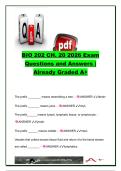
BIO 202 CH. 20 2026 Exam
Questions and Answers |
Already Graded A+


The prefix ________ means resembling a tree. - ANSWER ✔✔dendr-


The prefix _______ means juice. - ANSWER ✔✔chyl-


The prefix______ means lymph, lymphatic tissue, or lymphocyte. -

ANSWER ✔✔lymph-


The prefix ______ means middle. - ANSWER ✔✔med-


Vessels that collect excess tissue fluid and return it to the blood stream

are called _______. - ANSWER ✔✔lymphatics

, Both types of lymphocytes are found in the _______________, which

are inward extensions of cortical lymphoid tissue in lymph nodes. -

ANSWER ✔✔medullary cords


____________ have many appendages like tree branches, and collect

antigens to deliver to lymph nodes for recognition by immune cells. -

ANSWER ✔✔Dendritic cells


Liquefied fat, called ________ , is carried by lacteals from the small

intestine to the blood stream. - ANSWER ✔✔chyle


Which of the statements best explains the presence of red streaks on

Andrew's forearm?


a) The lymphatic vessels of his forearm are dilated.

b) The lymphatic vessels of his forearm are inflamed.

c) The major arteries of his forearm are inflamed.


d) The major arteries of his forearm are dilated. - ANSWER ✔✔b)

The lymphatic vessels of his forearm are inflamed.

The day after Andrew's surgery, the lymph nodes in his right armpit

become enlarged and tender. This was most likely caused by which of

the following?

Document information

Uploaded on
June 19, 2026
Number of pages
12
Written in
2025/2026
Type
Exam (elaborations)
Contains
Questions & answers
$18.99

Wrong document? Swap it for free Within 14 days of purchase and before downloading, you can choose a different document. You can simply spend the amount again.
Written by students who passed
Immediately available after payment
Read online or as PDF

Seller avatar
Reputation scores are based on the amount of documents a seller has sold for a fee and the reviews they have received for those documents. There are three levels: Bronze, Silver and Gold. The better the reputation, the more your can rely on the quality of the sellers work.
JOSHCLAY
3.5
(82)
Sold
383
Followers
16
Items
20324
Last sold
2 days ago


Why students choose Stuvia

Created by fellow students, verified by reviews

Quality you can trust: written by students who passed their tests and reviewed by others who've used these notes.

Didn't get what you expected? Choose another document

No worries! You can instantly pick a different document that better fits what you're looking for.

Pay as you like, start learning right away

No subscription, no commitments. Pay the way you're used to via credit card and download your PDF document instantly.

Student with book image

“Bought, downloaded, and aced it. It really can be that simple.”

Alisha Student

Working on your references?

Create accurate citations in APA, MLA and Harvard with our free citation generator.

Working on your references?

Frequently asked questions

