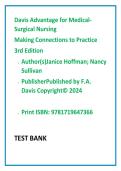
Davis Advantage for Medical-
Surgical Nursing
Making Connections to Practice
3rd Edition
• Author(s)Janice Hoffman; Nancy
Sullivan
• Print ISBN: 9781719647366
TEST BANK
,1) MCQ
Clinical Scenario:
A newly admitted adult patient says, “I have never had surgery
before, and I am worried I will wake up confused afterward.”
Question Stem:
Which nurse response best reflects patient-centered care and
effective assessment?
Answer Options:
A. “Do you understand the surgeon’s explanation?”
B. “What worries you most about the procedure?”
C. “You will be fine; most patients feel that way.”
D. “I will give you the brochure and come back later.”
Correct Answer:
B
Detailed Rationale:
An open-ended question invites the patient to express
concerns, priorities, beliefs, and knowledge gaps. This supports
patient-centered care and helps the nurse gather assessment
data before planning teaching or interventions.
Incorrect Option Analysis:
• A: Incorrect because it is a closed yes/no question and
may miss the patient’s actual concern. Misconception:
, Any question is equally useful. Risk: Important fears may
remain undisclosed.
• C: Incorrect because it reassures without assessment.
Misconception: Comforting words replace assessment.
Risk: Anxiety may increase if concerns are dismissed.
• D: Incorrect because it delays engagement and is not
individualized. Misconception: Handouts alone equal
teaching. Risk: The patient may not understand or feel
heard.
Nursing Process Linkage: Assessment
NCJMM Competencies: Recognize Cues; Analyze Cues
Difficulty Level: Easy
Bloom’s Cognitive Level: Apply
NCLEX Client Needs Category: Psychosocial Integrity
Key Learning Objective: Use therapeutic communication to
identify patient concerns and support individualized care.
2) SATA
Clinical Scenario:
An older adult taking opioids is identified as high risk for falls.
Question Stem:
Which actions reflect evidence-based fall prevention? Select all
that apply.
, Answer Options:
A. Use a validated fall-risk assessment tool on admission and
when the condition changes.
B. Keep the bed in the lowest position with brakes locked.
C. Encourage nonskid footwear when the patient is out of bed.
D. Raise all four side rails to prevent the patient from getting up
alone.
E. Place the call light and personal items within reach.
Correct Answer:
A, B, C, E
Detailed Rationale:
Standardized fall-risk screening, low bed position, nonskid
footwear, and accessible items are evidence-supported safety
measures. These interventions reduce risk while promoting safe
mobility.
Incorrect Option Analysis:
• D: Incorrect. All four side rails are not a fall-prevention
strategy and may increase injury risk. Misconception:
More barriers always mean more safety. Risk: Entrapment,
climbing over rails, or worse injuries if the patient falls.
Nursing Process Linkage: Implementation
NCJMM Competencies: Generate Solutions; Take Action
Difficulty Level: Moderate
Bloom’s Cognitive Level: Analyze
NCLEX Client Needs Category: Safety and Infection Control
Surgical Nursing
Making Connections to Practice
3rd Edition
• Author(s)Janice Hoffman; Nancy
Sullivan
• Print ISBN: 9781719647366
TEST BANK
,1) MCQ
Clinical Scenario:
A newly admitted adult patient says, “I have never had surgery
before, and I am worried I will wake up confused afterward.”
Question Stem:
Which nurse response best reflects patient-centered care and
effective assessment?
Answer Options:
A. “Do you understand the surgeon’s explanation?”
B. “What worries you most about the procedure?”
C. “You will be fine; most patients feel that way.”
D. “I will give you the brochure and come back later.”
Correct Answer:
B
Detailed Rationale:
An open-ended question invites the patient to express
concerns, priorities, beliefs, and knowledge gaps. This supports
patient-centered care and helps the nurse gather assessment
data before planning teaching or interventions.
Incorrect Option Analysis:
• A: Incorrect because it is a closed yes/no question and
may miss the patient’s actual concern. Misconception:
, Any question is equally useful. Risk: Important fears may
remain undisclosed.
• C: Incorrect because it reassures without assessment.
Misconception: Comforting words replace assessment.
Risk: Anxiety may increase if concerns are dismissed.
• D: Incorrect because it delays engagement and is not
individualized. Misconception: Handouts alone equal
teaching. Risk: The patient may not understand or feel
heard.
Nursing Process Linkage: Assessment
NCJMM Competencies: Recognize Cues; Analyze Cues
Difficulty Level: Easy
Bloom’s Cognitive Level: Apply
NCLEX Client Needs Category: Psychosocial Integrity
Key Learning Objective: Use therapeutic communication to
identify patient concerns and support individualized care.
2) SATA
Clinical Scenario:
An older adult taking opioids is identified as high risk for falls.
Question Stem:
Which actions reflect evidence-based fall prevention? Select all
that apply.
, Answer Options:
A. Use a validated fall-risk assessment tool on admission and
when the condition changes.
B. Keep the bed in the lowest position with brakes locked.
C. Encourage nonskid footwear when the patient is out of bed.
D. Raise all four side rails to prevent the patient from getting up
alone.
E. Place the call light and personal items within reach.
Correct Answer:
A, B, C, E
Detailed Rationale:
Standardized fall-risk screening, low bed position, nonskid
footwear, and accessible items are evidence-supported safety
measures. These interventions reduce risk while promoting safe
mobility.
Incorrect Option Analysis:
• D: Incorrect. All four side rails are not a fall-prevention
strategy and may increase injury risk. Misconception:
More barriers always mean more safety. Risk: Entrapment,
climbing over rails, or worse injuries if the patient falls.
Nursing Process Linkage: Implementation
NCJMM Competencies: Generate Solutions; Take Action
Difficulty Level: Moderate
Bloom’s Cognitive Level: Analyze
NCLEX Client Needs Category: Safety and Infection Control