
BIOLOGY
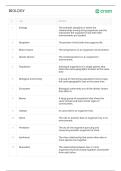
# Term Definition
1 Ecology The scientific discipline in which the
relationships among living organisms and the
interaction the organisms have with their
environments are studied.
2 Biosphere The portion of the Earth that supports life.
3 Biotic Factors The living factors in an organism's environment
4 Abiotic Factors The nonliving factors in an organism's
environment,
5 Population Individual organisms of a single species that
share the same geographic location at the same
time
6 Biological Community A group of interacting populations that occupy
the same geographic area at the same time .
7 Ecosystem Biological community ans all the abiotic factors
that affect it.
8 Biome A large group of ecosystems that share the
same climate and have similar types of
communities.
9 Habitat An area where an organism lives
10 Niche The role or position that an organism has in its
environment.
11 Predation The act of one organism pursuing and
consuming another organism for food
12 Symbiosis The close relationship that exists when two or
more species live together.
13 Mutualism The relationship between two or more
organisms that live closely together and benefit
from each other.
,BIOLOGY
# Term Definition
14 Commensalism A relationship in which one organism benefits
and the other organism is neither helped nor
harmed.
15 Parasitism A symbiotic relationship in which one organism
benefits at the expense of another organism.
16 Autotroph An organism that collects energy from sunlight
or inorganic substances to produce food.
17 heterotroph. An organism that gets its energy requirements
by consuming other organisms is called a(n)
18 Herbivore A heterotroph that eats only plants
19 Omnivore Organisms that eat both plants and animals.
20 Detritivores Organisms that eat fragments of dead matter in
the ecosystem.
21 Trophic Level Each step in a food chain or food web
22 Food Chain A simple model that shows how energy flows
through an ecosystem is called a(n)
23 Food web A model representing the many interconnected
food chains and pathways in which energy flows
through a group of organisms is called a(n)
24 Biomass The total mass of living matter at each trophic
level
25 Matter Anything that takes up space and has mass
26 Nutrient Is a chemical substance than an organism need
to function.
27 Biogeochemical Cycle The exchange of matter through the biosphere
28 Nitrogen Fixation The process of capture and conversion of
nitrogen that is usable by plants
, BIOLOGY
# Term Definition
29 Denitrification Process in which fixed nitrogen compounds are
converted back into nitrogen gas and returned
to the atmosphere.
30 Community Group of interacting populations that occupy
the same area at the same time
31 Limiting factor Any abiotic factor or biotic factor that restricts
the numbers, reproduction, or distribution or
organisms
32 Tolerance The ability of any organism to survive when
subjected to abiotic or biotic factors
33 Ecological Succession The change in an ecosystem that happens when
one community replaces another as a result of
changing abiotic and biotic factors
34 Primary Succession The establishment of a community in an area of
exposed rock that doesn't have any topsoil
35 Climax community The stable, mature community that results
when there is little change in the composition of
species
36 Secondary Succession Is the order it takes place after a community of
organisms and predictable change that takes
place after a community of organisms has been
removed but the soil has remained intact.
37 Weather The condition of the atmosphere at a specific
place and time.
38 Latitude The distance of any point on the surface of
Earth north or south from the equator
39 Climate The average weather conditions in an area,
including temperature and precipitation
40 Tundra A treeless biome with a layer of permanently
frozen soil below the surface called permafrost
# Term Definition
1 Ecology The scientific discipline in which the
relationships among living organisms and the
interaction the organisms have with their
environments are studied.
2 Biosphere The portion of the Earth that supports life.
3 Biotic Factors The living factors in an organism's environment
4 Abiotic Factors The nonliving factors in an organism's
environment,
5 Population Individual organisms of a single species that
share the same geographic location at the same
time
6 Biological Community A group of interacting populations that occupy
the same geographic area at the same time .
7 Ecosystem Biological community ans all the abiotic factors
that affect it.
8 Biome A large group of ecosystems that share the
same climate and have similar types of
communities.
9 Habitat An area where an organism lives
10 Niche The role or position that an organism has in its
environment.
11 Predation The act of one organism pursuing and
consuming another organism for food
12 Symbiosis The close relationship that exists when two or
more species live together.
13 Mutualism The relationship between two or more
organisms that live closely together and benefit
from each other.
,BIOLOGY
# Term Definition
14 Commensalism A relationship in which one organism benefits
and the other organism is neither helped nor
harmed.
15 Parasitism A symbiotic relationship in which one organism
benefits at the expense of another organism.
16 Autotroph An organism that collects energy from sunlight
or inorganic substances to produce food.
17 heterotroph. An organism that gets its energy requirements
by consuming other organisms is called a(n)
18 Herbivore A heterotroph that eats only plants
19 Omnivore Organisms that eat both plants and animals.
20 Detritivores Organisms that eat fragments of dead matter in
the ecosystem.
21 Trophic Level Each step in a food chain or food web
22 Food Chain A simple model that shows how energy flows
through an ecosystem is called a(n)
23 Food web A model representing the many interconnected
food chains and pathways in which energy flows
through a group of organisms is called a(n)
24 Biomass The total mass of living matter at each trophic
level
25 Matter Anything that takes up space and has mass
26 Nutrient Is a chemical substance than an organism need
to function.
27 Biogeochemical Cycle The exchange of matter through the biosphere
28 Nitrogen Fixation The process of capture and conversion of
nitrogen that is usable by plants
, BIOLOGY
# Term Definition
29 Denitrification Process in which fixed nitrogen compounds are
converted back into nitrogen gas and returned
to the atmosphere.
30 Community Group of interacting populations that occupy
the same area at the same time
31 Limiting factor Any abiotic factor or biotic factor that restricts
the numbers, reproduction, or distribution or
organisms
32 Tolerance The ability of any organism to survive when
subjected to abiotic or biotic factors
33 Ecological Succession The change in an ecosystem that happens when
one community replaces another as a result of
changing abiotic and biotic factors
34 Primary Succession The establishment of a community in an area of
exposed rock that doesn't have any topsoil
35 Climax community The stable, mature community that results
when there is little change in the composition of
species
36 Secondary Succession Is the order it takes place after a community of
organisms and predictable change that takes
place after a community of organisms has been
removed but the soil has remained intact.
37 Weather The condition of the atmosphere at a specific
place and time.
38 Latitude The distance of any point on the surface of
Earth north or south from the equator
39 Climate The average weather conditions in an area,
including temperature and precipitation
40 Tundra A treeless biome with a layer of permanently
frozen soil below the surface called permafrost


