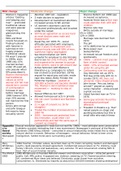
Mild change Moderate change Major change
- Women’s magazine - Abortion 1967 Act – legislation - Divorce Reform Act 1969 saw
articles “Getting 2 male doctors to approve increased acceptance,
and keeping your Development on backstreet abortions, however there was a fear man
man” – promoted increased access to WC women could abandon their wife and
traditional values UC women’s abortions could be children.
and were popular conducted professionally and brushed - Divorce rate rose
magazines, under the carpet - Births outside of marriage:
glamourizing this Still faced opposition as access hard 5% in 1950
ideal. as most doctors were male and 12% in 1980
- Mills and Boon disapproved - Marriage rate declined from
novels focussed on - Equal Pay Act 1970-75 – social 1972
finding husband attitudes persisted with employers, - The pill
with heroine in given 5 years to implement and 1974 (NHS) free for all women
submissive role – women hourly rate still 59% of men, More power over
hugely popular, workforce highly segregated bodies/fertility
traditional values - Sex Discrimination act 1975 - Increased sexual freedom and
- Pill wasn’t popular unlawful for employer to discriminate spontaneity
in 1960s, even due to sex but only in theory, difficult 1960s – condom most popular
1969 only 15% and expensive for women to pursue form of birth control
married women male careers, ways to get around law 1969 – 15% of married women
under 45 used pill, - Active feminism with Women’s under 45 using the pill
only popular when liberation e.g. campaigns to reform Controversy over the safety
GPs prescribed it, law on divorce and abortion, 1970s - Gay liberation set up 1971,
Women themselves argued for equal pay and jobs, made first Gay pride rally with 1k in
had traditional rape less taboo, Betty Friedan the London 1972, MC men, not
values as some Feminine mystique – peaked at universal, many stayed private
women still felt men 100,000 activists and became divided - John Inman “Are you being
should be in control 70s. Women’s own traditional view served?” played an openly
of contraception movement s – wanting to stay at camp character – show proved
- Increase in sex home a great success
before marriage - Sexual Offences Act 1967 Voted funniest man on TV in
1969 however 20% Allowed homosexual acts in private 1976
men 25% women Did not cover Scotland and Northern Some gay activists found the
still married the first Ireland stereotypical portrayal
person
21 = age of consent (vs 16 for offensive
- Actors John Inman
straights) Freedom in theatre e.g. ‘Hair’
and John Gielgud
Tripled the number of prosecutions in naked people on stage and
felt need to keep
1967-76 pushing boundary but this is
sexuality secret
2005 – homosexuals protected from small elite who watch these
discrimination, could enter civil
partnerships and had the same age of
consent as straights
Oppositio Sexual revolution appeared in news but not real life, 1960s – most attitudes were conservative
n to (celebrity scandals misleading that it was mainstream). Newspaper’s portrayal of the Moors
liberal Murderers 1966 killing children – unmarried in sexual relationship (news linked this to violent
society nature) decline in morals. Behaviour of teenagers – sexual behaviour linked to teen crime,
Newspaper hooliganism, fuelled moral panic surrounding youth
s
Mary 1964 Teacher, Christian values, launched clean up TV (most corrupting medium and damaged
Whitehous youth), rapid popularity showed agreement. Condemned sexual nature on TV, drinking, royal
e 1964 family criticism, crime and lawlessness, very extreme. TV and consumerism eroding faith in
God. Part of vocal Christian minority.
The NVALA 1965 Whitehouse co-founded National viewers and listeners association – attracted general
1965 public, CoE, MPs, police. It opposed sex, violence, swearing on TV. Feared socialism entering
UK, condemned Marx ideas and believed Christianity under threat from socialism,
consumerism, tv. Dismissed by majority as absurd but 100,000 members showing widespread
- Women’s magazine - Abortion 1967 Act – legislation - Divorce Reform Act 1969 saw
articles “Getting 2 male doctors to approve increased acceptance,
and keeping your Development on backstreet abortions, however there was a fear man
man” – promoted increased access to WC women could abandon their wife and
traditional values UC women’s abortions could be children.
and were popular conducted professionally and brushed - Divorce rate rose
magazines, under the carpet - Births outside of marriage:
glamourizing this Still faced opposition as access hard 5% in 1950
ideal. as most doctors were male and 12% in 1980
- Mills and Boon disapproved - Marriage rate declined from
novels focussed on - Equal Pay Act 1970-75 – social 1972
finding husband attitudes persisted with employers, - The pill
with heroine in given 5 years to implement and 1974 (NHS) free for all women
submissive role – women hourly rate still 59% of men, More power over
hugely popular, workforce highly segregated bodies/fertility
traditional values - Sex Discrimination act 1975 - Increased sexual freedom and
- Pill wasn’t popular unlawful for employer to discriminate spontaneity
in 1960s, even due to sex but only in theory, difficult 1960s – condom most popular
1969 only 15% and expensive for women to pursue form of birth control
married women male careers, ways to get around law 1969 – 15% of married women
under 45 used pill, - Active feminism with Women’s under 45 using the pill
only popular when liberation e.g. campaigns to reform Controversy over the safety
GPs prescribed it, law on divorce and abortion, 1970s - Gay liberation set up 1971,
Women themselves argued for equal pay and jobs, made first Gay pride rally with 1k in
had traditional rape less taboo, Betty Friedan the London 1972, MC men, not
values as some Feminine mystique – peaked at universal, many stayed private
women still felt men 100,000 activists and became divided - John Inman “Are you being
should be in control 70s. Women’s own traditional view served?” played an openly
of contraception movement s – wanting to stay at camp character – show proved
- Increase in sex home a great success
before marriage - Sexual Offences Act 1967 Voted funniest man on TV in
1969 however 20% Allowed homosexual acts in private 1976
men 25% women Did not cover Scotland and Northern Some gay activists found the
still married the first Ireland stereotypical portrayal
person
21 = age of consent (vs 16 for offensive
- Actors John Inman
straights) Freedom in theatre e.g. ‘Hair’
and John Gielgud
Tripled the number of prosecutions in naked people on stage and
felt need to keep
1967-76 pushing boundary but this is
sexuality secret
2005 – homosexuals protected from small elite who watch these
discrimination, could enter civil
partnerships and had the same age of
consent as straights
Oppositio Sexual revolution appeared in news but not real life, 1960s – most attitudes were conservative
n to (celebrity scandals misleading that it was mainstream). Newspaper’s portrayal of the Moors
liberal Murderers 1966 killing children – unmarried in sexual relationship (news linked this to violent
society nature) decline in morals. Behaviour of teenagers – sexual behaviour linked to teen crime,
Newspaper hooliganism, fuelled moral panic surrounding youth
s
Mary 1964 Teacher, Christian values, launched clean up TV (most corrupting medium and damaged
Whitehous youth), rapid popularity showed agreement. Condemned sexual nature on TV, drinking, royal
e 1964 family criticism, crime and lawlessness, very extreme. TV and consumerism eroding faith in
God. Part of vocal Christian minority.
The NVALA 1965 Whitehouse co-founded National viewers and listeners association – attracted general
1965 public, CoE, MPs, police. It opposed sex, violence, swearing on TV. Feared socialism entering
UK, condemned Marx ideas and believed Christianity under threat from socialism,
consumerism, tv. Dismissed by majority as absurd but 100,000 members showing widespread