

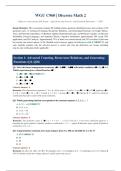
WGU C960 | Discrete Math 2
Objective Assessment (OA) Exam — Questions and Answers with Detailed Rationales — 2026
Exam Structure: This assessment contains 80 multiple-choice questions distributed across four sections of 20
questions each: (1) Advanced Counting, Recurrence Relations, and Generating Functions; (2) Graph Theory,
Trees, and Network Algorithms; (3) Boolean Algebra, Propositional Logic, and Predicate Calculus; (4) Discrete
Probability, Formal Languages, and Automata Theory. Cognitive distribution: approximately 30% recall, 50%
application, and 20% analysis. Approximately 75% of items are scenario-based, and 25% are direct. Each item
has exactly one correct option (A–D). Marked correct answers appear in bold green with [CORRECT], and
each rationale explains why the selected answer is correct and why the distractors are wrong, including
step-by-step verification where applicable.
Section 1: Advanced Counting, Recurrence Relations, and Generating
Functions (Q1–Q20)
Q1: Solve the linear homogeneous recurrence a■ = 5a■■ − 6a■■ with initial conditions a■ = 2, a■ = 5.
Which expression gives a closed form for a■?
A. a■ = 2■ + 3■ [CORRECT]
B. a■ = 2·2■ − 3■
C. a■ = 2■ − 3■
D. a■ = 3·2■ − 3■
Correct Answer: A
Rationale: The characteristic equation r² − 5r + 6 = 0 has roots r = 2 and r = 3, so a■ = A·2■ + B·3■. Applying a■ =
A + B = 2 and a■ = 2A + 3B = 5 yields A = 1, B = 1, giving a■ = 2■ + 3■. Options B, C, and D use incorrect
coefficients that fail to satisfy both initial conditions.
Q2: Which generating function corresponds to the constant sequence 1, 1, 1, 1, ... ?
A. 1 / (1 − x) [CORRECT]
B. 1 / (1 + x)
C. 1 / (1 − x)²
D. 1 / (1 − x²)
Correct Answer: A
Rationale: The geometric series Σ x■ = 1 + x + x² + ... = 1/(1−x) for |x| < 1 has every coefficient equal to 1,
matching the given sequence. Option C produces coefficients 1, 2, 3, ...; option B alternates signs; option D produces
coefficients 1, 0, 1, 0, ...
Q3: Using inclusion–exclusion, how many integers from 1 to 100 are divisible by 2 or by 3?
A. 67 [CORRECT]
B. 83
C. 50
D. 33
Correct Answer: A
Rationale: |A∪B| = |A| + |B| − |A∩B| = 50 (multiples of 2) + 33 (multiples of 3) − 16 (multiples of 6) = 67. Option B
(50+33) double counts the overlap; options C and D report only one set.
,Q4: A drawer contains 10 red, 10 blue, and 10 green socks. What is the minimum number of socks you
must draw (without looking) to guarantee a matching pair?
A. 4 [CORRECT]
B. 2
C. 11
D. 21
Correct Answer: A
Rationale: By the Pigeonhole Principle with 3 colors (pigeonholes), drawing 3 socks could give one of each color
with no pair; drawing one more (4 total) forces a repeat. Option B does not guarantee a pair (could draw two different
colors); options C and D are sufficient but not minimal.
Q5: How many distinct permutations exist of the letters in MISSISSIPPI?
A. 34650 [CORRECT]
B. 3960
C. 11!
D. 11! / 4!
Correct Answer: A
Rationale: There are 11 letters with repetitions: 4 S, 4 I, 2 P, 1 M. The count is 11! / (4!·4!·2!·1!) = 39916800 /
(24·24·2) = 34650. Option B divides by too few factorials; option C ignores repetitions; option D divides by only one
factorial.
Q6: A committee of 3 students is to be chosen from a class of 10. How many distinct committees are
possible?
A. 120 [CORRECT]
B. 720
C. 1000
D. 30
Correct Answer: A
Rationale: C(10, 3) = 10! / (3!·7!) = (10·9·8) / 6 = 120. Order does not matter, so combinations apply. Option B (720)
uses permutations P(10,3); option C incorrectly uses 10³; option D divides by an extra factor.
Q7: Solve a■ = 4a■■ − 4a■■ with a■ = 1, a■ = 6.
A. a■ = (1 + 2n)·2■ [CORRECT]
B. a■ = 2■
C. a■ = n·2■
D. a■ = (1 + n)·2■
Correct Answer: A
Rationale: Characteristic r² − 4r + 4 = 0 has repeated root r = 2, so a■ = (A + Bn)·2■. From a■ = A = 1 and a■ = (1
+ B)·2 = 6 we get B = 2, hence a■ = (1 + 2n)·2■. Option D would give a■ = 4, not 6; options B and C do not satisfy
both initial conditions.
Q8: Find the form of a particular solution to the non-homogeneous recurrence a■ = 3a■■ + 2·3■.
A. a■■ = Cn·3■ [CORRECT]
B. a■■ = C·3■
C. a■■ = C·2■
D. a■■ = Cn·2■
Correct Answer: A
, Rationale: The homogeneous characteristic root r = 3 coincides with the forcing term 3■, so the standard guess
C·3■ (option B) is a solution of the homogeneous equation and must be multiplied by n, giving Cn·3■. Options C
and D use the wrong base for the forcing function.
Q9: What is the value of the 4th Catalan number C■?
A. 14 [CORRECT]
B. 5
C. 42
D. 132
Correct Answer: A
Rationale: Catalan numbers are C■ = (1/(n+1))·C(2n, n). For n = 4: C■ = (1/5)·C(8,4) = (1/5)·70 = 14. Option B is
C■ = 5; option C is C■ = 42; option D is C■ = 132.
Q10: Using F■ = 0, F■ = 1, and F■ = F■■ + F■■, what is F■■?
A. 55 [CORRECT]
B. 34
C. 89
D. 144
Correct Answer: A
Rationale: Computing: 0, 1, 1, 2, 3, 5, 8, 13, 21, 34, 55 — F■■ = 55. Option B is F■ = 34; option C is F■■ = 89;
option D is F■■ = 144.
Q11: How many derangements (permutations with no fixed point) exist for 4 distinct elements?
A. 9 [CORRECT]
B. 24
C. 4
D. 6
Correct Answer: A
Rationale: The derangement count is !n = n!·Σ(0..n)(−1)■/k!. For n = 4: !4 = 24·(1 − 1 + 1/2 − 1/6 + 1/24) = 24 − 24
+ 12 − 4 + 1 = 9. Option B is 4!, the total permutation count; options C and D are too small.
Q12: Using Pascal's identity, evaluate C(10, 3) + C(10, 4).
A. 330 [CORRECT]
B. 340
C. 210
D. 120
Correct Answer: A
Rationale: Pascal's identity gives C(n, k) + C(n, k+1) = C(n+1, k+1), so C(10, 3) + C(10, 4) = C(11, 4) =
(11·10·9·8)/24 = 330. Option B miscalculates; option C is just C(10, 4) = 210; option D is C(10, 3) = 120.
Q13: How many non-negative integer solutions exist for x■ + x■ + x■ = 10?
A. 66 [CORRECT]
B. 120
C. 1000
D. 220
Correct Answer: A
Objective Assessment (OA) Exam — Questions and Answers with Detailed Rationales — 2026
Exam Structure: This assessment contains 80 multiple-choice questions distributed across four sections of 20
questions each: (1) Advanced Counting, Recurrence Relations, and Generating Functions; (2) Graph Theory,
Trees, and Network Algorithms; (3) Boolean Algebra, Propositional Logic, and Predicate Calculus; (4) Discrete
Probability, Formal Languages, and Automata Theory. Cognitive distribution: approximately 30% recall, 50%
application, and 20% analysis. Approximately 75% of items are scenario-based, and 25% are direct. Each item
has exactly one correct option (A–D). Marked correct answers appear in bold green with [CORRECT], and
each rationale explains why the selected answer is correct and why the distractors are wrong, including
step-by-step verification where applicable.
Section 1: Advanced Counting, Recurrence Relations, and Generating
Functions (Q1–Q20)
Q1: Solve the linear homogeneous recurrence a■ = 5a■■ − 6a■■ with initial conditions a■ = 2, a■ = 5.
Which expression gives a closed form for a■?
A. a■ = 2■ + 3■ [CORRECT]
B. a■ = 2·2■ − 3■
C. a■ = 2■ − 3■
D. a■ = 3·2■ − 3■
Correct Answer: A
Rationale: The characteristic equation r² − 5r + 6 = 0 has roots r = 2 and r = 3, so a■ = A·2■ + B·3■. Applying a■ =
A + B = 2 and a■ = 2A + 3B = 5 yields A = 1, B = 1, giving a■ = 2■ + 3■. Options B, C, and D use incorrect
coefficients that fail to satisfy both initial conditions.
Q2: Which generating function corresponds to the constant sequence 1, 1, 1, 1, ... ?
A. 1 / (1 − x) [CORRECT]
B. 1 / (1 + x)
C. 1 / (1 − x)²
D. 1 / (1 − x²)
Correct Answer: A
Rationale: The geometric series Σ x■ = 1 + x + x² + ... = 1/(1−x) for |x| < 1 has every coefficient equal to 1,
matching the given sequence. Option C produces coefficients 1, 2, 3, ...; option B alternates signs; option D produces
coefficients 1, 0, 1, 0, ...
Q3: Using inclusion–exclusion, how many integers from 1 to 100 are divisible by 2 or by 3?
A. 67 [CORRECT]
B. 83
C. 50
D. 33
Correct Answer: A
Rationale: |A∪B| = |A| + |B| − |A∩B| = 50 (multiples of 2) + 33 (multiples of 3) − 16 (multiples of 6) = 67. Option B
(50+33) double counts the overlap; options C and D report only one set.
,Q4: A drawer contains 10 red, 10 blue, and 10 green socks. What is the minimum number of socks you
must draw (without looking) to guarantee a matching pair?
A. 4 [CORRECT]
B. 2
C. 11
D. 21
Correct Answer: A
Rationale: By the Pigeonhole Principle with 3 colors (pigeonholes), drawing 3 socks could give one of each color
with no pair; drawing one more (4 total) forces a repeat. Option B does not guarantee a pair (could draw two different
colors); options C and D are sufficient but not minimal.
Q5: How many distinct permutations exist of the letters in MISSISSIPPI?
A. 34650 [CORRECT]
B. 3960
C. 11!
D. 11! / 4!
Correct Answer: A
Rationale: There are 11 letters with repetitions: 4 S, 4 I, 2 P, 1 M. The count is 11! / (4!·4!·2!·1!) = 39916800 /
(24·24·2) = 34650. Option B divides by too few factorials; option C ignores repetitions; option D divides by only one
factorial.
Q6: A committee of 3 students is to be chosen from a class of 10. How many distinct committees are
possible?
A. 120 [CORRECT]
B. 720
C. 1000
D. 30
Correct Answer: A
Rationale: C(10, 3) = 10! / (3!·7!) = (10·9·8) / 6 = 120. Order does not matter, so combinations apply. Option B (720)
uses permutations P(10,3); option C incorrectly uses 10³; option D divides by an extra factor.
Q7: Solve a■ = 4a■■ − 4a■■ with a■ = 1, a■ = 6.
A. a■ = (1 + 2n)·2■ [CORRECT]
B. a■ = 2■
C. a■ = n·2■
D. a■ = (1 + n)·2■
Correct Answer: A
Rationale: Characteristic r² − 4r + 4 = 0 has repeated root r = 2, so a■ = (A + Bn)·2■. From a■ = A = 1 and a■ = (1
+ B)·2 = 6 we get B = 2, hence a■ = (1 + 2n)·2■. Option D would give a■ = 4, not 6; options B and C do not satisfy
both initial conditions.
Q8: Find the form of a particular solution to the non-homogeneous recurrence a■ = 3a■■ + 2·3■.
A. a■■ = Cn·3■ [CORRECT]
B. a■■ = C·3■
C. a■■ = C·2■
D. a■■ = Cn·2■
Correct Answer: A
, Rationale: The homogeneous characteristic root r = 3 coincides with the forcing term 3■, so the standard guess
C·3■ (option B) is a solution of the homogeneous equation and must be multiplied by n, giving Cn·3■. Options C
and D use the wrong base for the forcing function.
Q9: What is the value of the 4th Catalan number C■?
A. 14 [CORRECT]
B. 5
C. 42
D. 132
Correct Answer: A
Rationale: Catalan numbers are C■ = (1/(n+1))·C(2n, n). For n = 4: C■ = (1/5)·C(8,4) = (1/5)·70 = 14. Option B is
C■ = 5; option C is C■ = 42; option D is C■ = 132.
Q10: Using F■ = 0, F■ = 1, and F■ = F■■ + F■■, what is F■■?
A. 55 [CORRECT]
B. 34
C. 89
D. 144
Correct Answer: A
Rationale: Computing: 0, 1, 1, 2, 3, 5, 8, 13, 21, 34, 55 — F■■ = 55. Option B is F■ = 34; option C is F■■ = 89;
option D is F■■ = 144.
Q11: How many derangements (permutations with no fixed point) exist for 4 distinct elements?
A. 9 [CORRECT]
B. 24
C. 4
D. 6
Correct Answer: A
Rationale: The derangement count is !n = n!·Σ(0..n)(−1)■/k!. For n = 4: !4 = 24·(1 − 1 + 1/2 − 1/6 + 1/24) = 24 − 24
+ 12 − 4 + 1 = 9. Option B is 4!, the total permutation count; options C and D are too small.
Q12: Using Pascal's identity, evaluate C(10, 3) + C(10, 4).
A. 330 [CORRECT]
B. 340
C. 210
D. 120
Correct Answer: A
Rationale: Pascal's identity gives C(n, k) + C(n, k+1) = C(n+1, k+1), so C(10, 3) + C(10, 4) = C(11, 4) =
(11·10·9·8)/24 = 330. Option B miscalculates; option C is just C(10, 4) = 210; option D is C(10, 3) = 120.
Q13: How many non-negative integer solutions exist for x■ + x■ + x■ = 10?
A. 66 [CORRECT]
B. 120
C. 1000
D. 220
Correct Answer: A


