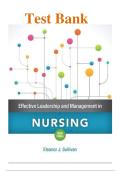
Davis Advantage for Medical-
Surgical Nursing
Making Connections to Practice
3rd Edition
• Author(s)Janice Hoffman; Nancy
Sullivan
• Print ISBN: 9781719647366
TEST BANK
1) MCQ
,Clinical Scenario: A new graduate nurse is caring for a patient
who reports feeling “lightheaded” after receiving a prescribed
antihypertensive medication. The patient is sitting at the
bedside.
Question Stem: What is the nurse’s best first action?
Answer Options:
A. Document the patient’s report and reassess later
B. Assist the patient back to bed and obtain vital signs
C. Tell the patient to drink water and walk to the bathroom
D. Administer the next dose of medication early to maintain
blood pressure control
Correct Answer: B
Detailed Rationale: Lightheadedness after an antihypertensive
medication may indicate hypotension or an adverse medication
response. The nurse should act immediately to prevent a fall,
support safety, and collect focused assessment data. Assisting
the patient to a safe position and obtaining vital signs reflects
early recognition of a cue and immediate action based on
patient safety.
Incorrect Option Analysis:
• A: Incorrect. Delaying assessment ignores a potentially
unstable finding.
o Misconception: “Chart first, act later.”
o Safety risk: Falls, syncope, worsening hypotension.
, • C: Incorrect. Ambulation increases fall risk before the
patient is assessed.
o Misconception: Fluids solve all dizziness.
o Safety risk: Injury from orthostatic hypotension.
• D: Incorrect. Giving more antihypertensive medication
could worsen hypotension.
o Misconception: More medication improves symptom
control.
o Safety risk: Severe hypotension, shock.
Nursing Process Linkage: Assessment
NCJMM Competencies: Recognize Cues; Take Action
Difficulty Level: Moderate
Bloom’s Cognitive Level: Apply
NCLEX Client Needs Category: Physiological Adaptation
Key Learning Objective: Identify immediate nursing actions
that promote patient safety when new symptoms suggest an
adverse response.
2) MCQ
Clinical Scenario: A medical-surgical unit is revising its standard
wound-care protocol after several staff members notice
variation in dressing change practices.
, Question Stem: Which action best reflects evidence-based
nursing care?
Answer Options:
A. Continue each nurse’s preferred dressing technique
B. Use the most recent research, clinical expertise, and patient
preferences to guide the protocol
C. Follow the technique that is fastest for staff to complete
D. Change the protocol only after a patient develops an
infection
Correct Answer: B
Detailed Rationale: Evidence-based practice combines current
best evidence, nurse expertise, and patient values. This
approach improves outcomes and supports consistent, safe
care. Quality improvement should be proactive, not reactive.
Incorrect Option Analysis:
• A: Incorrect. Variation without evidence increases
inconsistency.
o Misconception: Experienced nurses always use the
best method.
o Safety risk: Uneven wound healing, infection risk.
• C: Incorrect. Efficiency alone is not evidence-based.
o Misconception: Faster care is better care.
o Safety risk: Inadequate asepsis or improper dressing
technique.
Surgical Nursing
Making Connections to Practice
3rd Edition
• Author(s)Janice Hoffman; Nancy
Sullivan
• Print ISBN: 9781719647366
TEST BANK
1) MCQ
,Clinical Scenario: A new graduate nurse is caring for a patient
who reports feeling “lightheaded” after receiving a prescribed
antihypertensive medication. The patient is sitting at the
bedside.
Question Stem: What is the nurse’s best first action?
Answer Options:
A. Document the patient’s report and reassess later
B. Assist the patient back to bed and obtain vital signs
C. Tell the patient to drink water and walk to the bathroom
D. Administer the next dose of medication early to maintain
blood pressure control
Correct Answer: B
Detailed Rationale: Lightheadedness after an antihypertensive
medication may indicate hypotension or an adverse medication
response. The nurse should act immediately to prevent a fall,
support safety, and collect focused assessment data. Assisting
the patient to a safe position and obtaining vital signs reflects
early recognition of a cue and immediate action based on
patient safety.
Incorrect Option Analysis:
• A: Incorrect. Delaying assessment ignores a potentially
unstable finding.
o Misconception: “Chart first, act later.”
o Safety risk: Falls, syncope, worsening hypotension.
, • C: Incorrect. Ambulation increases fall risk before the
patient is assessed.
o Misconception: Fluids solve all dizziness.
o Safety risk: Injury from orthostatic hypotension.
• D: Incorrect. Giving more antihypertensive medication
could worsen hypotension.
o Misconception: More medication improves symptom
control.
o Safety risk: Severe hypotension, shock.
Nursing Process Linkage: Assessment
NCJMM Competencies: Recognize Cues; Take Action
Difficulty Level: Moderate
Bloom’s Cognitive Level: Apply
NCLEX Client Needs Category: Physiological Adaptation
Key Learning Objective: Identify immediate nursing actions
that promote patient safety when new symptoms suggest an
adverse response.
2) MCQ
Clinical Scenario: A medical-surgical unit is revising its standard
wound-care protocol after several staff members notice
variation in dressing change practices.
, Question Stem: Which action best reflects evidence-based
nursing care?
Answer Options:
A. Continue each nurse’s preferred dressing technique
B. Use the most recent research, clinical expertise, and patient
preferences to guide the protocol
C. Follow the technique that is fastest for staff to complete
D. Change the protocol only after a patient develops an
infection
Correct Answer: B
Detailed Rationale: Evidence-based practice combines current
best evidence, nurse expertise, and patient values. This
approach improves outcomes and supports consistent, safe
care. Quality improvement should be proactive, not reactive.
Incorrect Option Analysis:
• A: Incorrect. Variation without evidence increases
inconsistency.
o Misconception: Experienced nurses always use the
best method.
o Safety risk: Uneven wound healing, infection risk.
• C: Incorrect. Efficiency alone is not evidence-based.
o Misconception: Faster care is better care.
o Safety risk: Inadequate asepsis or improper dressing
technique.