WGU D429 - Section 1 Question and answers verified to
pass 2026
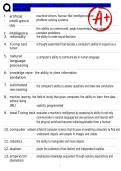
1 artificial machine-driven, human-like intelligence and
. intelli-gence problem-solving systems
(AI)
the ability to understand, apply knowledge, and solve
2 intelligence complex problems
.3. rationality the ability to make sound decisions
4. Turing test a thought experiment that decides a computer's ability to respond as a
human
5. natural a computer's ability to communicate in human language
language
processing
6. knowledge repre- the ability to store information
sentation
7. automated the computer's ability to answer questions and draw new conclusions
rea-soning
8. machine learning the field of study that gives computers the ability to learn from data
without being
(ML) explicitly programmed
9. total Turing test evaluates a machine's intelligence by assessing its ability to not only
communicate in natural language but also perceive and interact with
the physical world and become indistinguishable from a human
10. computer visiona field of computer science that focuses on enabling computers to find and
understand objects and people in images and videos
11. robotics the ability to manipulate and move objects
12. dualism posits the existence of two distinct and independent realities
13. empiricism emphasizes knowledge acquisition through sensory experiences and
observations
1/
10
, 14. induction involves drawing general conclusions from specific observations
2/
10
pass 2026
1 artificial machine-driven, human-like intelligence and
. intelli-gence problem-solving systems
(AI)
the ability to understand, apply knowledge, and solve
2 intelligence complex problems
.3. rationality the ability to make sound decisions
4. Turing test a thought experiment that decides a computer's ability to respond as a
human
5. natural a computer's ability to communicate in human language
language
processing
6. knowledge repre- the ability to store information
sentation
7. automated the computer's ability to answer questions and draw new conclusions
rea-soning
8. machine learning the field of study that gives computers the ability to learn from data
without being
(ML) explicitly programmed
9. total Turing test evaluates a machine's intelligence by assessing its ability to not only
communicate in natural language but also perceive and interact with
the physical world and become indistinguishable from a human
10. computer visiona field of computer science that focuses on enabling computers to find and
understand objects and people in images and videos
11. robotics the ability to manipulate and move objects
12. dualism posits the existence of two distinct and independent realities
13. empiricism emphasizes knowledge acquisition through sensory experiences and
observations
1/
10
, 14. induction involves drawing general conclusions from specific observations
2/
10