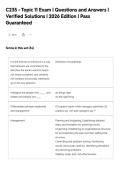
C235 - Topic 11 Exam | Questions and Answers |
Verified Solutions | 2026 Edition | Pass
Guaranteed
Save
Terms in this set (34)
it is the exercise of influence in a way Definition of Leadership
that followers are committed to the
direction the leader wants to head—
not simply compliant, and certainly
not resistant, but actually wanting to
go in the new direction.
Managers are people who ________ and do things right
leaders are people who _____. do the right thing
Differentiate between leadership (1) Leaders inspire while managers administer (2)
and management Leaders say "we" and managers say "I"
Management Planning and budgeting. Establishing detailed
steps and timetables for achieving results.
Organizing. Establishing an organizational structure
for accomplishing the plan and then staffing that
structure.
Controlling and problem solving. Monitoring
results versus plan carefully. Identifying deviations
and resolving problems.
Stability, order, and cost-effectiveness
, Leadership Establishing direction. Inspiring a shared vision of
the future and development of strategies for
producing the changes needed to accomplish that
vision.
Aligning people and resources. Communicating the
direction by words and deeds to those involved in
implementation. Influencing the creation of teams
and coalitions that understand the vision and buy in
to its importance.
Motivating, empowering, and administering.
Energizing people to overcome sometimes
significant barriers to change.
Change and long-term organizational viability.
which basically assume that leaders Trait Theory
are born and not made—enjoyed
considerable popularity in the first
half of the 20th century.
include things like focusing on Task-oriented behavior
employee performance, clarifying
rules and processes, determining
employee roles and goals, removing
roadblocks to performance, working
across department boundaries to
make it easier to get work done, and
so forth.
are those aimed at helping Person-oriented behavior
employees meet social and esteem
needs, giving encouragement and
reinforcement, asking for employee
input, listening to their concerns, and
so forth.
Verified Solutions | 2026 Edition | Pass
Guaranteed
Save
Terms in this set (34)
it is the exercise of influence in a way Definition of Leadership
that followers are committed to the
direction the leader wants to head—
not simply compliant, and certainly
not resistant, but actually wanting to
go in the new direction.
Managers are people who ________ and do things right
leaders are people who _____. do the right thing
Differentiate between leadership (1) Leaders inspire while managers administer (2)
and management Leaders say "we" and managers say "I"
Management Planning and budgeting. Establishing detailed
steps and timetables for achieving results.
Organizing. Establishing an organizational structure
for accomplishing the plan and then staffing that
structure.
Controlling and problem solving. Monitoring
results versus plan carefully. Identifying deviations
and resolving problems.
Stability, order, and cost-effectiveness
, Leadership Establishing direction. Inspiring a shared vision of
the future and development of strategies for
producing the changes needed to accomplish that
vision.
Aligning people and resources. Communicating the
direction by words and deeds to those involved in
implementation. Influencing the creation of teams
and coalitions that understand the vision and buy in
to its importance.
Motivating, empowering, and administering.
Energizing people to overcome sometimes
significant barriers to change.
Change and long-term organizational viability.
which basically assume that leaders Trait Theory
are born and not made—enjoyed
considerable popularity in the first
half of the 20th century.
include things like focusing on Task-oriented behavior
employee performance, clarifying
rules and processes, determining
employee roles and goals, removing
roadblocks to performance, working
across department boundaries to
make it easier to get work done, and
so forth.
are those aimed at helping Person-oriented behavior
employees meet social and esteem
needs, giving encouragement and
reinforcement, asking for employee
input, listening to their concerns, and
so forth.