

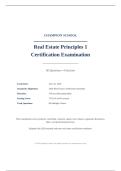
CHAMPION SCHOOL
Real Estate Principles 1
Certification Examination
60 Questions • 4 Sections
Exam Date: June 18, 2026
Standards Alignment: 2026 Real Estate Certification Standards
Duration: 3 Hours (Recommended)
Passing Score: 75% (45 of 60 correct)
Total Questions: 60 Multiple Choice
This examination covers property ownership, contracts, agency law, finance, appraisal, disclosures,
ethics, and professional practice.
Aligned with 2026 national and state real estate certification standards.
© 2026 Champion School. All rights reserved. For authorized use only.
, Real Estate Principles 1 - Champion School
Section 1: Property Ownership and Land Use Controls
Questions 1-15
Q1. Maria is purchasing a commercial building and discovers that the previous owner installed
custom-built shelving units bolted into the walls. The seller insists these are personal property and
intends to remove them before closing. Under the 2026 UCC adaptation of real property law,
which test is most relevant to determine whether the shelving is a fixture?
A. The adaptation test alone determines fixture status
B. The method of attachment test — if bolted, it is a fixture regardless of intent
C. The MARIA acronym (Method, Adaptation, Relationship, Intention, Agreement) is applied to
evaluate all relevant factors
D. Fixtures are always personal property unless specifically listed in the deed
Correct Answer: C
Rationale: The MARIA framework is the comprehensive test used under 2026 standards to determine
fixture status by evaluating Method of attachment, Adaptation to the property, Relationship of the parties,
Intention of the parties, and Agreement between parties. No single factor is dispositive.
Q2. A property owner holds a life estate pur autre vie based on the life of her nephew, who is
currently 25 years old. The owner wishes to sell her interest to a third party. Which statement best
describes the legal situation?
A. The life estate cannot be transferred because it is tied to the nephew's life
B. The owner can sell her interest, but the purchaser's rights end when the nephew dies
C. The owner can only transfer the life estate with the nephew's written consent
D. A life estate pur autre vie automatically converts to fee simple upon sale
Correct Answer: B
Rationale: A life estate pur autre vie is a freely transferable interest, but its duration is measured by the life
of another person (the nephew). The grantee's rights persist only until the measuring life ends, at which
point the remainder interest takes effect.
Q3. A city announces a plan to widen a major road, requiring a 15-foot strip of land from the
front of several residential properties. Homeowners will receive compensation but are unhappy
about the loss. Which constitutional principle and legal doctrine apply?
A. Police power allows the city to take the land without compensation
B. Eminent domain under the Fifth Amendment requires just compensation for the taking
C. The city must obtain voluntary consent from 100% of affected homeowners
D. The homeowners can block the taking by claiming adverse possession of the road right-of-way
Correct Answer: B
Rationale: Eminent domain is the government's power to take private property for public use, grounded in
the Fifth Amendment's Takings Clause. The government must provide just compensation, and affected
owners cannot unilaterally block a valid public-use taking.
Q4. A developer purchases 80 acres of agricultural land and wants to subdivide it into 160
quarter-acre residential lots. Under 2026 subdivision regulations, which of the following is most
likely required before any lots can be sold?
A. Only a recorded plat map filed with the county recorder's office
B. A tentative map, environmental review, and final subdivision map approval from the local
planning authority
C. Written consent from all adjacent property owners and the county agricultural commissioner
Page 2
, Real Estate Principles 1 - Champion School
D. A subdivision bond and proof of utility easements, but no environmental review
Correct Answer: B
Rationale: The 2026 Subdivision Map Act requires developers to go through a multi-step process including
a tentative map, environmental impact review under CEQA/NEPA, and final map approval before any lots
can be legally offered for sale. This protects buyers and the public interest.
Q5. The Champion School teaches the memory aid 'C.A.L.L.' for water rights. In a scenario
where a river runs through a rancher's property, which water rights doctrine applies if the state
follows the riparian system, and what does the 'L' in C.A.L.L. represent?
A. Littoral rights — the rancher owns the land beneath the river to the thread of the stream
B. Lateral support — the rancher has the right to reasonable use of water flowing past the
property
C. Prior appropriation (L = Lode) — the rancher must have a permit for water use
D. The 'L' stands for Liability, meaning the rancher is liable for any downstream pollution
Correct Answer: B
Rationale: Under the riparian doctrine, landowners whose property abuts a natural watercourse have the
right to reasonable use. The C.A.L.L. mnemonic covers Contamination, Access, Lateral support, and Level
— key riparian considerations for 2026 exam preparation.
Q6. A homeowner's association (HOA) files a lawsuit against a resident who has painted his house
bright purple and installed a 12-foot statue in the front yard, both in violation of the CC&Rs.; The
resident claims the restrictions violate his constitutional rights. What is the most likely outcome?
A. The resident wins because CC&Rs; cannot restrict personal expression under the First Amendment
B. The HOA wins because the resident agreed to the CC&Rs; when purchasing the property, and
they are enforceable private covenants
C. The CC&Rs; are unenforceable because they were recorded more than 10 years ago
D. The court will order the HOA to amend the CC&Rs; to accommodate the resident's preferences
Correct Answer: B
Rationale: CC&Rs; (Covenants, Conditions, and Restrictions) are private contractual agreements that run
with the land. Courts consistently uphold them when they are reasonable, recorded properly, and do not
violate public policy. Constitutional protections against government action generally do not apply to
private HOA restrictions.
Q7. James has openly used a vacant parcel of land adjacent to his property for 12 years, building a
fence, maintaining a garden, and paying property taxes on it. The true owner has never given
permission. Under 2026 adverse possession statutes (which require a 10-year statutory period),
what must James prove to claim ownership?
A. Continuous, open, notorious, exclusive, and hostile possession for the full statutory period
B. Only that he paid property taxes on the land for the required period
C. That the true owner abandoned the property and moved out of state
D. That he had a verbal agreement with the true owner to use the land
Correct Answer: A
Rationale: Adverse possession requires proof of all five elements: the possession must be (1) actual and
exclusive, (2) open and notorious, (3) hostile (without permission), (4) continuous for the statutory period,
and (5) under a claim of right. Tax payment alone is insufficient under 2026 standards.
Q8. A property owner discovers that a neighboring commercial building's foundation has caused
the shared party wall to crack, threatening structural integrity. Which property right is most
directly at issue?
A. Air rights, because the building extends into shared airspace
Page 3
Real Estate Principles 1
Certification Examination
60 Questions • 4 Sections
Exam Date: June 18, 2026
Standards Alignment: 2026 Real Estate Certification Standards
Duration: 3 Hours (Recommended)
Passing Score: 75% (45 of 60 correct)
Total Questions: 60 Multiple Choice
This examination covers property ownership, contracts, agency law, finance, appraisal, disclosures,
ethics, and professional practice.
Aligned with 2026 national and state real estate certification standards.
© 2026 Champion School. All rights reserved. For authorized use only.
, Real Estate Principles 1 - Champion School
Section 1: Property Ownership and Land Use Controls
Questions 1-15
Q1. Maria is purchasing a commercial building and discovers that the previous owner installed
custom-built shelving units bolted into the walls. The seller insists these are personal property and
intends to remove them before closing. Under the 2026 UCC adaptation of real property law,
which test is most relevant to determine whether the shelving is a fixture?
A. The adaptation test alone determines fixture status
B. The method of attachment test — if bolted, it is a fixture regardless of intent
C. The MARIA acronym (Method, Adaptation, Relationship, Intention, Agreement) is applied to
evaluate all relevant factors
D. Fixtures are always personal property unless specifically listed in the deed
Correct Answer: C
Rationale: The MARIA framework is the comprehensive test used under 2026 standards to determine
fixture status by evaluating Method of attachment, Adaptation to the property, Relationship of the parties,
Intention of the parties, and Agreement between parties. No single factor is dispositive.
Q2. A property owner holds a life estate pur autre vie based on the life of her nephew, who is
currently 25 years old. The owner wishes to sell her interest to a third party. Which statement best
describes the legal situation?
A. The life estate cannot be transferred because it is tied to the nephew's life
B. The owner can sell her interest, but the purchaser's rights end when the nephew dies
C. The owner can only transfer the life estate with the nephew's written consent
D. A life estate pur autre vie automatically converts to fee simple upon sale
Correct Answer: B
Rationale: A life estate pur autre vie is a freely transferable interest, but its duration is measured by the life
of another person (the nephew). The grantee's rights persist only until the measuring life ends, at which
point the remainder interest takes effect.
Q3. A city announces a plan to widen a major road, requiring a 15-foot strip of land from the
front of several residential properties. Homeowners will receive compensation but are unhappy
about the loss. Which constitutional principle and legal doctrine apply?
A. Police power allows the city to take the land without compensation
B. Eminent domain under the Fifth Amendment requires just compensation for the taking
C. The city must obtain voluntary consent from 100% of affected homeowners
D. The homeowners can block the taking by claiming adverse possession of the road right-of-way
Correct Answer: B
Rationale: Eminent domain is the government's power to take private property for public use, grounded in
the Fifth Amendment's Takings Clause. The government must provide just compensation, and affected
owners cannot unilaterally block a valid public-use taking.
Q4. A developer purchases 80 acres of agricultural land and wants to subdivide it into 160
quarter-acre residential lots. Under 2026 subdivision regulations, which of the following is most
likely required before any lots can be sold?
A. Only a recorded plat map filed with the county recorder's office
B. A tentative map, environmental review, and final subdivision map approval from the local
planning authority
C. Written consent from all adjacent property owners and the county agricultural commissioner
Page 2
, Real Estate Principles 1 - Champion School
D. A subdivision bond and proof of utility easements, but no environmental review
Correct Answer: B
Rationale: The 2026 Subdivision Map Act requires developers to go through a multi-step process including
a tentative map, environmental impact review under CEQA/NEPA, and final map approval before any lots
can be legally offered for sale. This protects buyers and the public interest.
Q5. The Champion School teaches the memory aid 'C.A.L.L.' for water rights. In a scenario
where a river runs through a rancher's property, which water rights doctrine applies if the state
follows the riparian system, and what does the 'L' in C.A.L.L. represent?
A. Littoral rights — the rancher owns the land beneath the river to the thread of the stream
B. Lateral support — the rancher has the right to reasonable use of water flowing past the
property
C. Prior appropriation (L = Lode) — the rancher must have a permit for water use
D. The 'L' stands for Liability, meaning the rancher is liable for any downstream pollution
Correct Answer: B
Rationale: Under the riparian doctrine, landowners whose property abuts a natural watercourse have the
right to reasonable use. The C.A.L.L. mnemonic covers Contamination, Access, Lateral support, and Level
— key riparian considerations for 2026 exam preparation.
Q6. A homeowner's association (HOA) files a lawsuit against a resident who has painted his house
bright purple and installed a 12-foot statue in the front yard, both in violation of the CC&Rs.; The
resident claims the restrictions violate his constitutional rights. What is the most likely outcome?
A. The resident wins because CC&Rs; cannot restrict personal expression under the First Amendment
B. The HOA wins because the resident agreed to the CC&Rs; when purchasing the property, and
they are enforceable private covenants
C. The CC&Rs; are unenforceable because they were recorded more than 10 years ago
D. The court will order the HOA to amend the CC&Rs; to accommodate the resident's preferences
Correct Answer: B
Rationale: CC&Rs; (Covenants, Conditions, and Restrictions) are private contractual agreements that run
with the land. Courts consistently uphold them when they are reasonable, recorded properly, and do not
violate public policy. Constitutional protections against government action generally do not apply to
private HOA restrictions.
Q7. James has openly used a vacant parcel of land adjacent to his property for 12 years, building a
fence, maintaining a garden, and paying property taxes on it. The true owner has never given
permission. Under 2026 adverse possession statutes (which require a 10-year statutory period),
what must James prove to claim ownership?
A. Continuous, open, notorious, exclusive, and hostile possession for the full statutory period
B. Only that he paid property taxes on the land for the required period
C. That the true owner abandoned the property and moved out of state
D. That he had a verbal agreement with the true owner to use the land
Correct Answer: A
Rationale: Adverse possession requires proof of all five elements: the possession must be (1) actual and
exclusive, (2) open and notorious, (3) hostile (without permission), (4) continuous for the statutory period,
and (5) under a claim of right. Tax payment alone is insufficient under 2026 standards.
Q8. A property owner discovers that a neighboring commercial building's foundation has caused
the shared party wall to crack, threatening structural integrity. Which property right is most
directly at issue?
A. Air rights, because the building extends into shared airspace
Page 3


