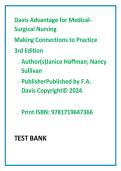
Davis Advantage for Medical-
Surgical Nursing
Making Connections to Practice
3rd Edition
• Author(s)Janice Hoffman; Nancy
Sullivan
• PublisherPublished by F.A.
Davis Copyright© 2024
• Print ISBN: 9781719647366
TEST BANK
,1) MCQ
Clinical scenario: A patient is 1 hour post-op after an
exploratory laparotomy. The nurse finds the patient pale,
diaphoretic, restless, BP 86/52 mm Hg, HR 124/min, RR 26/min,
and urine output 15 mL in the past hour.
Question stem: What is the nurse’s priority action?
Answer options:
A. Recheck vital signs in 30 minutes
B. Activate the rapid response team and apply oxygen
C. Offer oral fluids and reassess pain
D. Document the findings and continue routine care
Correct answer: B
Detailed rationale: These findings suggest acute hemodynamic
instability, possibly hemorrhage or shock. The nurse should act
immediately to support oxygenation and obtain urgent help.
Rapid response activation is appropriate because the patient is
showing signs of deterioration that exceed routine nursing
management.
Incorrect option analysis:
• A: Incorrect because it delays treatment in a potentially
unstable patient.
Misconception: “Trend first, act later.”
, Risk: Delayed recognition of shock and worsening
perfusion.
• C: Incorrect because oral fluids are not appropriate with
suspected instability and could delay definitive care.
Misconception: Hypotension is always from dehydration
alone.
Risk: Aspiration risk and delayed shock response.
• D: Incorrect because documentation does not replace
intervention.
Misconception: Charting is a priority over action.
Risk: Preventable decline, organ hypoperfusion.
Nursing process link: Implementation
NCJMM competency: Recognize Cues, Take Action
Difficulty: Difficult
Bloom’s level: Apply/Analyze
NCLEX client needs: Physiological Adaptation
Key learning objective: Recognize early signs of shock and
initiate urgent escalation of care.
2) MCQ
Clinical scenario: A 58-year-old patient with limited English
proficiency is admitted for heart failure exacerbation. The
patient’s adult daughter offers to interpret for consent-related
teaching.
Question stem: Which nursing action is best?
, Answer options:
A. Use the daughter because family members know the patient
best
B. Request a professional medical interpreter
C. Speak slowly and loudly in short phrases
D. Provide written teaching in English and ask the patient to
sign
Correct answer: B
Detailed rationale: Professional interpreters improve accuracy,
confidentiality, and patient understanding. This supports
patient-centered care, informed decision-making, and safety.
Incorrect option analysis:
• A: Incorrect because family interpreters may omit, alter, or
filter information.
Misconception: Family help is equivalent to trained
interpretation.
Risk: Miscommunication, consent problems, privacy
violations.
• C: Incorrect because volume does not solve language
barriers.
Misconception: Louder speech improves comprehension.
Risk: Frustration, incomplete understanding.
• D: Incorrect because a signature does not prove
comprehension.
Misconception: Written English materials alone are
Surgical Nursing
Making Connections to Practice
3rd Edition
• Author(s)Janice Hoffman; Nancy
Sullivan
• PublisherPublished by F.A.
Davis Copyright© 2024
• Print ISBN: 9781719647366
TEST BANK
,1) MCQ
Clinical scenario: A patient is 1 hour post-op after an
exploratory laparotomy. The nurse finds the patient pale,
diaphoretic, restless, BP 86/52 mm Hg, HR 124/min, RR 26/min,
and urine output 15 mL in the past hour.
Question stem: What is the nurse’s priority action?
Answer options:
A. Recheck vital signs in 30 minutes
B. Activate the rapid response team and apply oxygen
C. Offer oral fluids and reassess pain
D. Document the findings and continue routine care
Correct answer: B
Detailed rationale: These findings suggest acute hemodynamic
instability, possibly hemorrhage or shock. The nurse should act
immediately to support oxygenation and obtain urgent help.
Rapid response activation is appropriate because the patient is
showing signs of deterioration that exceed routine nursing
management.
Incorrect option analysis:
• A: Incorrect because it delays treatment in a potentially
unstable patient.
Misconception: “Trend first, act later.”
, Risk: Delayed recognition of shock and worsening
perfusion.
• C: Incorrect because oral fluids are not appropriate with
suspected instability and could delay definitive care.
Misconception: Hypotension is always from dehydration
alone.
Risk: Aspiration risk and delayed shock response.
• D: Incorrect because documentation does not replace
intervention.
Misconception: Charting is a priority over action.
Risk: Preventable decline, organ hypoperfusion.
Nursing process link: Implementation
NCJMM competency: Recognize Cues, Take Action
Difficulty: Difficult
Bloom’s level: Apply/Analyze
NCLEX client needs: Physiological Adaptation
Key learning objective: Recognize early signs of shock and
initiate urgent escalation of care.
2) MCQ
Clinical scenario: A 58-year-old patient with limited English
proficiency is admitted for heart failure exacerbation. The
patient’s adult daughter offers to interpret for consent-related
teaching.
Question stem: Which nursing action is best?
, Answer options:
A. Use the daughter because family members know the patient
best
B. Request a professional medical interpreter
C. Speak slowly and loudly in short phrases
D. Provide written teaching in English and ask the patient to
sign
Correct answer: B
Detailed rationale: Professional interpreters improve accuracy,
confidentiality, and patient understanding. This supports
patient-centered care, informed decision-making, and safety.
Incorrect option analysis:
• A: Incorrect because family interpreters may omit, alter, or
filter information.
Misconception: Family help is equivalent to trained
interpretation.
Risk: Miscommunication, consent problems, privacy
violations.
• C: Incorrect because volume does not solve language
barriers.
Misconception: Louder speech improves comprehension.
Risk: Frustration, incomplete understanding.
• D: Incorrect because a signature does not prove
comprehension.
Misconception: Written English materials alone are