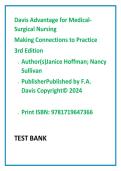
Davis Advantage for Medical-
Surgical Nursing
Making Connections to Practice
3rd Edition
• Author(s)Janice Hoffman; Nancy
Sullivan
• PublisherPublished by F.A.
Davis Copyright© 2024
• Print ISBN: 9781719647366
TEST BANK
,1) MCQ
Clinical Scenario:
A postoperative patient says, “I feel dizzy and my chest feels
tight” while walking to the bathroom.
Question Stem:
What is the nurse’s priority first action?
Answer Options:
A. Assist the patient to sit down and assess vital signs
B. Document the complaint and recheck in 30 minutes
C. Encourage the patient to take slow deep breaths and
continue walking
D. Return the patient to bed and wait for the provider
Correct Answer:
A
Detailed Rationale:
Dizziness and chest tightness are possible cues of decreased
oxygenation, hypotension, dysrhythmia, or impaired perfusion.
The nurse’s first responsibility is to ensure safety and gather
focused assessment data by sitting the patient down and
checking vital signs. This reflects clinical judgment: recognize
cues, take immediate action, then escalate as needed.
Incorrect Option Analysis:
• B: Incorrect because delay is unsafe.
, o Common misconception: “Document first, act later.”
o Patient safety risk: Could miss evolving
cardiopulmonary instability.
• C: Incorrect because exertion may worsen symptoms.
o Common misconception: Deep breathing alone
resolves all distress.
o Patient safety risk: May increase oxygen demand and
precipitate collapse.
• D: Incorrect because the nurse should not leave the
patient unsupported or delay assessment.
o Common misconception: The provider should be
contacted before basic assessment.
o Patient safety risk: Falls or delayed recognition of
deterioration.
Nursing Process Linkage:
Assessment
Clinical Judgment Competencies (NCJMM):
Recognize Cues; Take Action
Difficulty Level:
Moderate
Bloom’s Cognitive Level:
Apply
, NCLEX Client Needs Category:
Physiological Adaptation
Key Learning Objective:
Identify immediate nursing action when a patient shows signs
of possible acute deterioration.
2) MCQ
Clinical Scenario:
A medical-surgical unit is working to reduce catheter-associated
urinary tract infections (CAUTIs).
Question Stem:
Which nursing action is most consistent with evidence-based
practice?
Answer Options:
A. Irrigate the catheter once each shift to prevent blockage
B. Remove the catheter as soon as it is no longer needed
C. Keep the drainage bag above bladder level for easier
monitoring
D. Clean the urinary meatus with antiseptic solution every hour
Correct Answer:
B
Detailed Rationale:
The strongest evidence-based strategy to reduce CAUTI risk is
early removal of indwelling urinary catheters when they are
Surgical Nursing
Making Connections to Practice
3rd Edition
• Author(s)Janice Hoffman; Nancy
Sullivan
• PublisherPublished by F.A.
Davis Copyright© 2024
• Print ISBN: 9781719647366
TEST BANK
,1) MCQ
Clinical Scenario:
A postoperative patient says, “I feel dizzy and my chest feels
tight” while walking to the bathroom.
Question Stem:
What is the nurse’s priority first action?
Answer Options:
A. Assist the patient to sit down and assess vital signs
B. Document the complaint and recheck in 30 minutes
C. Encourage the patient to take slow deep breaths and
continue walking
D. Return the patient to bed and wait for the provider
Correct Answer:
A
Detailed Rationale:
Dizziness and chest tightness are possible cues of decreased
oxygenation, hypotension, dysrhythmia, or impaired perfusion.
The nurse’s first responsibility is to ensure safety and gather
focused assessment data by sitting the patient down and
checking vital signs. This reflects clinical judgment: recognize
cues, take immediate action, then escalate as needed.
Incorrect Option Analysis:
• B: Incorrect because delay is unsafe.
, o Common misconception: “Document first, act later.”
o Patient safety risk: Could miss evolving
cardiopulmonary instability.
• C: Incorrect because exertion may worsen symptoms.
o Common misconception: Deep breathing alone
resolves all distress.
o Patient safety risk: May increase oxygen demand and
precipitate collapse.
• D: Incorrect because the nurse should not leave the
patient unsupported or delay assessment.
o Common misconception: The provider should be
contacted before basic assessment.
o Patient safety risk: Falls or delayed recognition of
deterioration.
Nursing Process Linkage:
Assessment
Clinical Judgment Competencies (NCJMM):
Recognize Cues; Take Action
Difficulty Level:
Moderate
Bloom’s Cognitive Level:
Apply
, NCLEX Client Needs Category:
Physiological Adaptation
Key Learning Objective:
Identify immediate nursing action when a patient shows signs
of possible acute deterioration.
2) MCQ
Clinical Scenario:
A medical-surgical unit is working to reduce catheter-associated
urinary tract infections (CAUTIs).
Question Stem:
Which nursing action is most consistent with evidence-based
practice?
Answer Options:
A. Irrigate the catheter once each shift to prevent blockage
B. Remove the catheter as soon as it is no longer needed
C. Keep the drainage bag above bladder level for easier
monitoring
D. Clean the urinary meatus with antiseptic solution every hour
Correct Answer:
B
Detailed Rationale:
The strongest evidence-based strategy to reduce CAUTI risk is
early removal of indwelling urinary catheters when they are