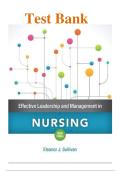
Davis Advantage for Medical-
Surgical Nursing
Making Connections to Practice
3rd Edition
• Author(s)Janice Hoffman; Nancy
Sullivan
• PublisherPublished by F.A.
Davis Copyright© 2024
• Print ISBN: 9781719647366
TEST BANK
,1. MCQ
Clinical Scenario:
A 58-year-old patient is receiving IV morphine after abdominal
surgery. The nurse enters the room and finds the patient
difficult to arouse, with a respiratory rate of 8/min and oxygen
saturation of 88% on room air.
Question Stem:
What is the nurse’s best action?
Answer Options:
A. Document the findings and reassess in 30 minutes
B. Hold the opioid, stimulate the patient, apply oxygen, and
notify the provider per protocol
C. Encourage the patient to ambulate to improve ventilation
D. Ask the family whether the patient usually sleeps deeply
after pain medication
Correct Answer:
B
Detailed Rationale:
The patient shows signs of opioid-induced respiratory
depression, which is an immediate patient safety concern. The
nurse must act quickly to support airway and breathing,
withhold the opioid, and escalate care according to protocol.
This reflects clinical judgment because the nurse recognizes a
deterioration cue and takes action before further harm occurs.
,Incorrect Option Analysis:
• A: Incorrect because delaying action places the patient at
risk for respiratory arrest.
Misconception: “Wait and watch” is safe when the patient
is merely sleepy.
Risk: Worsening hypoxia and cardiac arrest.
• C: Incorrect because ambulation is unsafe and not
appropriate for an unstable, poorly arousable patient.
Misconception: Movement always improves breathing.
Risk: Falls, aspiration, and delayed rescue.
• D: Incorrect because family impressions do not replace
urgent assessment and intervention.
Misconception: History is more important than current
physiologic instability.
Risk: Missed respiratory compromise.
Nursing Process Linkage:
Implementation
Clinical Judgment Competencies (NCJMM):
Recognize Cues; Take Action
Difficulty Level:
Difficult
Bloom’s Cognitive Level:
Apply
, NCLEX Client Needs Category:
Physiological Adaptation
Key Learning Objective:
Identify the priority response to acute opioid-related
respiratory depression.
2. MCQ
Clinical Scenario:
A nurse is helping a unit revise its practice for preventing
catheter-associated urinary tract infections.
Question Stem:
Which statement best describes evidence-based nursing care?
Answer Options:
A. Following long-standing unit habits because they are familiar
B. Using the best available research, clinical expertise, and
patient values to guide care
C. Asking the most senior nurse what the unit has always done
D. Using only randomized trials and ignoring the patient’s
preferences
Correct Answer:
B
Detailed Rationale:
Evidence-based nursing care integrates research evidence,
clinical expertise, and patient preferences. This is the
Surgical Nursing
Making Connections to Practice
3rd Edition
• Author(s)Janice Hoffman; Nancy
Sullivan
• PublisherPublished by F.A.
Davis Copyright© 2024
• Print ISBN: 9781719647366
TEST BANK
,1. MCQ
Clinical Scenario:
A 58-year-old patient is receiving IV morphine after abdominal
surgery. The nurse enters the room and finds the patient
difficult to arouse, with a respiratory rate of 8/min and oxygen
saturation of 88% on room air.
Question Stem:
What is the nurse’s best action?
Answer Options:
A. Document the findings and reassess in 30 minutes
B. Hold the opioid, stimulate the patient, apply oxygen, and
notify the provider per protocol
C. Encourage the patient to ambulate to improve ventilation
D. Ask the family whether the patient usually sleeps deeply
after pain medication
Correct Answer:
B
Detailed Rationale:
The patient shows signs of opioid-induced respiratory
depression, which is an immediate patient safety concern. The
nurse must act quickly to support airway and breathing,
withhold the opioid, and escalate care according to protocol.
This reflects clinical judgment because the nurse recognizes a
deterioration cue and takes action before further harm occurs.
,Incorrect Option Analysis:
• A: Incorrect because delaying action places the patient at
risk for respiratory arrest.
Misconception: “Wait and watch” is safe when the patient
is merely sleepy.
Risk: Worsening hypoxia and cardiac arrest.
• C: Incorrect because ambulation is unsafe and not
appropriate for an unstable, poorly arousable patient.
Misconception: Movement always improves breathing.
Risk: Falls, aspiration, and delayed rescue.
• D: Incorrect because family impressions do not replace
urgent assessment and intervention.
Misconception: History is more important than current
physiologic instability.
Risk: Missed respiratory compromise.
Nursing Process Linkage:
Implementation
Clinical Judgment Competencies (NCJMM):
Recognize Cues; Take Action
Difficulty Level:
Difficult
Bloom’s Cognitive Level:
Apply
, NCLEX Client Needs Category:
Physiological Adaptation
Key Learning Objective:
Identify the priority response to acute opioid-related
respiratory depression.
2. MCQ
Clinical Scenario:
A nurse is helping a unit revise its practice for preventing
catheter-associated urinary tract infections.
Question Stem:
Which statement best describes evidence-based nursing care?
Answer Options:
A. Following long-standing unit habits because they are familiar
B. Using the best available research, clinical expertise, and
patient values to guide care
C. Asking the most senior nurse what the unit has always done
D. Using only randomized trials and ignoring the patient’s
preferences
Correct Answer:
B
Detailed Rationale:
Evidence-based nursing care integrates research evidence,
clinical expertise, and patient preferences. This is the