

6/16/26, 7:23 AM NSG 552 Psychopharmacology Exam 1 - Modules 1-3 Questions and answers with verified Answers (Latest Update 2026) UPDAT…
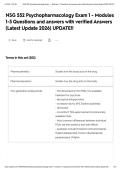
NSG 552 Psychopharmacology Exam 1 - Modules
1-3 Questions and answers with verified Answers
(Latest Update 2026) UPDATE!!
Save Add to calendar
Terms in this set (205)
Pharmacokinetics Studies how the body acts on the drug
Pharmacodynamics Studies how the drug acts on the body
First-generation antipsychotic - first developed in the 1950s, first available
treatment for psychosis
- aka typical antipsychotics
- increased risk for EPS, Tardive dyskinesia
- d2 blocker
- Currently 11 FDA-approved and commerically
available FGAs
- Most common differences between individual
FGAs are their potency and side effects
- examples include Thorazine (chlorpromazine),
Haldol (haloperidol), Prolixin (fluphenazine),
perphenazine (Trilafon
https://quizlet.com/1189819554/nsg-552-psychopharmacology-exam-1-modules-1-3-questions-and-answers-with-verified-answers-latest-update-202… 1/27
,6/16/26, 7:23 AM NSG 552 Psychopharmacology Exam 1 - Modules 1-3 Questions and answers with verified Answers (Latest Update 2026) UPDAT…
Second-generation antipsychotic - examples include Abilify (aripiprazole), Seroquel
(quetiapine), Zyprexa (olanzapine), Risperdal
(risperidone), Clozaril (clozapine)
- lower risk of EPS symptoms compared to 1st gen
- higher risk of metabolic side effects
- serotonin-dopamine receptor antagonists
- AKA atypical antipsychotics
EPS Involuntary movements that occur as a side effect
to certina medications. AKA drug induced
movement disorder. May include tardive dyskinesia,
dystonic reactions, parkinsons-like symptoms,
akathesia, NMD, akinesia
- Can be acute or chronic
- related to suppression of D2 dopamine receptors
in the nigrostriatal pathway
Tardive dyskinesia - characterized by involuntary movments in the
face and body
- often induced by long-term use of anitpsychotic
drugs
- can be associated with use of other medication
types (antidepressants, lithium, antihistamines)
- more common with 1st gen antipsychotics
- movements may include: writhing, mouth
puckering, tongue rolling, lip smacking, pill rolling,
tongue protrusion
https://quizlet.com/1189819554/nsg-552-psychopharmacology-exam-1-modules-1-3-questions-and-answers-with-verified-answers-latest-update-202… 2/27
, 6/16/26, 7:23 AM NSG 552 Psychopharmacology Exam 1 - Modules 1-3 Questions and answers with verified Answers (Latest Update 2026) UPDAT…
Upregulation Refers to the activiation of the nervous system. Is
the process by which a cell increases its response
to a subtance or signal from outside the cell to
carry out a specific response
downregulation Refers to state of calm/relation within nervous
system. Characterized by a decreased response by
a cell to a molecule or neurotransmitter.
Receptor Profiles FGA - Primarily D2 antagonism. Also antagonize
M2, H1, and a1 receptors
SGA - 5-HT2A & D2 antagonism. Rapid D2
dissociation. 5HT2A agonism. Also antagonizes M2,
H1, 5HT2C, and a1 receptors
Binding When a neurotransmitter binds to a receptor on a
receiving cell, it causes ion channels to open or
close.
Affinity The property of a drug that describes its ability to
bind to a receptor
Constant
Unique for each drug-receptor pair as it is
dependent on each of their structures
https://quizlet.com/1189819554/nsg-552-psychopharmacology-exam-1-modules-1-3-questions-and-answers-with-verified-answers-latest-update-202… 3/27
NSG 552 Psychopharmacology Exam 1 - Modules
1-3 Questions and answers with verified Answers
(Latest Update 2026) UPDATE!!
Save Add to calendar
Terms in this set (205)
Pharmacokinetics Studies how the body acts on the drug
Pharmacodynamics Studies how the drug acts on the body
First-generation antipsychotic - first developed in the 1950s, first available
treatment for psychosis
- aka typical antipsychotics
- increased risk for EPS, Tardive dyskinesia
- d2 blocker
- Currently 11 FDA-approved and commerically
available FGAs
- Most common differences between individual
FGAs are their potency and side effects
- examples include Thorazine (chlorpromazine),
Haldol (haloperidol), Prolixin (fluphenazine),
perphenazine (Trilafon
https://quizlet.com/1189819554/nsg-552-psychopharmacology-exam-1-modules-1-3-questions-and-answers-with-verified-answers-latest-update-202… 1/27
,6/16/26, 7:23 AM NSG 552 Psychopharmacology Exam 1 - Modules 1-3 Questions and answers with verified Answers (Latest Update 2026) UPDAT…
Second-generation antipsychotic - examples include Abilify (aripiprazole), Seroquel
(quetiapine), Zyprexa (olanzapine), Risperdal
(risperidone), Clozaril (clozapine)
- lower risk of EPS symptoms compared to 1st gen
- higher risk of metabolic side effects
- serotonin-dopamine receptor antagonists
- AKA atypical antipsychotics
EPS Involuntary movements that occur as a side effect
to certina medications. AKA drug induced
movement disorder. May include tardive dyskinesia,
dystonic reactions, parkinsons-like symptoms,
akathesia, NMD, akinesia
- Can be acute or chronic
- related to suppression of D2 dopamine receptors
in the nigrostriatal pathway
Tardive dyskinesia - characterized by involuntary movments in the
face and body
- often induced by long-term use of anitpsychotic
drugs
- can be associated with use of other medication
types (antidepressants, lithium, antihistamines)
- more common with 1st gen antipsychotics
- movements may include: writhing, mouth
puckering, tongue rolling, lip smacking, pill rolling,
tongue protrusion
https://quizlet.com/1189819554/nsg-552-psychopharmacology-exam-1-modules-1-3-questions-and-answers-with-verified-answers-latest-update-202… 2/27
, 6/16/26, 7:23 AM NSG 552 Psychopharmacology Exam 1 - Modules 1-3 Questions and answers with verified Answers (Latest Update 2026) UPDAT…
Upregulation Refers to the activiation of the nervous system. Is
the process by which a cell increases its response
to a subtance or signal from outside the cell to
carry out a specific response
downregulation Refers to state of calm/relation within nervous
system. Characterized by a decreased response by
a cell to a molecule or neurotransmitter.
Receptor Profiles FGA - Primarily D2 antagonism. Also antagonize
M2, H1, and a1 receptors
SGA - 5-HT2A & D2 antagonism. Rapid D2
dissociation. 5HT2A agonism. Also antagonizes M2,
H1, 5HT2C, and a1 receptors
Binding When a neurotransmitter binds to a receptor on a
receiving cell, it causes ion channels to open or
close.
Affinity The property of a drug that describes its ability to
bind to a receptor
Constant
Unique for each drug-receptor pair as it is
dependent on each of their structures
https://quizlet.com/1189819554/nsg-552-psychopharmacology-exam-1-modules-1-3-questions-and-answers-with-verified-answers-latest-update-202… 3/27


