

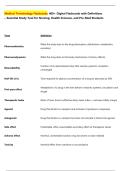
Medical Terminology Flashcards: 400+ Digital Flashcards with Definitions
– Essential Study Tool for Nursing, Health Sciences, and Pre-Med Students
Term Definition
What the body does to the drug (absorption, distribution, metabolism,
Pharmacokinetics
excretion)
Pharmacodynamics What the drug does to the body (mechanism of action, effects)
Fraction of an administered dose that reaches systemic circulation
Bioavailability
unchanged
Half-life (t½) Time required for plasma concentration of a drug to decrease by 50%
Metabolism of a drug in the liver before it reaches systemic circulation (oral
First-pass effect
drugs)
Therapeutic index Ratio of toxic dose to effective dose; lower index = narrower safety margin
Agonist Drug that binds to a receptor and activates it (produces a response)
Antagonist Drug that binds to a receptor but does not activate it; blocks the agonist
Side effect Predictable, often unavoidable secondary effect at therapeutic doses
Adverse effect Harmful, unintended reaction (may be severe or dose-related)
Toxicity Harmful effect from overdose or accumulation
,Term Definition
Allergic reaction Immune-mediated response to a drug (rash, anaphylaxis)
Idiosyncratic reaction Unpredictable, genetically determined abnormal response
Tolerance Reduced response to a drug after repeated use; higher dose needed
Dependence Physical or psychological need for a drug to avoid withdrawal
Addiction Compulsive drug use despite harm; behavioral syndrome
Drug interaction Altered drug effect caused by another drug, food, or supplement
Synergism Combined drug effect greater than the sum of individual effects
Potentiation One drug increases the effect of another (even if inactive alone)
Antagonism One drug reduces or blocks the effect of another
Loading dose Initial higher dose to rapidly achieve therapeutic level
Maintenance dose Subsequent doses to keep drug at steady-state concentration
Steady state Drug input equals elimination; plasma concentration stable
Peak level Highest plasma concentration after administration
Trough level Lowest plasma concentration just before next dose
Therapeutic drug
Measuring drug levels to optimize dosing (e.g., vancomycin, lithium)
monitoring
,Term Definition
ACE inhibitor Angiotensin-converting enzyme inhibitor; antihypertensive (e.g., lisinopril)
ARB Angiotensin II receptor blocker; antihypertensive (e.g., losartan)
Beta-blocker Blocks beta-adrenergic receptors; reduces heart rate, BP (e.g., metoprolol)
Inhibits calcium entry into cells; vasodilation, reduced contractility (e.g.,
Calcium channel blocker
amlodipine)
Diuretic Increases urine output; reduces fluid volume (e.g., furosemide, HCTZ)
Loop diuretic Acts on loop of Henle; potent diuretic (e.g., furosemide, bumetanide)
Thiazide diuretic Acts on distal tubule; mild diuretic (e.g., hydrochlorothiazide)
Potassium-sparing diuretic Spares potassium; weak diuretic (e.g., spironolactone)
Statin HMG-CoA reductase inhibitor; lowers LDL cholesterol (e.g., atorvastatin)
Anticoagulant Prevents blood clot formation (e.g., warfarin, heparin, apixaban)
Antiplatelet Prevents platelet aggregation (e.g., aspirin, clopidogrel)
Thrombolytic Dissolves existing blood clots (e.g., tPA, streptokinase)
Inotropic agent Alters heart contractility (positive: digoxin; negative: beta-blockers)
Chronotropic agent Alters heart rate (positive: increases rate; negative: decreases rate)
Bronchodilator Relaxes airway smooth muscle (e.g., albuterol, ipratropium)
, Term Definition
Anti-inflammatory; suppresses immune system (e.g., prednisone,
Corticosteroid
fluticasone)
NSAID Non-steroidal anti-inflammatory drug (e.g., ibuprofen, naproxen)
Opioid Narcotic analgesic; acts on mu receptors (e.g., morphine, fentanyl)
Drug not primarily analgesic but enhances pain relief (e.g., gabapentin,
Adjuvant analgesic
amitriptyline)
Antibiotic Kills or inhibits bacteria (e.g., amoxicillin, ciprofloxacin)
Bactericidal Kills bacteria directly (e.g., penicillins, vancomycin)
Bacteriostatic Inhibits bacterial growth (e.g., tetracycline, sulfonamides)
Broad-spectrum antibiotic Effective against wide range of bacteria (e.g., levofloxacin)
Narrow-spectrum antibiotic Effective against specific bacteria (e.g., penicillin G for strep)
Antifungal Treats fungal infections (e.g., fluconazole, amphotericin B)
Antiviral Treats viral infections (e.g., acyclovir, oseltamivir)
Antiemetic Prevents or treats nausea and vomiting (e.g., ondansetron, metoclopramide)
Prokinetic agent Increases GI motility (e.g., metoclopramide)
Laxative Promotes bowel movement (e.g., docusate, bisacodyl)
Antidiarrheal Reduces diarrhea (e.g., loperamide, bismuth subsalicylate)
– Essential Study Tool for Nursing, Health Sciences, and Pre-Med Students
Term Definition
What the body does to the drug (absorption, distribution, metabolism,
Pharmacokinetics
excretion)
Pharmacodynamics What the drug does to the body (mechanism of action, effects)
Fraction of an administered dose that reaches systemic circulation
Bioavailability
unchanged
Half-life (t½) Time required for plasma concentration of a drug to decrease by 50%
Metabolism of a drug in the liver before it reaches systemic circulation (oral
First-pass effect
drugs)
Therapeutic index Ratio of toxic dose to effective dose; lower index = narrower safety margin
Agonist Drug that binds to a receptor and activates it (produces a response)
Antagonist Drug that binds to a receptor but does not activate it; blocks the agonist
Side effect Predictable, often unavoidable secondary effect at therapeutic doses
Adverse effect Harmful, unintended reaction (may be severe or dose-related)
Toxicity Harmful effect from overdose or accumulation
,Term Definition
Allergic reaction Immune-mediated response to a drug (rash, anaphylaxis)
Idiosyncratic reaction Unpredictable, genetically determined abnormal response
Tolerance Reduced response to a drug after repeated use; higher dose needed
Dependence Physical or psychological need for a drug to avoid withdrawal
Addiction Compulsive drug use despite harm; behavioral syndrome
Drug interaction Altered drug effect caused by another drug, food, or supplement
Synergism Combined drug effect greater than the sum of individual effects
Potentiation One drug increases the effect of another (even if inactive alone)
Antagonism One drug reduces or blocks the effect of another
Loading dose Initial higher dose to rapidly achieve therapeutic level
Maintenance dose Subsequent doses to keep drug at steady-state concentration
Steady state Drug input equals elimination; plasma concentration stable
Peak level Highest plasma concentration after administration
Trough level Lowest plasma concentration just before next dose
Therapeutic drug
Measuring drug levels to optimize dosing (e.g., vancomycin, lithium)
monitoring
,Term Definition
ACE inhibitor Angiotensin-converting enzyme inhibitor; antihypertensive (e.g., lisinopril)
ARB Angiotensin II receptor blocker; antihypertensive (e.g., losartan)
Beta-blocker Blocks beta-adrenergic receptors; reduces heart rate, BP (e.g., metoprolol)
Inhibits calcium entry into cells; vasodilation, reduced contractility (e.g.,
Calcium channel blocker
amlodipine)
Diuretic Increases urine output; reduces fluid volume (e.g., furosemide, HCTZ)
Loop diuretic Acts on loop of Henle; potent diuretic (e.g., furosemide, bumetanide)
Thiazide diuretic Acts on distal tubule; mild diuretic (e.g., hydrochlorothiazide)
Potassium-sparing diuretic Spares potassium; weak diuretic (e.g., spironolactone)
Statin HMG-CoA reductase inhibitor; lowers LDL cholesterol (e.g., atorvastatin)
Anticoagulant Prevents blood clot formation (e.g., warfarin, heparin, apixaban)
Antiplatelet Prevents platelet aggregation (e.g., aspirin, clopidogrel)
Thrombolytic Dissolves existing blood clots (e.g., tPA, streptokinase)
Inotropic agent Alters heart contractility (positive: digoxin; negative: beta-blockers)
Chronotropic agent Alters heart rate (positive: increases rate; negative: decreases rate)
Bronchodilator Relaxes airway smooth muscle (e.g., albuterol, ipratropium)
, Term Definition
Anti-inflammatory; suppresses immune system (e.g., prednisone,
Corticosteroid
fluticasone)
NSAID Non-steroidal anti-inflammatory drug (e.g., ibuprofen, naproxen)
Opioid Narcotic analgesic; acts on mu receptors (e.g., morphine, fentanyl)
Drug not primarily analgesic but enhances pain relief (e.g., gabapentin,
Adjuvant analgesic
amitriptyline)
Antibiotic Kills or inhibits bacteria (e.g., amoxicillin, ciprofloxacin)
Bactericidal Kills bacteria directly (e.g., penicillins, vancomycin)
Bacteriostatic Inhibits bacterial growth (e.g., tetracycline, sulfonamides)
Broad-spectrum antibiotic Effective against wide range of bacteria (e.g., levofloxacin)
Narrow-spectrum antibiotic Effective against specific bacteria (e.g., penicillin G for strep)
Antifungal Treats fungal infections (e.g., fluconazole, amphotericin B)
Antiviral Treats viral infections (e.g., acyclovir, oseltamivir)
Antiemetic Prevents or treats nausea and vomiting (e.g., ondansetron, metoclopramide)
Prokinetic agent Increases GI motility (e.g., metoclopramide)
Laxative Promotes bowel movement (e.g., docusate, bisacodyl)
Antidiarrheal Reduces diarrhea (e.g., loperamide, bismuth subsalicylate)


