

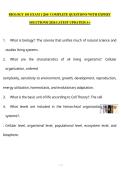
BIOLOGY 101 EXAM 1 |260 COMPLETE QUESTIONS WITH EXPERT
SOLUTIONS| 2026 LATEST UPDATED| A+
1. What is biology?: The science that unifies much of natural science and
studies living systems.
2. What are the characteristics of all living organisms?: Cellular
organization, ordered
complexity, sensitivity to environment, growth, development, reproduction,
energy utilization, homeostasis, and evolutionary adaptation.
3. What is the basic unit of life according to Cell Theory?: The cell.
4. What levels are included in the hierarchical organization of living
systems?-
: Cellular level, organismal level, populational level, ecosystem level, and
biosphere.
,5. What is an emergent property?: A characteristic that arises from the
interaction of components at a higher level of organization and cannot be
deduced by looking at the parts alone.
6. What is the aim of science?: To understand the natural world through
observation and reasoning.
7. What is deductive reasoning?: Using general principles to make specific
predictions.
8. What is inductive reasoning?: Using specific observations to develop
general conclusions.
9. What is a hypothesis?: A possible explanation for an observation that
must be tested for validity. 10. What is the purpose of experiments in
scientific inquiry?: To test hypotheses by carefully designing tests that
isolate one variable at a time.
11. What is the significance of predictions in hypothesis testing?: Predictions
provide a way to test the validity of hypotheses; if results are inconsistent, the
hypothesis must be rejected.
,12. What is reductionism in science?: The approach of breaking complex
processes down into simpler parts.
13. What is systems biology?: An approach that focuses on emergent
properties that cannot be understood by examining simpler parts alone.
14. What distinguishes basic research from applied research?: Basic
research extends knowledge boundaries, while applied research uses that
knowledge for practical applications.
15. Who is Charles Darwin?: A naturalist known for his contributions to the
theory of evolution through natural selection.
16. What is natural selection?: A mechanism for evolution where organisms
better adapted to their environment tend to survive and produce more
offspring.
17. What did Darwin observe about Galápagos Finches?: He noted that
characteristics of similar species varied from place to place, illustrating
'descent with modification.'
, 18. What is the significance of Thomas Malthus's work to Darwin?: Malthus's
ideas on population growth influenced Darwin's understanding of
competition and survival in nature.
19 What evidence supports Darwin's theory of natural selection?: Fossil
records, transitional forms, Earth's age, and comparative anatomy.
20. What are homologous structures?: Structures that share the same
evolutionary origin but differ in function and structure.
21. What are analogous structures?: Structures of different origin that serve
similar purposes, like butterfly and bird wings.
22. What is molecular evidence for evolution?: Comparing genomes or
proteins of different organisms to trace evolutionary history.
23. What are phylogenetic trees?: Diagrams that show the evolutionary
relationships among various biological species based on similarities and
differences in their physical or genetic characteristics.
SOLUTIONS| 2026 LATEST UPDATED| A+
1. What is biology?: The science that unifies much of natural science and
studies living systems.
2. What are the characteristics of all living organisms?: Cellular
organization, ordered
complexity, sensitivity to environment, growth, development, reproduction,
energy utilization, homeostasis, and evolutionary adaptation.
3. What is the basic unit of life according to Cell Theory?: The cell.
4. What levels are included in the hierarchical organization of living
systems?-
: Cellular level, organismal level, populational level, ecosystem level, and
biosphere.
,5. What is an emergent property?: A characteristic that arises from the
interaction of components at a higher level of organization and cannot be
deduced by looking at the parts alone.
6. What is the aim of science?: To understand the natural world through
observation and reasoning.
7. What is deductive reasoning?: Using general principles to make specific
predictions.
8. What is inductive reasoning?: Using specific observations to develop
general conclusions.
9. What is a hypothesis?: A possible explanation for an observation that
must be tested for validity. 10. What is the purpose of experiments in
scientific inquiry?: To test hypotheses by carefully designing tests that
isolate one variable at a time.
11. What is the significance of predictions in hypothesis testing?: Predictions
provide a way to test the validity of hypotheses; if results are inconsistent, the
hypothesis must be rejected.
,12. What is reductionism in science?: The approach of breaking complex
processes down into simpler parts.
13. What is systems biology?: An approach that focuses on emergent
properties that cannot be understood by examining simpler parts alone.
14. What distinguishes basic research from applied research?: Basic
research extends knowledge boundaries, while applied research uses that
knowledge for practical applications.
15. Who is Charles Darwin?: A naturalist known for his contributions to the
theory of evolution through natural selection.
16. What is natural selection?: A mechanism for evolution where organisms
better adapted to their environment tend to survive and produce more
offspring.
17. What did Darwin observe about Galápagos Finches?: He noted that
characteristics of similar species varied from place to place, illustrating
'descent with modification.'
, 18. What is the significance of Thomas Malthus's work to Darwin?: Malthus's
ideas on population growth influenced Darwin's understanding of
competition and survival in nature.
19 What evidence supports Darwin's theory of natural selection?: Fossil
records, transitional forms, Earth's age, and comparative anatomy.
20. What are homologous structures?: Structures that share the same
evolutionary origin but differ in function and structure.
21. What are analogous structures?: Structures of different origin that serve
similar purposes, like butterfly and bird wings.
22. What is molecular evidence for evolution?: Comparing genomes or
proteins of different organisms to trace evolutionary history.
23. What are phylogenetic trees?: Diagrams that show the evolutionary
relationships among various biological species based on similarities and
differences in their physical or genetic characteristics.


