

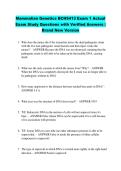
Mammalian Genetics BCH5413 Exam 1 Actual
Exam Study Questions with Verified Answers |
Brand New Version
1. Why does the mouse die if the researcher mixes the dead pathogenic strain
with the live non-pathogenic strain bacteria and then inject it into the
mouse? - ANSWER Because the DNA was not destroyed, meaning that the
pathogenic strain is still able to be taken up by the healthy DNA, causing
death
2. What was the only scenario in which the mouse lives? Why? - ANSWER
When the DNA was completely destroyed; the S strain was no longer able to
be pathogenic without its DNA
3. How many angstroms is the distance between stacked base pairs in DNA? -
ANSWER 3.4 A
4. What year was the structure of DNA discovered? - ANSWER 1953
5. T/F: Eukaryotic DNA in the nucleus of cells will not supercoil since it's
liner. - ANSWER False (linear DNA can be supercoiled if in a cell because
of its association with proteins)
6. T/F: Linear DNA in a test tube (no other substances present) is able to be
supercoiled. - ANSWER False (it needs the presence of other cellular
components to supercoil)
7. The type of supercoil in which DNA is twisted more tightly in the right-hand
direction - ANSWER Positive supercoil
,8. The type of supercoil in which DNA is twisted more loosely in the left-hand
direction - ANSWER Negative supercoil
9. Which type of supercoil allows the DNA to be more accessible for
replication and transcription? - ANSWER Negative supercoil
10.T/F: GC-rich DNA has a lower melting temperature than AT-rich DNA. -
ANSWER False (GC-rich DNA has more hydrogen bonds and is more
stable, giving it a higher melting temperature)
11.T/F: Chargaff's rule is that A=G and T=C. - ANSWER False (A = T and G
= C; the amount of purines and pyrimidines in DNA will always be equal;
A+G = C+T)
12.T/F: Increased salt concentration increases the stability of complimentary
base pairing. - ANSWER True (this cancels out the phosphate's negative
charge allowing for a more stable interaction of the DNA backbone)
13.What is the name of the most common ("normal") form of DNA? -
ANSWER B-DNA
14.B-DNA has how many bps per helical turn? - ANSWER 10 bp
15.Is A-DNA or Z-DNA a right-handed helix? - ANSWER A-DNA
16.Which type of DNA is favored by GC repeats and alternating
purines/pyrimidines? - ANSWER Z-DNA
,17.Which type of DNA is favored by AT-rich areas of fragile DNA? -
ANSWER Cruciform DNA
18.Is A-DNA or Z-DNA the dehydrated form? - ANSWER A-DNA (has a
looser structure)
19.How did Wilkins and Franklin contribute to the discovery of DNA's
structure? - ANSWER They did x-ray crystallography to discover the "X"
helix pattern of DNA
20.What are the 3 components of a nucleotide? - ANSWER A phosphate, a 5-C
sugar, and a nitrogenous base
21.How did Watson and Crick contribute to the discovery of DNA's structure? -
ANSWER They made a model of the structure of helical DNA using others'
previous research
22.What is attached to the 1' C in DNA's 5-C sugar? - ANSWER A
nitrogenous base (A, G, T, or C)
23.Which bases are the purines? - ANSWER A and G
24.Which bases are the pyrimidines? - ANSWER C, T, and U
25.T/F: Purines have a double-ring structure while pyrimidines have a single-
ring structure. - ANSWER True
26.What is attached to the 2' C in DNA's 5-C sugar? - ANSWER An -H group
(if DNA) or an -OH group (if RNA)
, 27.What is attached to the 3' C in DNA's 5-C sugar? - ANSWER An -OH
group (will interact with the phosphate on the 5' C of the next nucleotide)
28.What is attached to the 4' C in DNA's 5-C sugar? - ANSWER It completes
the ring structure (connects the 5' C and 3' C to the oxygen in the ring)
29.What is attached to the 5' C in DNA's 5-C sugar? - ANSWER A phosphate
group (will interact with the -OH group on the 3' C of the next nucleotide)
30.What gives DNA its (-) charge? - ANSWER The phosphate group losing an
oxygen in water
31.Why does DNA have directionality? - ANSWER It connects from
phosphate group -> -OH group -> phosphate group, etc. (never backwards),
which allows the nitrogenous bases to hydrogen bond
32.What does it mean that DNA is antiparallel? - ANSWER One single-strand
of DNA is 5' -> 3' and the other strand it connects to is 3' -> 5' (the strands
do not connect in the same direction to form dsDNA)
33.What does the Meselson and Stahl experiment (1958) confirm? - ANSWER
That DNA replication is semiconservative (the parent strand unzips to allow
for synthesis of a new strand)
34.T/F: The major groove in DNA's structure allows for more specificity in
binding proteins. - ANSWER True (the presence of 4 bps instead of 3 bps
like in the minor groove allows for a more unique pattern of binding)
Exam Study Questions with Verified Answers |
Brand New Version
1. Why does the mouse die if the researcher mixes the dead pathogenic strain
with the live non-pathogenic strain bacteria and then inject it into the
mouse? - ANSWER Because the DNA was not destroyed, meaning that the
pathogenic strain is still able to be taken up by the healthy DNA, causing
death
2. What was the only scenario in which the mouse lives? Why? - ANSWER
When the DNA was completely destroyed; the S strain was no longer able to
be pathogenic without its DNA
3. How many angstroms is the distance between stacked base pairs in DNA? -
ANSWER 3.4 A
4. What year was the structure of DNA discovered? - ANSWER 1953
5. T/F: Eukaryotic DNA in the nucleus of cells will not supercoil since it's
liner. - ANSWER False (linear DNA can be supercoiled if in a cell because
of its association with proteins)
6. T/F: Linear DNA in a test tube (no other substances present) is able to be
supercoiled. - ANSWER False (it needs the presence of other cellular
components to supercoil)
7. The type of supercoil in which DNA is twisted more tightly in the right-hand
direction - ANSWER Positive supercoil
,8. The type of supercoil in which DNA is twisted more loosely in the left-hand
direction - ANSWER Negative supercoil
9. Which type of supercoil allows the DNA to be more accessible for
replication and transcription? - ANSWER Negative supercoil
10.T/F: GC-rich DNA has a lower melting temperature than AT-rich DNA. -
ANSWER False (GC-rich DNA has more hydrogen bonds and is more
stable, giving it a higher melting temperature)
11.T/F: Chargaff's rule is that A=G and T=C. - ANSWER False (A = T and G
= C; the amount of purines and pyrimidines in DNA will always be equal;
A+G = C+T)
12.T/F: Increased salt concentration increases the stability of complimentary
base pairing. - ANSWER True (this cancels out the phosphate's negative
charge allowing for a more stable interaction of the DNA backbone)
13.What is the name of the most common ("normal") form of DNA? -
ANSWER B-DNA
14.B-DNA has how many bps per helical turn? - ANSWER 10 bp
15.Is A-DNA or Z-DNA a right-handed helix? - ANSWER A-DNA
16.Which type of DNA is favored by GC repeats and alternating
purines/pyrimidines? - ANSWER Z-DNA
,17.Which type of DNA is favored by AT-rich areas of fragile DNA? -
ANSWER Cruciform DNA
18.Is A-DNA or Z-DNA the dehydrated form? - ANSWER A-DNA (has a
looser structure)
19.How did Wilkins and Franklin contribute to the discovery of DNA's
structure? - ANSWER They did x-ray crystallography to discover the "X"
helix pattern of DNA
20.What are the 3 components of a nucleotide? - ANSWER A phosphate, a 5-C
sugar, and a nitrogenous base
21.How did Watson and Crick contribute to the discovery of DNA's structure? -
ANSWER They made a model of the structure of helical DNA using others'
previous research
22.What is attached to the 1' C in DNA's 5-C sugar? - ANSWER A
nitrogenous base (A, G, T, or C)
23.Which bases are the purines? - ANSWER A and G
24.Which bases are the pyrimidines? - ANSWER C, T, and U
25.T/F: Purines have a double-ring structure while pyrimidines have a single-
ring structure. - ANSWER True
26.What is attached to the 2' C in DNA's 5-C sugar? - ANSWER An -H group
(if DNA) or an -OH group (if RNA)
, 27.What is attached to the 3' C in DNA's 5-C sugar? - ANSWER An -OH
group (will interact with the phosphate on the 5' C of the next nucleotide)
28.What is attached to the 4' C in DNA's 5-C sugar? - ANSWER It completes
the ring structure (connects the 5' C and 3' C to the oxygen in the ring)
29.What is attached to the 5' C in DNA's 5-C sugar? - ANSWER A phosphate
group (will interact with the -OH group on the 3' C of the next nucleotide)
30.What gives DNA its (-) charge? - ANSWER The phosphate group losing an
oxygen in water
31.Why does DNA have directionality? - ANSWER It connects from
phosphate group -> -OH group -> phosphate group, etc. (never backwards),
which allows the nitrogenous bases to hydrogen bond
32.What does it mean that DNA is antiparallel? - ANSWER One single-strand
of DNA is 5' -> 3' and the other strand it connects to is 3' -> 5' (the strands
do not connect in the same direction to form dsDNA)
33.What does the Meselson and Stahl experiment (1958) confirm? - ANSWER
That DNA replication is semiconservative (the parent strand unzips to allow
for synthesis of a new strand)
34.T/F: The major groove in DNA's structure allows for more specificity in
binding proteins. - ANSWER True (the presence of 4 bps instead of 3 bps
like in the minor groove allows for a more unique pattern of binding)


