

UHC Ethics and Compliance:
Universal Mastery Test Bank
PART 0: THE NAVIGATOR
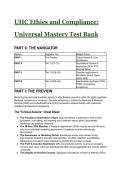
Section Cognitive Tier Subject Focus
PART I The Preview Critical Axioms & Core
Architecture
PART II Tier 1 (Q1–15) Foundational Syntax &
Application (SOA, PTC,
Nominal Value)
PART II Tier 2 (Q16–35) Complex Application &
Simulation (Event Types,
LEAN, AEP)
PART II Tier 3 (Q36–60) Grandmaster Synthesis (FWA,
TPMO, Compliance
Exceptions)
PART I: THE PREVIEW
Mastering this test bank translates directly to elite, flawless execution within the highly regulated
Medicare compliance environment. Absolute adherence to Centers for Medicare & Medicaid
Services (CMS) and UnitedHealthcare (UHC) frameworks replaces liability with systematic,
bulletproof professional competence.
The "Critical Axioms" Cheat Sheet
● The Principle of Unsolicited Contact: Inbound initiation is paramount. Door-to-door
solicitation, cold-calling, and reaching out to referrals without direct, documented
permission are absolute violations.
● The 48-Hour SOA Mandate: A Scope of Appointment (SOA) must be secured 48 hours
prior to an individual marketing appointment. Exceptions must be meticulously
documented.
● The Educational vs. Marketing Divide: Educational events must remain strictly
informational; marketing activities, plan specifics, and SOA collection are forbidden.
Marketing events permit sales activities but prohibit the provision of meals.
● The Profit & Incentive Restriction: Gifts and promotional items must never exceed a
nominal retail value of $15 per individual item ($75 annual aggregate) and must be offered
universally.
● The Integrity of Informed Consent: Signatures executed by a Power of Attorney (POA)
, are legally void unless explicitly supported by documented state authority presented upon
request.
PART II: THE ELITE TEST BANK
Tier 1: Foundational Syntax & Application
Q1: A licensed agent schedules a personal marketing appointment to discuss Medicare
Advantage plans with a prospect. Based on CMS compliance frameworks, WHEN is the
absolute latest the Scope of Appointment (SOA) must generally be obtained? A) Immediately
following the conclusion of the marketing presentation. B) At the exact moment the agent greets
the consumer at their residence. C) No less than 48 hours before the marketing appointment. D)
Simultaneously with the signing of the enrollment application.
● The Answer: C (No less than 48 hours before the marketing appointment.)
● Distractor Analysis:
○ A is incorrect: Post-presentation SOA collection violates the fundamental purpose
of scoping, which is to govern boundaries before the presentation begins.
○ B is incorrect: While walk-in exceptions exist, the general mandate dictates a
48-hour cooling-off window.
○ D is incorrect: Securing the SOA at the point of enrollment nullifies consumer
protection protocols.
The Mentor's Analysis: The SOA is a preemptive shield, not a retroactive formality. It protects
the consumer from high-pressure cross-selling tactics by defining parameters in advance.
Professional/Academic Intuition: Always secure the operational perimeter 48 hours in
advance unless an explicit exception applies.
Q2: An agent intends to provide a promotional giveaway at an upcoming formal marketing
event. To maintain compliance with CMS nominal value regulations, which action is MOST
APPROPRIATE? A) Offering a $20 gift card to a local pharmacy for attendees who complete an
application. B) Distributing a $12 branded calendar to every attendee regardless of enrollment.
C) Providing a free blood pressure screening valued at $15. D) Raffling a single $50 cash prize
at the end of the seminar.
● The Answer: B (Distributing a $12 branded calendar to every attendee regardless of
enrollment.)
● Distractor Analysis:
○ A is incorrect: Gift cards tied to enrollment constitute an illegal inducement and
exceed the $15 threshold.
○ C is incorrect: Health screenings are strictly prohibited as giveaways at marketing
events.
○ D is incorrect: Cash or cash equivalents of any amount are fundamentally
prohibited.
The Mentor's Analysis: Incentives must be universally accessible and devoid of steering
mechanisms. The $15 nominal value threshold is a strict cap to prevent bribery.
Professional/Academic Intuition: Nominal value equals $15 or less, offered universally,
and never as cash or health benefits.
Q3: A consumer returns a Business Reply Card (BRC) indicating interest in a Prescription Drug
Plan (PDP). The agent receives the BRC and initiates a phone call. Based on Permission to Call
(PTC) guidelines, what is the agent PERMITTED to do? A) Pitch both the requested PDP and a
, Medicare Supplement plan to ensure comprehensive coverage. B) Use the call to schedule an
appointment specifically to discuss the PDP requested on the BRC. C) Ask the consumer for the
phone numbers of three friends who might also need a PDP. D) Enroll the consumer over the
phone without verifying Medicare eligibility.
● The Answer: B (Use the call to schedule an appointment specifically to discuss the PDP
requested on the BRC.)
● Distractor Analysis:
○ A is incorrect: PTC is explicitly limited to the product scope defined on the BRC.
Pitching a Supplement is a violation.
○ C is incorrect: Soliciting phone numbers for outbound referral calls constitutes
unsolicited contact.
○ D is incorrect: Eligibility verification is a prerequisite for any enrollment.
The Mentor's Analysis: A Business Reply Card grants narrow, product-specific access. It is not
an open-ended invitation to canvas a prospect's entire portfolio. Professional/Academic
Intuition: Permission to Call is strictly confined to the explicit parameters authorized by
the consumer.
Q4: An agent wishes to grow their business by leveraging existing client networks. Which
method of lead generation is STRICTLY PROHIBITED under the unsolicited contact
framework? A) Mailing a generic, branded postcard to a purchased list of zip codes. B) Leaving
a business card at a client's home after they failed to show up for a scheduled appointment. C)
Calling a current client to inform them of an upcoming educational event. D) Calling the
neighbor of a current client after the client provides the neighbor's phone number as a referral.
● The Answer: D (Calling the neighbor of a current client after the client provides the
neighbor's phone number as a referral.)
● Distractor Analysis:
○ A is incorrect: Direct postal mail is explicitly permitted as generic marketing.
○ B is incorrect: Leaving information after a "no-show" for a pre-scheduled
appointment is compliant.
○ C is incorrect: Agents may call current enrollees to discuss educational events.
The Mentor's Analysis: Referrals require the referred individual to initiate the contact.
Outbound calling to a referral without prior consent is cold-calling. Professional/Academic
Intuition: A referral provides a name, but it does not provide Permission to Call.
Q5: During the completion of a LEAN application, the consumer states they lack an email
address. What is the REQUIRED action regarding the email field? A) Enter the agent's email
address to ensure correspondence is tracked. B) Enter a generic, system-generated email
address. C) Leave the consumer email address field entirely blank. D) Require the consumer to
create an email account before proceeding.
● The Answer: C (Leave the consumer email address field entirely blank.)
● Distractor Analysis:
○ A is incorrect: Entering an agent's email diverts legally mandated correspondence
away from the member.
○ B is incorrect: Falsifying data fields corrupts the integrity of the enrollment
database.
○ D is incorrect: Digital access cannot be used as a barrier to Medicare enrollment.
The Mentor's Analysis: The application must perfectly reflect the consumer's reality. If a data
point does not exist, it must remain blank. Professional/Academic Intuition: Never substitute
agent data for consumer data within an enrollment application.
Q6: Which of the following activities is explicitly ALLOWED during an event advertised strictly
Universal Mastery Test Bank
PART 0: THE NAVIGATOR
Section Cognitive Tier Subject Focus
PART I The Preview Critical Axioms & Core
Architecture
PART II Tier 1 (Q1–15) Foundational Syntax &
Application (SOA, PTC,
Nominal Value)
PART II Tier 2 (Q16–35) Complex Application &
Simulation (Event Types,
LEAN, AEP)
PART II Tier 3 (Q36–60) Grandmaster Synthesis (FWA,
TPMO, Compliance
Exceptions)
PART I: THE PREVIEW
Mastering this test bank translates directly to elite, flawless execution within the highly regulated
Medicare compliance environment. Absolute adherence to Centers for Medicare & Medicaid
Services (CMS) and UnitedHealthcare (UHC) frameworks replaces liability with systematic,
bulletproof professional competence.
The "Critical Axioms" Cheat Sheet
● The Principle of Unsolicited Contact: Inbound initiation is paramount. Door-to-door
solicitation, cold-calling, and reaching out to referrals without direct, documented
permission are absolute violations.
● The 48-Hour SOA Mandate: A Scope of Appointment (SOA) must be secured 48 hours
prior to an individual marketing appointment. Exceptions must be meticulously
documented.
● The Educational vs. Marketing Divide: Educational events must remain strictly
informational; marketing activities, plan specifics, and SOA collection are forbidden.
Marketing events permit sales activities but prohibit the provision of meals.
● The Profit & Incentive Restriction: Gifts and promotional items must never exceed a
nominal retail value of $15 per individual item ($75 annual aggregate) and must be offered
universally.
● The Integrity of Informed Consent: Signatures executed by a Power of Attorney (POA)
, are legally void unless explicitly supported by documented state authority presented upon
request.
PART II: THE ELITE TEST BANK
Tier 1: Foundational Syntax & Application
Q1: A licensed agent schedules a personal marketing appointment to discuss Medicare
Advantage plans with a prospect. Based on CMS compliance frameworks, WHEN is the
absolute latest the Scope of Appointment (SOA) must generally be obtained? A) Immediately
following the conclusion of the marketing presentation. B) At the exact moment the agent greets
the consumer at their residence. C) No less than 48 hours before the marketing appointment. D)
Simultaneously with the signing of the enrollment application.
● The Answer: C (No less than 48 hours before the marketing appointment.)
● Distractor Analysis:
○ A is incorrect: Post-presentation SOA collection violates the fundamental purpose
of scoping, which is to govern boundaries before the presentation begins.
○ B is incorrect: While walk-in exceptions exist, the general mandate dictates a
48-hour cooling-off window.
○ D is incorrect: Securing the SOA at the point of enrollment nullifies consumer
protection protocols.
The Mentor's Analysis: The SOA is a preemptive shield, not a retroactive formality. It protects
the consumer from high-pressure cross-selling tactics by defining parameters in advance.
Professional/Academic Intuition: Always secure the operational perimeter 48 hours in
advance unless an explicit exception applies.
Q2: An agent intends to provide a promotional giveaway at an upcoming formal marketing
event. To maintain compliance with CMS nominal value regulations, which action is MOST
APPROPRIATE? A) Offering a $20 gift card to a local pharmacy for attendees who complete an
application. B) Distributing a $12 branded calendar to every attendee regardless of enrollment.
C) Providing a free blood pressure screening valued at $15. D) Raffling a single $50 cash prize
at the end of the seminar.
● The Answer: B (Distributing a $12 branded calendar to every attendee regardless of
enrollment.)
● Distractor Analysis:
○ A is incorrect: Gift cards tied to enrollment constitute an illegal inducement and
exceed the $15 threshold.
○ C is incorrect: Health screenings are strictly prohibited as giveaways at marketing
events.
○ D is incorrect: Cash or cash equivalents of any amount are fundamentally
prohibited.
The Mentor's Analysis: Incentives must be universally accessible and devoid of steering
mechanisms. The $15 nominal value threshold is a strict cap to prevent bribery.
Professional/Academic Intuition: Nominal value equals $15 or less, offered universally,
and never as cash or health benefits.
Q3: A consumer returns a Business Reply Card (BRC) indicating interest in a Prescription Drug
Plan (PDP). The agent receives the BRC and initiates a phone call. Based on Permission to Call
(PTC) guidelines, what is the agent PERMITTED to do? A) Pitch both the requested PDP and a
, Medicare Supplement plan to ensure comprehensive coverage. B) Use the call to schedule an
appointment specifically to discuss the PDP requested on the BRC. C) Ask the consumer for the
phone numbers of three friends who might also need a PDP. D) Enroll the consumer over the
phone without verifying Medicare eligibility.
● The Answer: B (Use the call to schedule an appointment specifically to discuss the PDP
requested on the BRC.)
● Distractor Analysis:
○ A is incorrect: PTC is explicitly limited to the product scope defined on the BRC.
Pitching a Supplement is a violation.
○ C is incorrect: Soliciting phone numbers for outbound referral calls constitutes
unsolicited contact.
○ D is incorrect: Eligibility verification is a prerequisite for any enrollment.
The Mentor's Analysis: A Business Reply Card grants narrow, product-specific access. It is not
an open-ended invitation to canvas a prospect's entire portfolio. Professional/Academic
Intuition: Permission to Call is strictly confined to the explicit parameters authorized by
the consumer.
Q4: An agent wishes to grow their business by leveraging existing client networks. Which
method of lead generation is STRICTLY PROHIBITED under the unsolicited contact
framework? A) Mailing a generic, branded postcard to a purchased list of zip codes. B) Leaving
a business card at a client's home after they failed to show up for a scheduled appointment. C)
Calling a current client to inform them of an upcoming educational event. D) Calling the
neighbor of a current client after the client provides the neighbor's phone number as a referral.
● The Answer: D (Calling the neighbor of a current client after the client provides the
neighbor's phone number as a referral.)
● Distractor Analysis:
○ A is incorrect: Direct postal mail is explicitly permitted as generic marketing.
○ B is incorrect: Leaving information after a "no-show" for a pre-scheduled
appointment is compliant.
○ C is incorrect: Agents may call current enrollees to discuss educational events.
The Mentor's Analysis: Referrals require the referred individual to initiate the contact.
Outbound calling to a referral without prior consent is cold-calling. Professional/Academic
Intuition: A referral provides a name, but it does not provide Permission to Call.
Q5: During the completion of a LEAN application, the consumer states they lack an email
address. What is the REQUIRED action regarding the email field? A) Enter the agent's email
address to ensure correspondence is tracked. B) Enter a generic, system-generated email
address. C) Leave the consumer email address field entirely blank. D) Require the consumer to
create an email account before proceeding.
● The Answer: C (Leave the consumer email address field entirely blank.)
● Distractor Analysis:
○ A is incorrect: Entering an agent's email diverts legally mandated correspondence
away from the member.
○ B is incorrect: Falsifying data fields corrupts the integrity of the enrollment
database.
○ D is incorrect: Digital access cannot be used as a barrier to Medicare enrollment.
The Mentor's Analysis: The application must perfectly reflect the consumer's reality. If a data
point does not exist, it must remain blank. Professional/Academic Intuition: Never substitute
agent data for consumer data within an enrollment application.
Q6: Which of the following activities is explicitly ALLOWED during an event advertised strictly


