

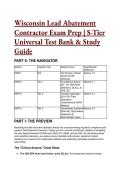
Wisconsin Lead Abatement
Contractor Exam Prep | S-Tier
Universal Test Bank & Study
Guide
PART 0: THE NAVIGATOR
Section Cognitive Tier Subject Focus Page/Section
Reference
PART I N/A The Preview: Critical Section 1.0
Axioms & Elite
Directives
PART II Tier 1 Foundational Syntax Section 2.1
(Q1–15): Hard Deck
Definitions, DLALs, &
DHS 163
PART II Tier 2 Complex Application Section 2.2
(Q16–35): Field
Operations,
Containment & OSHA
Matrices
PART II Tier 3 Grandmaster Synthesis Section 2.3
(Q36–60): High-Stakes
Abatement &
Multi-Variable Crises
PART I: THE PREVIEW
Mastering this elite test bank translates directly into uncompromising regulatory compliance and
superior field abatement execution, forging you into a top-tier practitioner capable of navigating
the strict legal frameworks of Wisconsin DHS 163, OSHA, and the EPA. By internalizing these
sixty analytical scenarios, you replace novice hesitation with precise, academic intuition,
shielding your practice from catastrophic liabilities and protecting vulnerable populations from
lead toxicity.
The "Critical Axioms" Cheat Sheet
● The 2026 EPA Dust-Lead Action Levels (DLAL): Post-abatement clearance strictly
, requires dust-lead levels to be below 5 µg/ft² for floors, 40 µg/ft² for interior windowsills,
and 100 µg/ft² for window troughs.
● The 2-Day DHS 163 Notification Mandate: An original written notice of abatement must
be received by the Wisconsin Department of Health Services (DHS) a minimum of 2
working days BEFORE the start of regulated activity.
● The 50/30 OSHA Matrix: The Permissible Exposure Limit (PEL) is 50 µg/m³; the Action
Level (AL) is 30 µg/m³. Medical removal for construction workers triggers immediately at a
blood lead level (BLL) of 50 µg/dL.
● The 1-Hour Settling Axiom: Following final cleaning, a mandatory minimum of 1 hour
must elapse before conducting clearance dust-wipe sampling. The cleaning sequence
must always be "ceiling to floor, and out the door".
● The 5.0 mg/L TCLP Threshold: Under the Toxicity Characteristic Leaching Procedure
(TCLP), any waste stream leaching lead at or above 5.0 mg/L is classified as a
Characteristic Hazardous Waste (D008) and cannot be disposed of as standard
construction debris.
PART II: THE ELITE TEST BANK
Section 2.1: Tier 1 - Foundational Syntax & Application
Q1: A certified lead abatement supervisor completes final cleaning on an interior abatement
project in a pre-1978 child-occupied facility. Under the fully implemented 2026 EPA standards,
what is the maximum allowable dust-lead concentration for an interior floor to pass clearance?
Based on the principles of Wisconsin DHS 163 and EPA standards, which conclusion is the
MOST ACCURATE? A) Less than 10 µg/ft² B) Less than 40 µg/ft² C) Less than 5 µg/ft² D) Any
detectable reportable level
● The Answer: C (Less than 5 µg/ft²)
● Distractor Analysis:
○ A is incorrect: This is the outdated legacy standard utilized prior to the 2025/2026
EPA rule revisions.
○ B is incorrect: This represents the new 2026 standard for interior windowsills, not
floors.
○ D is incorrect: "Any reportable level" refers to the new Dust-Lead Reportable Level
(DLRL) used to define a hazard during a risk assessment, not the Dust-Lead Action
Level (DLAL) used for post-abatement clearance.
The Mentor's Analysis: The 2026 regulatory framework severely tightened the tolerances for
residual lead dust. Clearance is a binary pass/fail mechanism governed by the Dust-Lead Action
Level (DLAL). Professional/Academic Intuition: Floors = 5, Sills = 40, Troughs = 100.
Memorize this 2026 matrix; utilizing legacy clearance numbers exposes the contractor to
massive regulatory liability and jeopardizes occupant health.
Q2: A contractor plans to begin a scheduled lead abatement project on a Thursday morning. To
comply with Wisconsin DHS 163, when is the LATEST the Department of Health Services can
officially receive the original written notice of abatement? A) Monday by 4:00 p.m. B) Tuesday
by 4:00 p.m. C) Wednesday by 12:00 p.m. D) Seven calendar days prior to the start date.
● The Answer: A (Monday by 4:00 p.m.)
● Distractor Analysis:
○ B is incorrect: Receiving it on Tuesday leaves only Wednesday as a full working
, day before a Thursday start, violating the "not less than 2 working days" rule.
○ C is incorrect: The department requires two full working days. A notice received
after 4:00 p.m. is stamped as received on the next working day.
○ D is incorrect: Seven days is a legacy EPA RRP pre-education pamphlet timeline,
not the DHS 163 abatement notification timeline.
The Mentor's Analysis: Administrative compliance is as critical as physical containment. DHS
163 requires a minimum of 2 working days' notice prior to the start date. Days are calculated
Monday through Friday, excluding state holidays, with a hard 4:00 p.m. cutoff.
Professional/Academic Intuition: Count backward two full business days from the project
start date; if you miss the 4:00 p.m. cutoff, your legal timeline shifts entirely.
Q3: During exterior lead abatement, a worker prepares to strip deteriorated lead-based paint
from wood siding. Based on Wisconsin DHS 163 prohibited practices, which action is
STRICTLY PROHIBITED? A) Utilizing wet scraping in conjunction with a misting bottle. B)
Operating a heat gun on the paint at a temperature of 1150° F. C) Using a chemical paint
stripper devoid of methylene chloride. D) Machine sanding using an orbital sander equipped
with a HEPA-filtered exhaust control.
● The Answer: B (Operating a heat gun on the paint at a temperature of 1150° F.)
● Distractor Analysis:
○ A is incorrect: "Working wet" is an industry-standard, heavily encouraged safe work
practice.
○ C is incorrect: Chemical strippers are permitted provided they do not contain
methylene chloride.
○ D is incorrect: Machine sanding is permitted only if the tool is shrouded and directly
attached to a functioning HEPA vacuum system.
The Mentor's Analysis: Heat guns operating at or above 1100° F volatilize lead, converting
solid particulate into highly toxic, easily inhalable lead fumes that defeat standard P100
particulate respirators. Professional/Academic Intuition: Thermal paint removal must
NEVER meet or exceed 1100° F. Fumes bypass standard particulate filters and rapidly
elevate worker blood lead levels.
Q4: An abatement company generates 500 pounds of architectural debris coated in lead-based
paint. The waste undergoes a Toxicity Characteristic Leaching Procedure (TCLP). The
laboratory reports a lead leaching result of 6.2 mg/L. Based on RCRA and Wisconsin DNR
regulations, what is the MOST APPROPRIATE classification for this waste? A) Standard
Construction and Demolition (C&D) Waste. B) Listed Hazardous Waste (F-Code). C)
Characteristic Hazardous Waste (D008). D) Universal Waste.
● The Answer: C (Characteristic Hazardous Waste (D008).)
● Distractor Analysis:
○ A is incorrect: Because the waste exceeds the 5.0 mg/L TCLP limit, it cannot be
legally disposed of in a standard C&D landfill.
○ B is incorrect: Lead abatement debris is generally characteristic, not "listed" (like
specific industrial manufacturing solvents or methylene chloride).
○ D is incorrect: Universal waste applies to items like intact batteries, fluorescent
lamps, and certain intact CRTs, not bulk lead-painted architectural debris.
The Mentor's Analysis: Waste characterization dictates the financial and logistical trajectory of
disposal. The TCLP test measures the potential for a contaminant to leach into groundwater.
The absolute regulatory threshold for lead is 5.0 mg/L. Professional/Academic Intuition: A
TCLP result ≥ 5.0 mg/L legally transforms standard debris into D008 Characteristic
Hazardous Waste.
Contractor Exam Prep | S-Tier
Universal Test Bank & Study
Guide
PART 0: THE NAVIGATOR
Section Cognitive Tier Subject Focus Page/Section
Reference
PART I N/A The Preview: Critical Section 1.0
Axioms & Elite
Directives
PART II Tier 1 Foundational Syntax Section 2.1
(Q1–15): Hard Deck
Definitions, DLALs, &
DHS 163
PART II Tier 2 Complex Application Section 2.2
(Q16–35): Field
Operations,
Containment & OSHA
Matrices
PART II Tier 3 Grandmaster Synthesis Section 2.3
(Q36–60): High-Stakes
Abatement &
Multi-Variable Crises
PART I: THE PREVIEW
Mastering this elite test bank translates directly into uncompromising regulatory compliance and
superior field abatement execution, forging you into a top-tier practitioner capable of navigating
the strict legal frameworks of Wisconsin DHS 163, OSHA, and the EPA. By internalizing these
sixty analytical scenarios, you replace novice hesitation with precise, academic intuition,
shielding your practice from catastrophic liabilities and protecting vulnerable populations from
lead toxicity.
The "Critical Axioms" Cheat Sheet
● The 2026 EPA Dust-Lead Action Levels (DLAL): Post-abatement clearance strictly
, requires dust-lead levels to be below 5 µg/ft² for floors, 40 µg/ft² for interior windowsills,
and 100 µg/ft² for window troughs.
● The 2-Day DHS 163 Notification Mandate: An original written notice of abatement must
be received by the Wisconsin Department of Health Services (DHS) a minimum of 2
working days BEFORE the start of regulated activity.
● The 50/30 OSHA Matrix: The Permissible Exposure Limit (PEL) is 50 µg/m³; the Action
Level (AL) is 30 µg/m³. Medical removal for construction workers triggers immediately at a
blood lead level (BLL) of 50 µg/dL.
● The 1-Hour Settling Axiom: Following final cleaning, a mandatory minimum of 1 hour
must elapse before conducting clearance dust-wipe sampling. The cleaning sequence
must always be "ceiling to floor, and out the door".
● The 5.0 mg/L TCLP Threshold: Under the Toxicity Characteristic Leaching Procedure
(TCLP), any waste stream leaching lead at or above 5.0 mg/L is classified as a
Characteristic Hazardous Waste (D008) and cannot be disposed of as standard
construction debris.
PART II: THE ELITE TEST BANK
Section 2.1: Tier 1 - Foundational Syntax & Application
Q1: A certified lead abatement supervisor completes final cleaning on an interior abatement
project in a pre-1978 child-occupied facility. Under the fully implemented 2026 EPA standards,
what is the maximum allowable dust-lead concentration for an interior floor to pass clearance?
Based on the principles of Wisconsin DHS 163 and EPA standards, which conclusion is the
MOST ACCURATE? A) Less than 10 µg/ft² B) Less than 40 µg/ft² C) Less than 5 µg/ft² D) Any
detectable reportable level
● The Answer: C (Less than 5 µg/ft²)
● Distractor Analysis:
○ A is incorrect: This is the outdated legacy standard utilized prior to the 2025/2026
EPA rule revisions.
○ B is incorrect: This represents the new 2026 standard for interior windowsills, not
floors.
○ D is incorrect: "Any reportable level" refers to the new Dust-Lead Reportable Level
(DLRL) used to define a hazard during a risk assessment, not the Dust-Lead Action
Level (DLAL) used for post-abatement clearance.
The Mentor's Analysis: The 2026 regulatory framework severely tightened the tolerances for
residual lead dust. Clearance is a binary pass/fail mechanism governed by the Dust-Lead Action
Level (DLAL). Professional/Academic Intuition: Floors = 5, Sills = 40, Troughs = 100.
Memorize this 2026 matrix; utilizing legacy clearance numbers exposes the contractor to
massive regulatory liability and jeopardizes occupant health.
Q2: A contractor plans to begin a scheduled lead abatement project on a Thursday morning. To
comply with Wisconsin DHS 163, when is the LATEST the Department of Health Services can
officially receive the original written notice of abatement? A) Monday by 4:00 p.m. B) Tuesday
by 4:00 p.m. C) Wednesday by 12:00 p.m. D) Seven calendar days prior to the start date.
● The Answer: A (Monday by 4:00 p.m.)
● Distractor Analysis:
○ B is incorrect: Receiving it on Tuesday leaves only Wednesday as a full working
, day before a Thursday start, violating the "not less than 2 working days" rule.
○ C is incorrect: The department requires two full working days. A notice received
after 4:00 p.m. is stamped as received on the next working day.
○ D is incorrect: Seven days is a legacy EPA RRP pre-education pamphlet timeline,
not the DHS 163 abatement notification timeline.
The Mentor's Analysis: Administrative compliance is as critical as physical containment. DHS
163 requires a minimum of 2 working days' notice prior to the start date. Days are calculated
Monday through Friday, excluding state holidays, with a hard 4:00 p.m. cutoff.
Professional/Academic Intuition: Count backward two full business days from the project
start date; if you miss the 4:00 p.m. cutoff, your legal timeline shifts entirely.
Q3: During exterior lead abatement, a worker prepares to strip deteriorated lead-based paint
from wood siding. Based on Wisconsin DHS 163 prohibited practices, which action is
STRICTLY PROHIBITED? A) Utilizing wet scraping in conjunction with a misting bottle. B)
Operating a heat gun on the paint at a temperature of 1150° F. C) Using a chemical paint
stripper devoid of methylene chloride. D) Machine sanding using an orbital sander equipped
with a HEPA-filtered exhaust control.
● The Answer: B (Operating a heat gun on the paint at a temperature of 1150° F.)
● Distractor Analysis:
○ A is incorrect: "Working wet" is an industry-standard, heavily encouraged safe work
practice.
○ C is incorrect: Chemical strippers are permitted provided they do not contain
methylene chloride.
○ D is incorrect: Machine sanding is permitted only if the tool is shrouded and directly
attached to a functioning HEPA vacuum system.
The Mentor's Analysis: Heat guns operating at or above 1100° F volatilize lead, converting
solid particulate into highly toxic, easily inhalable lead fumes that defeat standard P100
particulate respirators. Professional/Academic Intuition: Thermal paint removal must
NEVER meet or exceed 1100° F. Fumes bypass standard particulate filters and rapidly
elevate worker blood lead levels.
Q4: An abatement company generates 500 pounds of architectural debris coated in lead-based
paint. The waste undergoes a Toxicity Characteristic Leaching Procedure (TCLP). The
laboratory reports a lead leaching result of 6.2 mg/L. Based on RCRA and Wisconsin DNR
regulations, what is the MOST APPROPRIATE classification for this waste? A) Standard
Construction and Demolition (C&D) Waste. B) Listed Hazardous Waste (F-Code). C)
Characteristic Hazardous Waste (D008). D) Universal Waste.
● The Answer: C (Characteristic Hazardous Waste (D008).)
● Distractor Analysis:
○ A is incorrect: Because the waste exceeds the 5.0 mg/L TCLP limit, it cannot be
legally disposed of in a standard C&D landfill.
○ B is incorrect: Lead abatement debris is generally characteristic, not "listed" (like
specific industrial manufacturing solvents or methylene chloride).
○ D is incorrect: Universal waste applies to items like intact batteries, fluorescent
lamps, and certain intact CRTs, not bulk lead-painted architectural debris.
The Mentor's Analysis: Waste characterization dictates the financial and logistical trajectory of
disposal. The TCLP test measures the potential for a contaminant to leach into groundwater.
The absolute regulatory threshold for lead is 5.0 mg/L. Professional/Academic Intuition: A
TCLP result ≥ 5.0 mg/L legally transforms standard debris into D008 Characteristic
Hazardous Waste.


