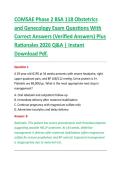
COMSAE Phase 2 BSA 118 Obstetrics
and Gynecology Exam Questions With
Correct Answers (Verified Answers) Plus
Rationales 2026 Q&A | Instant
Download Pdf.
Question 1
A 29-year-old G1P0 at 34 weeks presents with severe headache, right
upper quadrant pain, and BP 168/112 mmHg. Urine protein is 4+.
Platelets are 88,000/µL. What is the most appropriate next step in
management?
A. Oral labetalol and outpatient follow-up
B. Immediate delivery after maternal stabilization
C. Continue pregnancy with magnesium sulfate only
D. Administer tocolytics and delay delivery
Answer: B
Rationale: This patient has severe preeclampsia with thrombocytopenia
suggesting possible HELLP syndrome. At ≥34 weeks, definitive
management is delivery after maternal stabilization (often magnesium
sulfate for seizure prophylaxis and BP control). Expectant management
is inappropriate due to maternal risk.
,Question 2
A 24-year-old presents with sudden unilateral pelvic pain and a positive
pregnancy test. Transvaginal ultrasound shows no intrauterine
pregnancy and an adnexal mass. She is hemodynamically stable. What
is the best treatment?
A. Immediate laparotomy
B. Methotrexate therapy
C. Misoprostol
D. Observation only
Answer: B
Rationale: Stable patient with suspected ectopic pregnancy and no
rupture is a candidate for methotrexate if criteria are met. Surgery is
reserved for instability or rupture.
Question 3
A patient in active labor develops repetitive late decelerations. What is
the first intervention?
A. Immediate cesarean delivery
B. Maternal repositioning and oxygen
C. Amnioinfusion
D. Tocolysis
Answer: B
Rationale: Late decelerations indicate uteroplacental insufficiency. Initial
management includes maternal repositioning, oxygen, IV fluids, and
stopping oxytocin if running.
,Question 4
A 32-year-old has heavy menstrual bleeding and a “bulky, tender
uterus.” Pregnancy test is negative. Most likely diagnosis?
A. Endometrial cancer
B. Adenomyosis
C. Fibroids with torsion
D. Endometritis
Answer: B
Rationale: Adenomyosis classically presents with dysmenorrhea, heavy
bleeding, and uniformly enlarged tender uterus.
Question 5
A 35-year-old has HPV 16 positive Pap smear with high-grade squamous
intraepithelial lesion (HSIL). Next step?
A. Repeat Pap in 1 year
B. HPV vaccination
C. Colposcopy with biopsy
D. Endometrial biopsy
Answer: C
Rationale: HSIL requires immediate colposcopic evaluation and biopsy
due to high risk of CIN 2/3 or cancer.
Question 6
, A postpartum woman develops fever, uterine tenderness, and foul-
smelling lochia. Diagnosis?
A. Mastitis
B. Endometritis
C. UTI
D. Septic pelvic thrombophlebitis
Answer: B
Rationale: Postpartum endometritis presents with fever, uterine
tenderness, and foul lochia, especially after cesarean delivery.
Question 7
A 26-year-old G2P1 at 39 weeks has fetal heart tracing with variable
decelerations. Best initial step?
A. Immediate C-section
B. Maternal oxygen only
C. Amnioinfusion
D. Induction of labor
Answer: C
Rationale: Variable decelerations are due to cord compression;
amnioinfusion can relieve this.
Question 8
A patient has postpartum hemorrhage after vaginal delivery. Uterus is
boggy. First-line medication?
and Gynecology Exam Questions With
Correct Answers (Verified Answers) Plus
Rationales 2026 Q&A | Instant
Download Pdf.
Question 1
A 29-year-old G1P0 at 34 weeks presents with severe headache, right
upper quadrant pain, and BP 168/112 mmHg. Urine protein is 4+.
Platelets are 88,000/µL. What is the most appropriate next step in
management?
A. Oral labetalol and outpatient follow-up
B. Immediate delivery after maternal stabilization
C. Continue pregnancy with magnesium sulfate only
D. Administer tocolytics and delay delivery
Answer: B
Rationale: This patient has severe preeclampsia with thrombocytopenia
suggesting possible HELLP syndrome. At ≥34 weeks, definitive
management is delivery after maternal stabilization (often magnesium
sulfate for seizure prophylaxis and BP control). Expectant management
is inappropriate due to maternal risk.
,Question 2
A 24-year-old presents with sudden unilateral pelvic pain and a positive
pregnancy test. Transvaginal ultrasound shows no intrauterine
pregnancy and an adnexal mass. She is hemodynamically stable. What
is the best treatment?
A. Immediate laparotomy
B. Methotrexate therapy
C. Misoprostol
D. Observation only
Answer: B
Rationale: Stable patient with suspected ectopic pregnancy and no
rupture is a candidate for methotrexate if criteria are met. Surgery is
reserved for instability or rupture.
Question 3
A patient in active labor develops repetitive late decelerations. What is
the first intervention?
A. Immediate cesarean delivery
B. Maternal repositioning and oxygen
C. Amnioinfusion
D. Tocolysis
Answer: B
Rationale: Late decelerations indicate uteroplacental insufficiency. Initial
management includes maternal repositioning, oxygen, IV fluids, and
stopping oxytocin if running.
,Question 4
A 32-year-old has heavy menstrual bleeding and a “bulky, tender
uterus.” Pregnancy test is negative. Most likely diagnosis?
A. Endometrial cancer
B. Adenomyosis
C. Fibroids with torsion
D. Endometritis
Answer: B
Rationale: Adenomyosis classically presents with dysmenorrhea, heavy
bleeding, and uniformly enlarged tender uterus.
Question 5
A 35-year-old has HPV 16 positive Pap smear with high-grade squamous
intraepithelial lesion (HSIL). Next step?
A. Repeat Pap in 1 year
B. HPV vaccination
C. Colposcopy with biopsy
D. Endometrial biopsy
Answer: C
Rationale: HSIL requires immediate colposcopic evaluation and biopsy
due to high risk of CIN 2/3 or cancer.
Question 6
, A postpartum woman develops fever, uterine tenderness, and foul-
smelling lochia. Diagnosis?
A. Mastitis
B. Endometritis
C. UTI
D. Septic pelvic thrombophlebitis
Answer: B
Rationale: Postpartum endometritis presents with fever, uterine
tenderness, and foul lochia, especially after cesarean delivery.
Question 7
A 26-year-old G2P1 at 39 weeks has fetal heart tracing with variable
decelerations. Best initial step?
A. Immediate C-section
B. Maternal oxygen only
C. Amnioinfusion
D. Induction of labor
Answer: C
Rationale: Variable decelerations are due to cord compression;
amnioinfusion can relieve this.
Question 8
A patient has postpartum hemorrhage after vaginal delivery. Uterus is
boggy. First-line medication?