

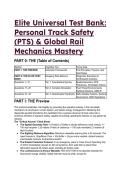
Elite Universal Test Bank:
Personal Track Safety
(PTS) & Global Rail
Mechanics Mastery
PART 0: THE (Table of Contents)
Section Cognitive Tier Focus Area
PART I: THE PREVIEW Axiomatic Frameworks First Principles, Physics, and
Hard Rules
PART II: THE ELITE TEST Escaping Rote Memory Diagnostic Scenarios &
BANK Synthesized Analytics
Questions 1–10 Tier 1: Foundational Syntax Spatial Geometry, PPE
Tolerances, Immediate Actions
Questions 11–20 Tier 2: Complex Simulation Fluid Threat Environments,
Sighting Distance, GSM-R
Questions 21–30 Tier 3: Grandmaster Synthesis Multi-Variable Failures, Sentinel
Governance, SGR Operations
PART I: THE Preview
This protocol eradicates rote fragility by grounding the operative entirely in the immutable
mechanics of rail physics, human factors, and kinetic energy management. Mastering this
diagnostic gauntlet transforms the candidate from a passive observer of track rules into a
proactive architect of systemic safety, capable of averting catastrophic failures on any global rail
network.
The "Critical Axioms" Cheat Sheet:
● The Spatial Geometry Rule: A Position of Safety is strictly defined by track velocity. <=
100 mph requires 1.25 meters (4 feet) of clearance. > 100 mph mandates 2.0 meters (6
feet 6 inches).
● The Sighting Distance Algorithm: Maximum allowable warning time is 45 seconds. The
base formula is: Stop/Move Time + 10s Buffer + (5s per extra variable: distant lookouts,
intermediate lookouts, bi-directional watch).
● The Kinetic Protection Protocol: In an emergency, place a Track Circuit Operating Clip
(T-COC) immediately (except on 4th rail systems), then walk 2km to place three
detonators spaced 20 meters apart, standing 30 meters clear.
● The Luminescence & Armour Mandate: RIS-3279-TOM is the absolute standard for
fluorescent orange visibility. Safety helmets must be white, except for
, inexperienced/learning-support staff who are restricted to blue. Rigger boots are strictly
prohibited due to critical failures in ankle support.
● The Systemic Governance Rule: The Sentinel Scheme dictates that the Primary
Sponsor holds absolute accountability for an individual's fatigue management and rule
breach investigations, while the Sub-Sponsor handles task-specific PPE.
PART II: THE ELITE TEST BANK
Q1: A maintenance team is walking along a line with a permissible track speed of 115 mph.
They must step clear of the track as a locomotive approaches. Based on the principles of spatial
safety geometry, which action is the MOST ACCURATE? A) The team must stand at least 1.25
meters (4 feet) from the nearest open line to avoid the slipstream. B) The team must stand at
least 2.0 meters (6 feet 6 inches) from the nearest open line. C) The team must stand at least
3.0 meters (10 feet) from the nearest open line, as it is classified as a high-speed route. D) The
team may stand 1.25 meters away provided a site warden is actively monitoring their position.
● The Answer: B (The team must stand at least 2.0 meters (6 feet 6 inches) from the
nearest open line.)
● Distractor Analysis:
○ A is incorrect: 1.25 meters is the legal threshold only for track speeds of 100 mph or
less. At 115 mph, the kinetic energy and aerodynamic slipstream require greater
spatial buffering.
○ C is incorrect: 3.0 meters defines the threshold of being "on or near the line" without
a permanent fence, not the designated position of safety for high-speed lines.
○ D is incorrect: A site warden is utilized for a separated site of work, but they do not
alter the immutable physical requirement of a 2.0-meter clearance on lines
exceeding 100 mph.
The Mentor's Analysis: Train velocity exponentially increases aerodynamic drag and the risk of
debris projection. The absolute safety boundary expands correspondingly. The relationship
between speed and required safety distance is non-negotiable.
Track Speed Minimum Position of Safety Clearance
0 - 100 mph 1.25 meters (4 feet)
101 - 125 mph 2.0 meters (6 feet 6 inches)
Professional/Academic Intuition: Velocity dictates geometry; cross the 100 mph
threshold, and the safe boundary instantly expands to 2.0 meters.
Q2: During an engineering possession, a new operative arrives at the access point wearing
lace-up safety boots compliant with BS EN ISO 20345, RIS-3279-TOM compliant high-visibility
trousers, and a white safety helmet. Based on the Sentinel Scheme and Network Rail
standards, which action is the MOST APPROPRIATE? A) The operative may proceed, as their
PPE meets all current global compliance standards. B) The operative must be refused entry
until they exchange their white helmet for a blue one. C) The operative must be refused entry
because high-visibility trousers are optional; only the upper body must meet RIS-3279-TOM. D)
The operative may proceed only if they are issued rigger boots for enhanced ankle support on
the ballast.
● The Answer: B (The operative must be refused entry until they exchange their white
helmet for a blue one.)
● Distractor Analysis:
○ A is incorrect: While the boots and high-visibility clothing are compliant, new PTS
, holders completing a period of learning support must wear a blue safety helmet
(PANTONE 2935c) to visually broadcast their inexperienced status.
○ C is incorrect: Network Rail enforces a "Full Orange Policy." Both the upper body
and trousers must meet RIS-3279-TOM standards.
○ D is incorrect: Rigger boots are strictly prohibited across the infrastructure because
their loose fit creates severe ankle roll hazards on uneven track ballast.
The Mentor's Analysis: Visual hierarchy on a high-risk worksite operates as a primary
engineering control. By forcing inexperienced workers into blue helmets, the system
automatically triggers enhanced supervision and limits task assignment without requiring verbal
communication. The environment must adapt to the weakest cognitive link.
Professional/Academic Intuition: In safety science, experience level must be immediately
visually quantifiable.
Q3: A track worker observes a catastrophic derailment blocking both the Up and Down mainline
tracks on a third-rail 750V DC electrified system. Based on emergency protection mechanics,
what is the FIRST physical action the worker must take after contacting the Signaller or
Electrical Control Operator (ECO)? A) Walk 2 kilometers in the direction of oncoming traffic and
place three detonators. B) Apply a Track Circuit Operating Clip (T-COC) to the running rail
nearest the conductor rail, followed by the furthest rail. C) Apply a Track Circuit Operating Clip
(T-COC) to the running rail furthest from the conductor rail, followed by the nearest rail. D) Do
not apply a T-COC, as they are prohibited on all DC electrified lines to prevent arcing.
● The Answer: C (Apply a Track Circuit Operating Clip (T-COC) to the running rail furthest
from the conductor rail, followed by the nearest rail.)
● Distractor Analysis:
○ A is incorrect: Laying detonators at 2km is required, but it is fundamentally slower
than dropping the adjacent signals to danger immediately via a track circuit short.
○ B is incorrect: Applying the clip to the rail nearest the live 3rd rail first forces the
worker's hands and body over the live conductor for a prolonged period, creating a
lethal arc or contact risk.
○ D is incorrect: T-COCs are prohibited only on 4th rail systems (where the center rail
is the negative return). They are mandatory on 3rd rail systems if applied correctly.
The Mentor's Analysis: Short-circuiting the track instantly drops the protecting signals to red,
neutralizing kinetic threats at the speed of light. However, surviving the physical application of
the device requires strict geometric discipline: always anchor away from the lethal energy
source first to minimize exposure time. Professional/Academic Intuition: Secure the safe rail
first; never cross the strike zone twice.
Q4: An operative is utilizing the GSM-R (Global System for Mobile Communications – Railway)
terminal and accidentally depresses the red button, initiating a Railway Emergency Call (REC).
Based on communication protocols, which immediate action is the MOST ACCURATE? A) Turn
off the GSM-R terminal immediately to cancel the broadcast and prevent network congestion. B)
Press the green button to override the REC and issue a standard priority call to operations
control. C) Stay on the line, state "This is an emergency call," wait for the lead signaller, and
explain it was triggered accidentally. D) Switch to the short dial code '1400' to inform the
Electrical Control Operator of the false alarm.
● The Answer: C (Stay on the line, state "This is an emergency call," wait for the lead
signaller, and explain it was triggered accidentally.)
● Distractor Analysis:
○ A is incorrect: Terminating the unit does not cancel the REC in the network
sub-system; it results in a "Stuck Registration," forcing the signaller to halt all traffic
Personal Track Safety
(PTS) & Global Rail
Mechanics Mastery
PART 0: THE (Table of Contents)
Section Cognitive Tier Focus Area
PART I: THE PREVIEW Axiomatic Frameworks First Principles, Physics, and
Hard Rules
PART II: THE ELITE TEST Escaping Rote Memory Diagnostic Scenarios &
BANK Synthesized Analytics
Questions 1–10 Tier 1: Foundational Syntax Spatial Geometry, PPE
Tolerances, Immediate Actions
Questions 11–20 Tier 2: Complex Simulation Fluid Threat Environments,
Sighting Distance, GSM-R
Questions 21–30 Tier 3: Grandmaster Synthesis Multi-Variable Failures, Sentinel
Governance, SGR Operations
PART I: THE Preview
This protocol eradicates rote fragility by grounding the operative entirely in the immutable
mechanics of rail physics, human factors, and kinetic energy management. Mastering this
diagnostic gauntlet transforms the candidate from a passive observer of track rules into a
proactive architect of systemic safety, capable of averting catastrophic failures on any global rail
network.
The "Critical Axioms" Cheat Sheet:
● The Spatial Geometry Rule: A Position of Safety is strictly defined by track velocity. <=
100 mph requires 1.25 meters (4 feet) of clearance. > 100 mph mandates 2.0 meters (6
feet 6 inches).
● The Sighting Distance Algorithm: Maximum allowable warning time is 45 seconds. The
base formula is: Stop/Move Time + 10s Buffer + (5s per extra variable: distant lookouts,
intermediate lookouts, bi-directional watch).
● The Kinetic Protection Protocol: In an emergency, place a Track Circuit Operating Clip
(T-COC) immediately (except on 4th rail systems), then walk 2km to place three
detonators spaced 20 meters apart, standing 30 meters clear.
● The Luminescence & Armour Mandate: RIS-3279-TOM is the absolute standard for
fluorescent orange visibility. Safety helmets must be white, except for
, inexperienced/learning-support staff who are restricted to blue. Rigger boots are strictly
prohibited due to critical failures in ankle support.
● The Systemic Governance Rule: The Sentinel Scheme dictates that the Primary
Sponsor holds absolute accountability for an individual's fatigue management and rule
breach investigations, while the Sub-Sponsor handles task-specific PPE.
PART II: THE ELITE TEST BANK
Q1: A maintenance team is walking along a line with a permissible track speed of 115 mph.
They must step clear of the track as a locomotive approaches. Based on the principles of spatial
safety geometry, which action is the MOST ACCURATE? A) The team must stand at least 1.25
meters (4 feet) from the nearest open line to avoid the slipstream. B) The team must stand at
least 2.0 meters (6 feet 6 inches) from the nearest open line. C) The team must stand at least
3.0 meters (10 feet) from the nearest open line, as it is classified as a high-speed route. D) The
team may stand 1.25 meters away provided a site warden is actively monitoring their position.
● The Answer: B (The team must stand at least 2.0 meters (6 feet 6 inches) from the
nearest open line.)
● Distractor Analysis:
○ A is incorrect: 1.25 meters is the legal threshold only for track speeds of 100 mph or
less. At 115 mph, the kinetic energy and aerodynamic slipstream require greater
spatial buffering.
○ C is incorrect: 3.0 meters defines the threshold of being "on or near the line" without
a permanent fence, not the designated position of safety for high-speed lines.
○ D is incorrect: A site warden is utilized for a separated site of work, but they do not
alter the immutable physical requirement of a 2.0-meter clearance on lines
exceeding 100 mph.
The Mentor's Analysis: Train velocity exponentially increases aerodynamic drag and the risk of
debris projection. The absolute safety boundary expands correspondingly. The relationship
between speed and required safety distance is non-negotiable.
Track Speed Minimum Position of Safety Clearance
0 - 100 mph 1.25 meters (4 feet)
101 - 125 mph 2.0 meters (6 feet 6 inches)
Professional/Academic Intuition: Velocity dictates geometry; cross the 100 mph
threshold, and the safe boundary instantly expands to 2.0 meters.
Q2: During an engineering possession, a new operative arrives at the access point wearing
lace-up safety boots compliant with BS EN ISO 20345, RIS-3279-TOM compliant high-visibility
trousers, and a white safety helmet. Based on the Sentinel Scheme and Network Rail
standards, which action is the MOST APPROPRIATE? A) The operative may proceed, as their
PPE meets all current global compliance standards. B) The operative must be refused entry
until they exchange their white helmet for a blue one. C) The operative must be refused entry
because high-visibility trousers are optional; only the upper body must meet RIS-3279-TOM. D)
The operative may proceed only if they are issued rigger boots for enhanced ankle support on
the ballast.
● The Answer: B (The operative must be refused entry until they exchange their white
helmet for a blue one.)
● Distractor Analysis:
○ A is incorrect: While the boots and high-visibility clothing are compliant, new PTS
, holders completing a period of learning support must wear a blue safety helmet
(PANTONE 2935c) to visually broadcast their inexperienced status.
○ C is incorrect: Network Rail enforces a "Full Orange Policy." Both the upper body
and trousers must meet RIS-3279-TOM standards.
○ D is incorrect: Rigger boots are strictly prohibited across the infrastructure because
their loose fit creates severe ankle roll hazards on uneven track ballast.
The Mentor's Analysis: Visual hierarchy on a high-risk worksite operates as a primary
engineering control. By forcing inexperienced workers into blue helmets, the system
automatically triggers enhanced supervision and limits task assignment without requiring verbal
communication. The environment must adapt to the weakest cognitive link.
Professional/Academic Intuition: In safety science, experience level must be immediately
visually quantifiable.
Q3: A track worker observes a catastrophic derailment blocking both the Up and Down mainline
tracks on a third-rail 750V DC electrified system. Based on emergency protection mechanics,
what is the FIRST physical action the worker must take after contacting the Signaller or
Electrical Control Operator (ECO)? A) Walk 2 kilometers in the direction of oncoming traffic and
place three detonators. B) Apply a Track Circuit Operating Clip (T-COC) to the running rail
nearest the conductor rail, followed by the furthest rail. C) Apply a Track Circuit Operating Clip
(T-COC) to the running rail furthest from the conductor rail, followed by the nearest rail. D) Do
not apply a T-COC, as they are prohibited on all DC electrified lines to prevent arcing.
● The Answer: C (Apply a Track Circuit Operating Clip (T-COC) to the running rail furthest
from the conductor rail, followed by the nearest rail.)
● Distractor Analysis:
○ A is incorrect: Laying detonators at 2km is required, but it is fundamentally slower
than dropping the adjacent signals to danger immediately via a track circuit short.
○ B is incorrect: Applying the clip to the rail nearest the live 3rd rail first forces the
worker's hands and body over the live conductor for a prolonged period, creating a
lethal arc or contact risk.
○ D is incorrect: T-COCs are prohibited only on 4th rail systems (where the center rail
is the negative return). They are mandatory on 3rd rail systems if applied correctly.
The Mentor's Analysis: Short-circuiting the track instantly drops the protecting signals to red,
neutralizing kinetic threats at the speed of light. However, surviving the physical application of
the device requires strict geometric discipline: always anchor away from the lethal energy
source first to minimize exposure time. Professional/Academic Intuition: Secure the safe rail
first; never cross the strike zone twice.
Q4: An operative is utilizing the GSM-R (Global System for Mobile Communications – Railway)
terminal and accidentally depresses the red button, initiating a Railway Emergency Call (REC).
Based on communication protocols, which immediate action is the MOST ACCURATE? A) Turn
off the GSM-R terminal immediately to cancel the broadcast and prevent network congestion. B)
Press the green button to override the REC and issue a standard priority call to operations
control. C) Stay on the line, state "This is an emergency call," wait for the lead signaller, and
explain it was triggered accidentally. D) Switch to the short dial code '1400' to inform the
Electrical Control Operator of the false alarm.
● The Answer: C (Stay on the line, state "This is an emergency call," wait for the lead
signaller, and explain it was triggered accidentally.)
● Distractor Analysis:
○ A is incorrect: Terminating the unit does not cancel the REC in the network
sub-system; it results in a "Stuck Registration," forcing the signaller to halt all traffic


