
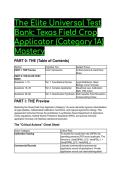
The Elite Universal Test
Bank: Texas Field Crop
Applicator (Category 1A)
Mastery
PART 0: THE (Table of Contents)
Section Cognitive Tier Subject Focus
PART I: THE Preview Core Frameworks Critical Axioms & Hard Deck
Rules
PART II: THE ELITE TEST
BANK
Questions 1–15 Tier 1: Foundational Syntax Legal Definitions, Basic
Biology, Core Formulas
Questions 16–35 Tier 2: Complex Application Situational Law, Calibration
Math, IPM Action
Questions 36–60 Tier 3: Grandmaster Synthesis Multi-Variable Field Simulation,
Compounding Crises
PART I: THE Preview
Mastering the Texas Field Crop Applicator (Category 1A) exam demands rigorous internalization
of legal statutes, mathematical calibration mechanics, and regional agronomic biology. This
assessment instrument forces the practitioner to synthesize Texas Department of Agriculture
(TDA) regulations, federal Worker Protection Standards (WPS), and precise chemical
application formulas into flawless operational execution.
The "Critical Axioms" Cheat Sheet
Axiom Category Critical Rule
Calibration Scaling To double the nozzle flow rate (GPM), the
operating pressure (PSI) must quadruple. The
formula is: (\text{GPM}_1)^2 / \text{PSI}_1 =
(\text{GPM}_2)^2 / \text{PSI}_2.
Commercial Records Licensed commercial/noncommercial
applicators record all applications. Private
applicators record only restricted/regulated
,Axiom Category Critical Rule
chemicals. Retention is precisely 24 months.
Regulated Herbicides Application is strictly prohibited if wind exceeds
10 mph. Highly volatile ester formulations are
unconditionally banned if susceptible crops
exist within a 4-mile radius.
Phymatotrichopsis Paradox Texas root rot (Phymatotrichopsis omnivora)
destroys broadleaf dicots (cotton, alfalfa) but
cannot infect monocots. Rotational suppression
using grasses (corn, sorghum) is mandatory.
WPS Information Employers must display application data and
Safety Data Sheets (SDS) at a central location
within 24 hours of application, retain the display
for 30 days post-REI, and archive for 2 years.
PART II: THE ELITE TEST BANK
Q1: A commercial agricultural pesticide applicator in Texas establishes a business to apply
restricted-use pesticides (RUPs) on contracted field crops. Based on TDA financial responsibility
regulations, which minimum insurance coverage is IMMEDIATELY required prior to operation?
A) A $50,000 general liability policy covering bodily injury and property damage combined. B) A
certificate of deposit for $250,000 held in escrow by the Texas Department of Agriculture. C) A
liability policy providing $100,000 for property damage, $100,000 for bodily injury per
occurrence, or a $200,000 general aggregate. D) A $500,000 comprehensive umbrella policy
specifically covering drift-related crop loss.
● The Answer: C (A liability policy providing $100,000 for property damage, $100,000 for
bodily injury per occurrence, or a $200,000 general aggregate.)
● Distractor Analysis:
○ A is incorrect: $50,000 is insufficient. The statutory baseline for a commercial
applicator business in Texas is exactly double this amount per occurrence.
○ B is incorrect: While alternative instruments exist, the explicit foundational
requirement in Section 76.111 of the Agriculture Code is the $100k/$100k liability
policy.
○ D is incorrect: A half-million-dollar policy exceeds state minimums. It is highly
protective but not the legal baseline.
The Mentor's Analysis: Financial responsibility acts as the regulatory gateway to commercial
application in Texas. When establishing an entity, the immediate priority is shielding the public
from catastrophic liability. By utilizing the 100/100/200 aggregate rule, the practitioner bypasses
the common trap of operating underinsured and facing license revocation.
Professional/Academic Intuition: Commercial applicators treat the land of others for
compensation; therefore, they require a rigid $100k/$100k baseline, whereas private applicators
do not.
Q2: During an audit, a TDA inspector reviews records for a Commercial Applicator and a Private
Applicator. The Commercial Applicator has recorded all applications (general and restricted
use), while the Private Applicator has only recorded applications of restricted-use and regulated
herbicides. Based on the Texas Administrative Code (4 TAC § 7.33), which conclusion is the
MOST ACCURATE? A) Both applicators are in violation; both must record every pesticide
application regardless of classification. B) Both applicators are in perfect compliance with TDA
,recordkeeping laws. C) The Commercial Applicator is in violation for wasting administrative
resources on general-use records. D) The Private Applicator is in violation for failing to
document general-use pesticide applications.
● The Answer: B (Both applicators are in perfect compliance with TDA recordkeeping
laws.)
● Distractor Analysis:
○ A is incorrect: Private applicators are not required to log general-use,
over-the-counter pesticides.
○ C is incorrect: Commercial and noncommercial applicators are explicitly mandated
by law to maintain records of all pesticide applications, including general-use
products.
○ D is incorrect: A certified Private Applicator is legally compelled to maintain records
only of restricted-use pesticides, state-limited-use pesticides, and regulated
herbicides.
The Mentor's Analysis: Recordkeeping burdens scale directly with commercial intent. When
facing a TDA audit, the immediate priority is producing 24 months of flawless documentation. By
utilizing differential recordkeeping standards, the practitioner bypasses the common trap of
holding private farmers to commercial administrative burdens. Professional/Academic
Intuition: Commercial applicators log everything; Private applicators log only the restricted and
regulated. Both retain records for exactly two years.
Q3: An applicator evaluates a ground sprayer equipped with nozzles spaced 20 inches apart.
The rig travels a 308-foot timed calibration course in an average of 70 seconds. Utilizing
standard Texas A&M AgriLife Extension conversion formulas, what is the exact ground speed of
this equipment? A) 2.5 MPH B) 3.0 MPH C) 4.4 MPH D) 5.1 MPH
● The Answer: B (3.0 MPH)
● Distractor Analysis:
○ A is incorrect: This stems from dividing distance by time without executing the
necessary minutes-to-hours conversion.
○ C is incorrect: This represents a mathematical inversion of the conversion constant.
○ D is incorrect: This is a plausible distractor representing an overly rapid calibration
run.
○ Calculation: Speed = (308 ft / 70 sec) * (60 sec / 1 min) = 264 ft/min. Since 1 MPH =
88 ft/min, = 3.0 MPH.
The Mentor's Analysis: Ground speed serves as the primary denominator in application
volume equations. When establishing calibration metrics, the immediate priority is converting
feet-per-second into miles-per-hour. By utilizing the 88 ft/min constant, the practitioner bypasses
the common trap of drastically miscalculating the Gallons Per Acre (GPA) output.
Professional/Academic Intuition: One mile per hour is permanently equal to 88 feet per
minute. Memorize this constant to instantly verify any timed calibration course.
Q4: A cotton producer in the Texas Blacklands observes circular patches of rapid plant mortality
in late June. The taproots are girdled, enveloped in a soil sheath, and exhibit tan mycelial
strands. The soil is highly alkaline. Based on this pathology, which long-term cultural strategy is
the MOST APPROPRIATE? A) Apply a deep-shanked granular fungicide immediately to
eradicate the pathogen. B) Rotate the field to grain sorghum or corn for the next three to four
years. C) Rotate the field to a resistant broadleaf crop such as alfalfa or peanuts. D) Decrease
the soil pH using heavy sulfur applications to kill the fungal spores.
● The Answer: B (Rotate the field to grain sorghum or corn for the next three to four years.)
● Distractor Analysis:
, ○ A is incorrect: Phymatotrichopsis omnivora (Texas root rot) sclerotia survive up to
six feet deep; eradication via standard granular fungicides is practically impossible
once established.
○ C is incorrect: Alfalfa and peanuts are highly susceptible dicots. The pathogen
attacks over 2,000 broadleaf species.
○ D is incorrect: While the fungus thrives in alkaline conditions, heavily altering the pH
of entire calcareous field profiles is agronomically unfeasible.
The Mentor's Analysis: Pathogens with vast host ranges require biological starvation rather
than chemical eradication. When diagnosing Phymatotrichopsis omnivora, the immediate
priority is removing the pathogen's primary food source. By utilizing monocot rotational
sequences, the practitioner bypasses the trap of wasting capital on ineffective soil fungicides.
Professional/Academic Intuition: Texas root rot destroys dicots (cotton, alfalfa) but cannot
digest monocots (grasses, corn, sorghum). Starve the fungus with grass.
Q5: During the first three weeks of squaring, a dryland cotton field experiences severe early
square abscission. The shed squares turn dark brown, dry up, and fall, leaving a characteristic
scar on the fruiting site. Which pest is the MOST LIKELY vector for this specific damage? A)
Sorghum midge (Contarinia sorghicola) B) Cotton fleahopper (Pseudatomoscelis seriatus) C)
Western flower thrips (Frankliniella occidentalis) D) Greenbug (Schizaphis graminum)
● The Answer: B (Cotton fleahopper (Pseudatomoscelis seriatus))
● Distractor Analysis:
○ A is incorrect: The sorghum midge attacks the developing grain heads of sorghum,
not the squares of cotton plants.
○ C is incorrect: Thrips attack the leaves and terminals of seedling cotton, causing
silvering and blackened leaves, not primarily the "blasting" of early squares.
○ D is incorrect: Greenbugs are aphids that attack sorghum and wheat, injecting
toxins into leaves, not cotton squares.
The Mentor's Analysis: Early fruit retention dictates ultimate yield potential in cotton
ecosystems. When observing pinpoint abscission of early squares, the immediate priority is
identifying piercing-sucking insects migrating from wild hosts. By utilizing square-scar
diagnostics, the practitioner bypasses the trap of misidentifying physiological shed as pest
damage. Professional/Academic Intuition: The cotton fleahopper is the apex predator of the
pinpoint cotton square. The first three weeks of squaring are the absolute critical window for
chemical intervention.
Q6: A commercial applicator must renew a TDA Category 1A (Field Crop) license. Under
current TDA continuing education regulations, which requirement must they EXACTLY fulfill
annually to maintain commercial status? A) 15 CEUs total, including 2 in laws and regulations.
B) 5 CEUs total, including 1 in laws and regulations, and 1 in either IPM or drift minimization. C)
10 CEUs total, entirely obtainable via correspondence courses. D) No CEUs are required if the
applicator operates exclusively on an employer's property.
● The Answer: B (5 CEUs total, including 1 in laws and regulations, and 1 in either IPM or
drift minimization.)
● Distractor Analysis:
○ A is incorrect: This is the strict requirement for Private Applicators, who obtain 15
CEUs over a 5-year renewal cycle.
○ C is incorrect: This blends the private applicator correspondence allowance with an
incorrect annual total.
○ D is incorrect: Applicators operating exclusively on an employer's property using
restricted-use pesticides are classified as Noncommercial Applicators, who still
Bank: Texas Field Crop
Applicator (Category 1A)
Mastery
PART 0: THE (Table of Contents)
Section Cognitive Tier Subject Focus
PART I: THE Preview Core Frameworks Critical Axioms & Hard Deck
Rules
PART II: THE ELITE TEST
BANK
Questions 1–15 Tier 1: Foundational Syntax Legal Definitions, Basic
Biology, Core Formulas
Questions 16–35 Tier 2: Complex Application Situational Law, Calibration
Math, IPM Action
Questions 36–60 Tier 3: Grandmaster Synthesis Multi-Variable Field Simulation,
Compounding Crises
PART I: THE Preview
Mastering the Texas Field Crop Applicator (Category 1A) exam demands rigorous internalization
of legal statutes, mathematical calibration mechanics, and regional agronomic biology. This
assessment instrument forces the practitioner to synthesize Texas Department of Agriculture
(TDA) regulations, federal Worker Protection Standards (WPS), and precise chemical
application formulas into flawless operational execution.
The "Critical Axioms" Cheat Sheet
Axiom Category Critical Rule
Calibration Scaling To double the nozzle flow rate (GPM), the
operating pressure (PSI) must quadruple. The
formula is: (\text{GPM}_1)^2 / \text{PSI}_1 =
(\text{GPM}_2)^2 / \text{PSI}_2.
Commercial Records Licensed commercial/noncommercial
applicators record all applications. Private
applicators record only restricted/regulated
,Axiom Category Critical Rule
chemicals. Retention is precisely 24 months.
Regulated Herbicides Application is strictly prohibited if wind exceeds
10 mph. Highly volatile ester formulations are
unconditionally banned if susceptible crops
exist within a 4-mile radius.
Phymatotrichopsis Paradox Texas root rot (Phymatotrichopsis omnivora)
destroys broadleaf dicots (cotton, alfalfa) but
cannot infect monocots. Rotational suppression
using grasses (corn, sorghum) is mandatory.
WPS Information Employers must display application data and
Safety Data Sheets (SDS) at a central location
within 24 hours of application, retain the display
for 30 days post-REI, and archive for 2 years.
PART II: THE ELITE TEST BANK
Q1: A commercial agricultural pesticide applicator in Texas establishes a business to apply
restricted-use pesticides (RUPs) on contracted field crops. Based on TDA financial responsibility
regulations, which minimum insurance coverage is IMMEDIATELY required prior to operation?
A) A $50,000 general liability policy covering bodily injury and property damage combined. B) A
certificate of deposit for $250,000 held in escrow by the Texas Department of Agriculture. C) A
liability policy providing $100,000 for property damage, $100,000 for bodily injury per
occurrence, or a $200,000 general aggregate. D) A $500,000 comprehensive umbrella policy
specifically covering drift-related crop loss.
● The Answer: C (A liability policy providing $100,000 for property damage, $100,000 for
bodily injury per occurrence, or a $200,000 general aggregate.)
● Distractor Analysis:
○ A is incorrect: $50,000 is insufficient. The statutory baseline for a commercial
applicator business in Texas is exactly double this amount per occurrence.
○ B is incorrect: While alternative instruments exist, the explicit foundational
requirement in Section 76.111 of the Agriculture Code is the $100k/$100k liability
policy.
○ D is incorrect: A half-million-dollar policy exceeds state minimums. It is highly
protective but not the legal baseline.
The Mentor's Analysis: Financial responsibility acts as the regulatory gateway to commercial
application in Texas. When establishing an entity, the immediate priority is shielding the public
from catastrophic liability. By utilizing the 100/100/200 aggregate rule, the practitioner bypasses
the common trap of operating underinsured and facing license revocation.
Professional/Academic Intuition: Commercial applicators treat the land of others for
compensation; therefore, they require a rigid $100k/$100k baseline, whereas private applicators
do not.
Q2: During an audit, a TDA inspector reviews records for a Commercial Applicator and a Private
Applicator. The Commercial Applicator has recorded all applications (general and restricted
use), while the Private Applicator has only recorded applications of restricted-use and regulated
herbicides. Based on the Texas Administrative Code (4 TAC § 7.33), which conclusion is the
MOST ACCURATE? A) Both applicators are in violation; both must record every pesticide
application regardless of classification. B) Both applicators are in perfect compliance with TDA
,recordkeeping laws. C) The Commercial Applicator is in violation for wasting administrative
resources on general-use records. D) The Private Applicator is in violation for failing to
document general-use pesticide applications.
● The Answer: B (Both applicators are in perfect compliance with TDA recordkeeping
laws.)
● Distractor Analysis:
○ A is incorrect: Private applicators are not required to log general-use,
over-the-counter pesticides.
○ C is incorrect: Commercial and noncommercial applicators are explicitly mandated
by law to maintain records of all pesticide applications, including general-use
products.
○ D is incorrect: A certified Private Applicator is legally compelled to maintain records
only of restricted-use pesticides, state-limited-use pesticides, and regulated
herbicides.
The Mentor's Analysis: Recordkeeping burdens scale directly with commercial intent. When
facing a TDA audit, the immediate priority is producing 24 months of flawless documentation. By
utilizing differential recordkeeping standards, the practitioner bypasses the common trap of
holding private farmers to commercial administrative burdens. Professional/Academic
Intuition: Commercial applicators log everything; Private applicators log only the restricted and
regulated. Both retain records for exactly two years.
Q3: An applicator evaluates a ground sprayer equipped with nozzles spaced 20 inches apart.
The rig travels a 308-foot timed calibration course in an average of 70 seconds. Utilizing
standard Texas A&M AgriLife Extension conversion formulas, what is the exact ground speed of
this equipment? A) 2.5 MPH B) 3.0 MPH C) 4.4 MPH D) 5.1 MPH
● The Answer: B (3.0 MPH)
● Distractor Analysis:
○ A is incorrect: This stems from dividing distance by time without executing the
necessary minutes-to-hours conversion.
○ C is incorrect: This represents a mathematical inversion of the conversion constant.
○ D is incorrect: This is a plausible distractor representing an overly rapid calibration
run.
○ Calculation: Speed = (308 ft / 70 sec) * (60 sec / 1 min) = 264 ft/min. Since 1 MPH =
88 ft/min, = 3.0 MPH.
The Mentor's Analysis: Ground speed serves as the primary denominator in application
volume equations. When establishing calibration metrics, the immediate priority is converting
feet-per-second into miles-per-hour. By utilizing the 88 ft/min constant, the practitioner bypasses
the common trap of drastically miscalculating the Gallons Per Acre (GPA) output.
Professional/Academic Intuition: One mile per hour is permanently equal to 88 feet per
minute. Memorize this constant to instantly verify any timed calibration course.
Q4: A cotton producer in the Texas Blacklands observes circular patches of rapid plant mortality
in late June. The taproots are girdled, enveloped in a soil sheath, and exhibit tan mycelial
strands. The soil is highly alkaline. Based on this pathology, which long-term cultural strategy is
the MOST APPROPRIATE? A) Apply a deep-shanked granular fungicide immediately to
eradicate the pathogen. B) Rotate the field to grain sorghum or corn for the next three to four
years. C) Rotate the field to a resistant broadleaf crop such as alfalfa or peanuts. D) Decrease
the soil pH using heavy sulfur applications to kill the fungal spores.
● The Answer: B (Rotate the field to grain sorghum or corn for the next three to four years.)
● Distractor Analysis:
, ○ A is incorrect: Phymatotrichopsis omnivora (Texas root rot) sclerotia survive up to
six feet deep; eradication via standard granular fungicides is practically impossible
once established.
○ C is incorrect: Alfalfa and peanuts are highly susceptible dicots. The pathogen
attacks over 2,000 broadleaf species.
○ D is incorrect: While the fungus thrives in alkaline conditions, heavily altering the pH
of entire calcareous field profiles is agronomically unfeasible.
The Mentor's Analysis: Pathogens with vast host ranges require biological starvation rather
than chemical eradication. When diagnosing Phymatotrichopsis omnivora, the immediate
priority is removing the pathogen's primary food source. By utilizing monocot rotational
sequences, the practitioner bypasses the trap of wasting capital on ineffective soil fungicides.
Professional/Academic Intuition: Texas root rot destroys dicots (cotton, alfalfa) but cannot
digest monocots (grasses, corn, sorghum). Starve the fungus with grass.
Q5: During the first three weeks of squaring, a dryland cotton field experiences severe early
square abscission. The shed squares turn dark brown, dry up, and fall, leaving a characteristic
scar on the fruiting site. Which pest is the MOST LIKELY vector for this specific damage? A)
Sorghum midge (Contarinia sorghicola) B) Cotton fleahopper (Pseudatomoscelis seriatus) C)
Western flower thrips (Frankliniella occidentalis) D) Greenbug (Schizaphis graminum)
● The Answer: B (Cotton fleahopper (Pseudatomoscelis seriatus))
● Distractor Analysis:
○ A is incorrect: The sorghum midge attacks the developing grain heads of sorghum,
not the squares of cotton plants.
○ C is incorrect: Thrips attack the leaves and terminals of seedling cotton, causing
silvering and blackened leaves, not primarily the "blasting" of early squares.
○ D is incorrect: Greenbugs are aphids that attack sorghum and wheat, injecting
toxins into leaves, not cotton squares.
The Mentor's Analysis: Early fruit retention dictates ultimate yield potential in cotton
ecosystems. When observing pinpoint abscission of early squares, the immediate priority is
identifying piercing-sucking insects migrating from wild hosts. By utilizing square-scar
diagnostics, the practitioner bypasses the trap of misidentifying physiological shed as pest
damage. Professional/Academic Intuition: The cotton fleahopper is the apex predator of the
pinpoint cotton square. The first three weeks of squaring are the absolute critical window for
chemical intervention.
Q6: A commercial applicator must renew a TDA Category 1A (Field Crop) license. Under
current TDA continuing education regulations, which requirement must they EXACTLY fulfill
annually to maintain commercial status? A) 15 CEUs total, including 2 in laws and regulations.
B) 5 CEUs total, including 1 in laws and regulations, and 1 in either IPM or drift minimization. C)
10 CEUs total, entirely obtainable via correspondence courses. D) No CEUs are required if the
applicator operates exclusively on an employer's property.
● The Answer: B (5 CEUs total, including 1 in laws and regulations, and 1 in either IPM or
drift minimization.)
● Distractor Analysis:
○ A is incorrect: This is the strict requirement for Private Applicators, who obtain 15
CEUs over a 5-year renewal cycle.
○ C is incorrect: This blends the private applicator correspondence allowance with an
incorrect annual total.
○ D is incorrect: Applicators operating exclusively on an employer's property using
restricted-use pesticides are classified as Noncommercial Applicators, who still


