

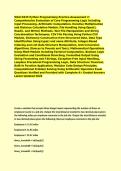
WGU D335 Python Programming Practice Assessment 2:
Comprehensive Evaluation of Core Programming Logic Including
Input Processing, Arithmetic Computation, Iterative Multiplication
and Distance Calculation Models, File Handling Using Open(),
Read(), and Write() Methods, Text File Manipulation and String
Concatenation Techniques, CSV File Parsing Using Python CSV
Module, Dictionary Construction from Structured Data, Data Type
Identification Using type() and name Attribute, Integer-Based
Indexing and List Data Structure Manipulation, Unit Conversion
Algorithms (Ounces to Pounds and Tons), Mathematical Operations
Using Math Module Including Factorial Computation, Boolean Logic
Evaluation and Conditional Branching, Formatted Output Using
String Formatting and f-Strings, Exception-Free Input Handling,
Loopless Procedural Programming Logic, Data Structure Traversal,
Built-In Function Application, Modular Code Design Principles,
Computational Problem Solving Using Arithmetic Operators Exam
Questions Verified and Provided with Complete A+ Graded Answers
Latest Updated 2026
Create a solution that accepts three integer inputs representing the number of times an
employee travels to a job site. Output the total distance traveled to two decimal places given
the following miles per employee commute to the job site. Output the total distance traveled
to two decimal places given the following miles per employee commute to the job site:
Employee A: 15.62 miles
Employee B: 41.85 miles
Employee C: 32.67 miles
times_traveledA = int(input())
times_traveledB = int(input())
times_traveledC = int(input())
, employeeA = 15.62 #miles
employeeB = 41.85 #miles
employeeC = 32.67 #miles
distance_traveledA = times_traveledA * employeeA
distance_traveledB = times_traveledB * employeeB
distance_traveledC = times_traveledC * employeeC
total_miles_traveled = distance_traveledA + distance_traveledB + distance_traveledC
print('Distance: {:.2f} miles'.format(total_miles_traveled))
Create a solution that accepts an input identifying the name of a text file, for example,
"WordTextFile1.txt". Each text file contains three rows with one word per row. Using the
open() function and write() and read() methods, interact with the input text file to write a
new sentence string composed of the three existing words to the end of the file contents on a
new line. Output the new file contents.
file_name = input()
with open(file_name, 'r') as f:
word1 = str(f.readline()).strip()
word2 = str(f.readline()).strip()
word3 = str(f.readline()).strip()
f = open(file_name, 'r')
lines = f.read().splitlines()
lines = ' '.join(lines)
f.close()
print(f'{word1}\n{word2}\n{word3}\n{lines}')
Comprehensive Evaluation of Core Programming Logic Including
Input Processing, Arithmetic Computation, Iterative Multiplication
and Distance Calculation Models, File Handling Using Open(),
Read(), and Write() Methods, Text File Manipulation and String
Concatenation Techniques, CSV File Parsing Using Python CSV
Module, Dictionary Construction from Structured Data, Data Type
Identification Using type() and name Attribute, Integer-Based
Indexing and List Data Structure Manipulation, Unit Conversion
Algorithms (Ounces to Pounds and Tons), Mathematical Operations
Using Math Module Including Factorial Computation, Boolean Logic
Evaluation and Conditional Branching, Formatted Output Using
String Formatting and f-Strings, Exception-Free Input Handling,
Loopless Procedural Programming Logic, Data Structure Traversal,
Built-In Function Application, Modular Code Design Principles,
Computational Problem Solving Using Arithmetic Operators Exam
Questions Verified and Provided with Complete A+ Graded Answers
Latest Updated 2026
Create a solution that accepts three integer inputs representing the number of times an
employee travels to a job site. Output the total distance traveled to two decimal places given
the following miles per employee commute to the job site. Output the total distance traveled
to two decimal places given the following miles per employee commute to the job site:
Employee A: 15.62 miles
Employee B: 41.85 miles
Employee C: 32.67 miles
times_traveledA = int(input())
times_traveledB = int(input())
times_traveledC = int(input())
, employeeA = 15.62 #miles
employeeB = 41.85 #miles
employeeC = 32.67 #miles
distance_traveledA = times_traveledA * employeeA
distance_traveledB = times_traveledB * employeeB
distance_traveledC = times_traveledC * employeeC
total_miles_traveled = distance_traveledA + distance_traveledB + distance_traveledC
print('Distance: {:.2f} miles'.format(total_miles_traveled))
Create a solution that accepts an input identifying the name of a text file, for example,
"WordTextFile1.txt". Each text file contains three rows with one word per row. Using the
open() function and write() and read() methods, interact with the input text file to write a
new sentence string composed of the three existing words to the end of the file contents on a
new line. Output the new file contents.
file_name = input()
with open(file_name, 'r') as f:
word1 = str(f.readline()).strip()
word2 = str(f.readline()).strip()
word3 = str(f.readline()).strip()
f = open(file_name, 'r')
lines = f.read().splitlines()
lines = ' '.join(lines)
f.close()
print(f'{word1}\n{word2}\n{word3}\n{lines}')


