

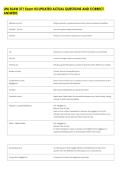
UNL BLAW 371 Exam #3 UPDATED ACTUAL QUESTIONS AND CORRECT
ANSWERS
Definition of a tort trying to remedy in a personal nature of harm done to someone (monetarty)
Criminal v. Tort law who is the person asking for the remedy
Criminal remedy is the punishment imposed by the government
Tort personal; you suing someone else for the harm they did to you (monetary)
Tort law comes from judge made law (evolving nature)
Criminal Law statutory; government gives you notice of what the crime is (theft, D.U.I, murder)
Burden of proof Criminal: beyond a reasonable doubt
Civil: preponderance of the evidence
Classifications of torts: have to have a breach (act or omission) of duty of care to another person (owe to
Negligence person that is injured). Not intentional
Omission Did not do something that you should have done
Proximate cause Legal cause. It exists when the connection between an act and an injury is strong
enough to justify imposing liability.
Palsgraf v. Long Island Railroad Tort: Negligence
Element: Duty of Care
There must be a direct foreseeable link between the negligent act and the
damage, aka proximate cause. Injury caused to a party of sufficient distance in an
unforeseeable manner does not attract a duty of care.
Gezci v. Lifetime Fitness Tort: Negligence
Element: Duty of Care
if a client has signed a waiver, a business is not reliable for the negligence in
equipment breaking down or anything else written in the waiver.
Superseding acts an intervening act that is legally sufficient to transfer blame for the harm in
question from the defendant to a third party, or to a natural event.
Comparative Negligence compare and contrast the negligence percentage
, Contributory Negligence A rule in tort law, used in only a few states, that completely bars the plaintiff from
recovering any damages if the damage suffered is partly the plaintiff's own fault.
Intentional Torts: putting someone in immediate fear of death or bodily injury (words/actions)
assault
Intentional Torts: unwanted touching according to the standard of a reasonable person
battery
ANSWERS
Definition of a tort trying to remedy in a personal nature of harm done to someone (monetarty)
Criminal v. Tort law who is the person asking for the remedy
Criminal remedy is the punishment imposed by the government
Tort personal; you suing someone else for the harm they did to you (monetary)
Tort law comes from judge made law (evolving nature)
Criminal Law statutory; government gives you notice of what the crime is (theft, D.U.I, murder)
Burden of proof Criminal: beyond a reasonable doubt
Civil: preponderance of the evidence
Classifications of torts: have to have a breach (act or omission) of duty of care to another person (owe to
Negligence person that is injured). Not intentional
Omission Did not do something that you should have done
Proximate cause Legal cause. It exists when the connection between an act and an injury is strong
enough to justify imposing liability.
Palsgraf v. Long Island Railroad Tort: Negligence
Element: Duty of Care
There must be a direct foreseeable link between the negligent act and the
damage, aka proximate cause. Injury caused to a party of sufficient distance in an
unforeseeable manner does not attract a duty of care.
Gezci v. Lifetime Fitness Tort: Negligence
Element: Duty of Care
if a client has signed a waiver, a business is not reliable for the negligence in
equipment breaking down or anything else written in the waiver.
Superseding acts an intervening act that is legally sufficient to transfer blame for the harm in
question from the defendant to a third party, or to a natural event.
Comparative Negligence compare and contrast the negligence percentage
, Contributory Negligence A rule in tort law, used in only a few states, that completely bars the plaintiff from
recovering any damages if the damage suffered is partly the plaintiff's own fault.
Intentional Torts: putting someone in immediate fear of death or bodily injury (words/actions)
assault
Intentional Torts: unwanted touching according to the standard of a reasonable person
battery


