

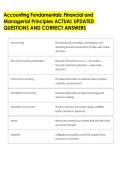
Accounting Fundamentals: Financial and
Managerial Principles ACTUAL UPDATED
QUESTIONS AND CORRECT ANSWERS
Accounting The process of recording, summarizing, and
reporting business transactions to help users make
decisions
Flow of Accounting Information Business transactions occur → recorded →
financial statements prepared → users make
decisions
Financial Accounting Provides information to external users (investors,
creditors, government)
Managerial Accounting Provides information to internal managers for
decision-making
5 Buckets of Accounts The five main account types: Assets, Liabilities,
Equity, Revenue, Expenses
Assets Resources owned by a business that provide future
economic benefit
Liabilities Obligations a business owes that require future
payment or sacrifice
, Equity Owner's claim on the assets of the business
Revenue Value earned from providing goods or services to
customers
Expenses Costs incurred in running the business to generate
revenue
Balance Sheet Accounts Assets, Liabilities, and Equity (point in time)
Income Statement Accounts Revenue and Expenses (period of time)
Accounting Equation Assets = Liabilities + Equity
Expanded Accounting Equation Assets = Liabilities + Equity + Revenues − Expenses −
Dividends
Paid-in Capital Amount invested in the business by owners
(common stock)
Retained Earnings Accumulated net income kept in the business
Dividends Distributions of profits to shareholders that reduce
retained earnings
Financial Statements Reports that summarize financial performance and
position
Income Statement Reports revenues, expenses, and net income over
a period
Net Income Revenues minus expenses
Managerial Principles ACTUAL UPDATED
QUESTIONS AND CORRECT ANSWERS
Accounting The process of recording, summarizing, and
reporting business transactions to help users make
decisions
Flow of Accounting Information Business transactions occur → recorded →
financial statements prepared → users make
decisions
Financial Accounting Provides information to external users (investors,
creditors, government)
Managerial Accounting Provides information to internal managers for
decision-making
5 Buckets of Accounts The five main account types: Assets, Liabilities,
Equity, Revenue, Expenses
Assets Resources owned by a business that provide future
economic benefit
Liabilities Obligations a business owes that require future
payment or sacrifice
, Equity Owner's claim on the assets of the business
Revenue Value earned from providing goods or services to
customers
Expenses Costs incurred in running the business to generate
revenue
Balance Sheet Accounts Assets, Liabilities, and Equity (point in time)
Income Statement Accounts Revenue and Expenses (period of time)
Accounting Equation Assets = Liabilities + Equity
Expanded Accounting Equation Assets = Liabilities + Equity + Revenues − Expenses −
Dividends
Paid-in Capital Amount invested in the business by owners
(common stock)
Retained Earnings Accumulated net income kept in the business
Dividends Distributions of profits to shareholders that reduce
retained earnings
Financial Statements Reports that summarize financial performance and
position
Income Statement Reports revenues, expenses, and net income over
a period
Net Income Revenues minus expenses


