

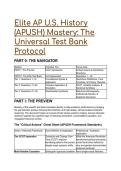
Elite AP U.S. History
(APUSH) Mastery: The
Universal Test Bank
Protocol
PART 0: THE NAVIGATOR
Section Cognitive Tier Focus Area
PART I: The Preview Core Frameworks Critical Axioms & Hard-Deck
Directives
PART II: The Elite Test Bank Full Assessment Questions 1 – 30
Tier 1: Questions 1–10 Foundational Syntax & Hard-Deck Definitions, Core
Application Timelines, & Primary Theories
Tier 2: Questions 11–20 Complex Application & CCOT, Variable Analysis, &
Simulation Sectional Synthesis
Tier 3: Questions 21–30 Grandmaster Synthesis Multi-Era Historiography,
Institutional Failures, &
Capstone Scenarios
PART I: THE PREVIEW
Mastery of this specific test bank translates directly to elite academic performance by bridging
the gap between passive historical fact-retention and high-stakes, stimulus-based analytical
reasoning. The document forges an A-level scholar whose systems mastery ensures absolute
resilience against the cognitive traps of historical presentism, oversimplified causation, and
misapplied historical context.
The "Critical Axioms" Cheat Sheet (APUSH Framework Standards)
Axiom / Historical Framework Core Definition & Application Professional / Academic
Implication
The CCOT Imperative Continuity and Change Over While the American Revolution
Time (CCOT) requires transformed political structures,
identifying patterns that persist social hierarchies defined by
despite major systemic shifts. race and gender demonstrated
profound continuity.
Multi-Variable Causation Distinguish rigorously between Avoid single-cause fallacies;
,Axiom / Historical Framework Core Definition & Application
Professional / Academic
Implication
immediate catalysts, proximate the firing on Fort Sumter is a
causes, and long-term systemic catalyst, whereas divergent
pressures. economic models represent
systemic causation.
The Historiographical Lens Objective facts are continually Understand the tension
reinterpreted based on new between competing
evidence or shifting cultural interpretations, such as
values. whether the Founders'
constitutional compromises on
enslavement were pragmatic
delays or active endorsements
of white supremacy.
The Sourcing Protocol (HIPP) A primary source's utility Analyzing a primary source
depends entirely on its without identifying its
Historical Context, Intended ideological origins, geographic
Audience, Purpose, and Point biases, or economic
of View. motivations is an analytical
failure.
The Periodization Threshold Historical events must be Applying post-Civil War (Period
strictly contextualized within 6) industrial logic to antebellum
their officially defined (Period 4) market revolutions
chronological parameters. guarantees anachronistic
reasoning errors.
PART II: THE ELITE TEST BANK
Tier 1: Foundational Syntax & Application
Q1: During the late sixteenth century, the Spanish Crown implemented the Repartimiento
system to replace the original Encomienda framework. Based on the principles of HISTORICAL
CAUSATION, which conclusion regarding this imperial transition is the MOST ACCURATE? A)
The transition successfully eliminated forced Indigenous labor in the Americas by replacing it
entirely with imported African chattel slavery. B) The Crown initiated the transition primarily to
promote religious freedom and integrate Indigenous populations into the highest ranks of the
Spanish nobility. C) The transition represented an administrative attempt by the Crown to limit
the autonomy of conquistadors and address the demographic collapse of Indigenous
populations, though forced labor persisted under a revised legal syntax. D) The policy shift was
a direct, immediate response to the successful Pueblo Revolt of 1680, which forced the Spanish
to abandon all tribute demands permanently.
● The Answer: C (The transition represented an administrative attempt by the Crown to
limit the autonomy of conquistadors and address the demographic collapse of Indigenous
populations, though forced labor persisted under a revised legal syntax.)
● Distractor Analysis:
○ A is incorrect: While the reliance on enslaved African labor increased, Indigenous
forced labor did not entirely disappear; it was merely restructured from direct grants
of people (Encomienda) to mandatory, rotational draft labor quotas (Repartimiento).
, ○ B is incorrect: The Spanish Crown sought centralized control and sustained
economic extraction, not social integration or religious liberty for Indigenous
peoples.
○ D is incorrect: The Pueblo Revolt occurred in 1680, nearly a century after the New
Laws (1542) began the phase-out of the Encomienda system, representing a
severe chronological sequencing error.
The Mentor's Analysis: Novices frequently confuse the legal abolition of an exploitative system
with the practical end of its mechanics. When facing imperial labor transitions, the immediate
analytical priority is identifying the enduring economic imperative of the colonizing power. By
utilizing structural continuity analysis, the scholar bypasses the novice error of assuming that
metropolitan legal reforms equate to humanitarian triumphs on the colonial periphery.
Professional/Academic Intuition: Imperial legal reforms often mask the preservation of
economic extraction under new administrative syntax.
Q2: During the era of Salutary Neglect (c. 1607–1763), the British government rarely enforced
the strict mercantilist provisions of the Navigation Acts. Based on the principles of COLONIAL
DEVELOPMENT, what was the MOST SIGNIFICANT long-term consequence of this policy? A)
The colonies developed a deep economic dependency on the French empire, leading directly to
colonial treason during the Seven Years' War. B) It allowed the colonies to cultivate autonomous
political institutions and robust, independent commercial smuggling networks that later fueled
the ideological resistance to imperial control. C) It resulted in the immediate abolition of colonial
militias, leaving the coastal colonies entirely defenseless against indigenous raids and piracy. D)
The policy mandated the establishment of the Anglican Church as the sole religious institution in
the New England colonies, unifying the region ideologically.
● The Answer: B (It allowed the colonies to cultivate autonomous political institutions and
robust, independent commercial smuggling networks that later fueled the ideological
resistance to imperial control.)
● Distractor Analysis:
○ A is incorrect: The colonies did not develop a dependency on France; they
developed illicit trade networks with French and Dutch entities, but their primary
cultural and economic ties remained firmly with Britain until 1763.
○ C is incorrect: The lack of British regular troops actually forced the colonies to
strengthen, not abolish, their own local militias to defend against frontier threats.
○ D is incorrect: Salutary Neglect applied primarily to transatlantic trade and political
oversight, not the imposition of a singular state religion; New England remained
staunchly Puritan/Congregationalist throughout this era.
The Mentor's Analysis: Salutary Neglect is the critical baseline variable explaining why the
post-1763 British taxation efforts failed so spectacularly and triggered a revolution. When facing
sudden shifts in imperial policy, the immediate priority is analyzing the established baseline that
was disrupted. By utilizing institutional autonomy theory, the scholar bypasses the trap of
viewing the American Revolution solely as a reactionary anti-tax movement, recognizing it
instead as a conservative defense of long-established self-governance.
Professional/Academic Intuition: Revolutions rarely ignite because conditions are
inherently terrible; they ignite when long-established autonomies and privileges are
suddenly revoked.
Q3: The "Edenton Tea Party" and the widespread "homespun" movement demonstrate that
during the American Revolution, women adopted specific, highly effective tactical roles. Based
on the historiographical concept of the POLITICIZATION OF THE HOUSEHOLD, which
statement is the MOST ACCURATE? A) Women were entirely passive observers of the conflict,
(APUSH) Mastery: The
Universal Test Bank
Protocol
PART 0: THE NAVIGATOR
Section Cognitive Tier Focus Area
PART I: The Preview Core Frameworks Critical Axioms & Hard-Deck
Directives
PART II: The Elite Test Bank Full Assessment Questions 1 – 30
Tier 1: Questions 1–10 Foundational Syntax & Hard-Deck Definitions, Core
Application Timelines, & Primary Theories
Tier 2: Questions 11–20 Complex Application & CCOT, Variable Analysis, &
Simulation Sectional Synthesis
Tier 3: Questions 21–30 Grandmaster Synthesis Multi-Era Historiography,
Institutional Failures, &
Capstone Scenarios
PART I: THE PREVIEW
Mastery of this specific test bank translates directly to elite academic performance by bridging
the gap between passive historical fact-retention and high-stakes, stimulus-based analytical
reasoning. The document forges an A-level scholar whose systems mastery ensures absolute
resilience against the cognitive traps of historical presentism, oversimplified causation, and
misapplied historical context.
The "Critical Axioms" Cheat Sheet (APUSH Framework Standards)
Axiom / Historical Framework Core Definition & Application Professional / Academic
Implication
The CCOT Imperative Continuity and Change Over While the American Revolution
Time (CCOT) requires transformed political structures,
identifying patterns that persist social hierarchies defined by
despite major systemic shifts. race and gender demonstrated
profound continuity.
Multi-Variable Causation Distinguish rigorously between Avoid single-cause fallacies;
,Axiom / Historical Framework Core Definition & Application
Professional / Academic
Implication
immediate catalysts, proximate the firing on Fort Sumter is a
causes, and long-term systemic catalyst, whereas divergent
pressures. economic models represent
systemic causation.
The Historiographical Lens Objective facts are continually Understand the tension
reinterpreted based on new between competing
evidence or shifting cultural interpretations, such as
values. whether the Founders'
constitutional compromises on
enslavement were pragmatic
delays or active endorsements
of white supremacy.
The Sourcing Protocol (HIPP) A primary source's utility Analyzing a primary source
depends entirely on its without identifying its
Historical Context, Intended ideological origins, geographic
Audience, Purpose, and Point biases, or economic
of View. motivations is an analytical
failure.
The Periodization Threshold Historical events must be Applying post-Civil War (Period
strictly contextualized within 6) industrial logic to antebellum
their officially defined (Period 4) market revolutions
chronological parameters. guarantees anachronistic
reasoning errors.
PART II: THE ELITE TEST BANK
Tier 1: Foundational Syntax & Application
Q1: During the late sixteenth century, the Spanish Crown implemented the Repartimiento
system to replace the original Encomienda framework. Based on the principles of HISTORICAL
CAUSATION, which conclusion regarding this imperial transition is the MOST ACCURATE? A)
The transition successfully eliminated forced Indigenous labor in the Americas by replacing it
entirely with imported African chattel slavery. B) The Crown initiated the transition primarily to
promote religious freedom and integrate Indigenous populations into the highest ranks of the
Spanish nobility. C) The transition represented an administrative attempt by the Crown to limit
the autonomy of conquistadors and address the demographic collapse of Indigenous
populations, though forced labor persisted under a revised legal syntax. D) The policy shift was
a direct, immediate response to the successful Pueblo Revolt of 1680, which forced the Spanish
to abandon all tribute demands permanently.
● The Answer: C (The transition represented an administrative attempt by the Crown to
limit the autonomy of conquistadors and address the demographic collapse of Indigenous
populations, though forced labor persisted under a revised legal syntax.)
● Distractor Analysis:
○ A is incorrect: While the reliance on enslaved African labor increased, Indigenous
forced labor did not entirely disappear; it was merely restructured from direct grants
of people (Encomienda) to mandatory, rotational draft labor quotas (Repartimiento).
, ○ B is incorrect: The Spanish Crown sought centralized control and sustained
economic extraction, not social integration or religious liberty for Indigenous
peoples.
○ D is incorrect: The Pueblo Revolt occurred in 1680, nearly a century after the New
Laws (1542) began the phase-out of the Encomienda system, representing a
severe chronological sequencing error.
The Mentor's Analysis: Novices frequently confuse the legal abolition of an exploitative system
with the practical end of its mechanics. When facing imperial labor transitions, the immediate
analytical priority is identifying the enduring economic imperative of the colonizing power. By
utilizing structural continuity analysis, the scholar bypasses the novice error of assuming that
metropolitan legal reforms equate to humanitarian triumphs on the colonial periphery.
Professional/Academic Intuition: Imperial legal reforms often mask the preservation of
economic extraction under new administrative syntax.
Q2: During the era of Salutary Neglect (c. 1607–1763), the British government rarely enforced
the strict mercantilist provisions of the Navigation Acts. Based on the principles of COLONIAL
DEVELOPMENT, what was the MOST SIGNIFICANT long-term consequence of this policy? A)
The colonies developed a deep economic dependency on the French empire, leading directly to
colonial treason during the Seven Years' War. B) It allowed the colonies to cultivate autonomous
political institutions and robust, independent commercial smuggling networks that later fueled
the ideological resistance to imperial control. C) It resulted in the immediate abolition of colonial
militias, leaving the coastal colonies entirely defenseless against indigenous raids and piracy. D)
The policy mandated the establishment of the Anglican Church as the sole religious institution in
the New England colonies, unifying the region ideologically.
● The Answer: B (It allowed the colonies to cultivate autonomous political institutions and
robust, independent commercial smuggling networks that later fueled the ideological
resistance to imperial control.)
● Distractor Analysis:
○ A is incorrect: The colonies did not develop a dependency on France; they
developed illicit trade networks with French and Dutch entities, but their primary
cultural and economic ties remained firmly with Britain until 1763.
○ C is incorrect: The lack of British regular troops actually forced the colonies to
strengthen, not abolish, their own local militias to defend against frontier threats.
○ D is incorrect: Salutary Neglect applied primarily to transatlantic trade and political
oversight, not the imposition of a singular state religion; New England remained
staunchly Puritan/Congregationalist throughout this era.
The Mentor's Analysis: Salutary Neglect is the critical baseline variable explaining why the
post-1763 British taxation efforts failed so spectacularly and triggered a revolution. When facing
sudden shifts in imperial policy, the immediate priority is analyzing the established baseline that
was disrupted. By utilizing institutional autonomy theory, the scholar bypasses the trap of
viewing the American Revolution solely as a reactionary anti-tax movement, recognizing it
instead as a conservative defense of long-established self-governance.
Professional/Academic Intuition: Revolutions rarely ignite because conditions are
inherently terrible; they ignite when long-established autonomies and privileges are
suddenly revoked.
Q3: The "Edenton Tea Party" and the widespread "homespun" movement demonstrate that
during the American Revolution, women adopted specific, highly effective tactical roles. Based
on the historiographical concept of the POLITICIZATION OF THE HOUSEHOLD, which
statement is the MOST ACCURATE? A) Women were entirely passive observers of the conflict,


