

CHCP LMRT MOD 1 (week 3) ACTUAL UPDATED QUESTIONS AND CORRECT
ANSWERS
What is body habitus? common variations in the shape of the human body
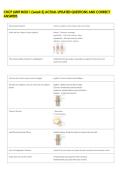
What are the 4 types of body habitus? sthenic - Common, average
hyposthenic - 2nd most common, skinny
hypersthenic - 3rd most common, broad
asthenic - least common, narrow
Why is body habitus important in radiography? it determines the size, shape, and position of organs of the thoracic and
abdominal cavities
What are the common planes used in imaging? Sagittal, Coronal, Horizontal and Oblique
Describe the Sagittal, coronal, horizontal and oblique Sagittal - divides body into left and right
planes Coronal - divided body into front/back
Horizontal - divides body into top and bottom
Oblique - angled and specific
Planes of the skull 1. Base plane
2. Occlusal plane
Axial Plane (Transverse Plane) Horizontal plane, divides the body into upper and lower parts
What is Radiographic Projection a path of the x-ray beam as it passes through the patient (from entrance to exit)
What does AP and PA mean? Anteroposterior (ray passes from front to back)
Posteroanterior (ray passes from back to front)
ANSWERS
What is body habitus? common variations in the shape of the human body
What are the 4 types of body habitus? sthenic - Common, average
hyposthenic - 2nd most common, skinny
hypersthenic - 3rd most common, broad
asthenic - least common, narrow
Why is body habitus important in radiography? it determines the size, shape, and position of organs of the thoracic and
abdominal cavities
What are the common planes used in imaging? Sagittal, Coronal, Horizontal and Oblique
Describe the Sagittal, coronal, horizontal and oblique Sagittal - divides body into left and right
planes Coronal - divided body into front/back
Horizontal - divides body into top and bottom
Oblique - angled and specific
Planes of the skull 1. Base plane
2. Occlusal plane
Axial Plane (Transverse Plane) Horizontal plane, divides the body into upper and lower parts
What is Radiographic Projection a path of the x-ray beam as it passes through the patient (from entrance to exit)
What does AP and PA mean? Anteroposterior (ray passes from front to back)
Posteroanterior (ray passes from back to front)


