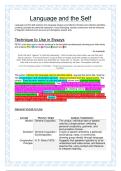
Language and the Self
Language and the Self explores how language shapes and reflects individual and collective identities,
covering concepts like personal expression, social belonging, identity construction and the influence
of linguistic elements such as slurs and derogatory speech acts.
Technique to Use in Essays
PETAL is the best way to use the evidence in the text while simultaneously showing your wider study
and analysis. Point Evidence Technique Analysis and Link.
An example:
Even the term “reserve” is cold and alienating – think of what we mean when we use that word
about a person. “The environment” is just as bad: an empty word that creates no pictures in the
mind. Wild animals and plants are described as “resources” or “stocks,” as if they belong to us and
their role is to serve us: a notion disastrously extended by the term “ecosystem services.”
From The Guardian article in 2019 titled, “Forget ‘the environment’: we need new words to convey life’s
wonders”.
The author criticizes the language used to describe nature, arguing that terms like “reserve,”
“the environment,” and “ecosystem services” distance humans from the natural world. The
phrase “Even the term ‘reserve’ is cold and alienating shows how common terminology
frames nature as impersonal or utilitarian. This connects to the Sapir-Whorf Hypothesis
(1929) on linguistic relativity/determinism, which proposes that the language we use shape
our thoughts and ifluences how we perceive reality. By labelling nature in mechanistic or
ownership-based terms like “reserves’, our understanding of the natural world becomes
limited and objectifying. The paragraph demonstrates that language is not neutral, because
describing plants and animals as “stocks” encourages humans to see them primarily as tools
for exploitation rather than beings with intrinsic value.
General Vocab to Use
Concept Theorist / Origin Analysis / Explanation
Idiolect General Linguistics The unique, individual style of speech
used by a single person, reflecting
personal vocabulary, grammar, and
pronunciation choices.
Sociolect General Linguistics / A style of speech shared by a particular
Sociolinguistics social group, class, or community,
showing group identity through language.
Cooperative H. P. Grice (1975) Suggests that speakers typically try to be
Principle understood and make sense, and listeners
assume this, using context and inference
to interpret meaning.
, Face- Penelope Brown & Words or actions that risk damaging
threatening Stephen Levinson someone’s social self-esteem (“face”),
acts (FTA) (1987) either by challenging their authority or
imposing on them.
Positive Brown & Levinson Strategies to build rapport and make the
Politeness (1987) listener feel appreciated or liked, e.g.,
compliments, jokes, shared references.
Negative Brown & Levinson Politeness strategies aimed at minimizing
Politeness (1987) imposition, showing respect, and avoiding
offending the listener when making
requests.
Adversative General Linguistics Words that connect clauses or sentences
Conjunction while signalling contrast, opposition, or
exception, e.g., “but” “however.”
Narrative Jerome Bruner Constructing self through stories like
Construction (1991) Writing about life events in diaries Shows
how language constructs temporal and
personal identity.
Audience Elaborated by Alan Adjusting speech style across contexts.
Design/Self Bell (1984) Code-switching between slang with
Styling friends and formal language at school.
Illustrates adaptability and context-
dependent self-presentation.
Theories to Know for Self-Identity & Perception
Face Theory initiated by Erving Goffman in 1967 and developed by Penelope Brown
and Steven Levinson in the last 1980s.
Described conversational face as the image one has of themselves as a
conversationalist.
Examples of face threatening acts :
- disapproval, criticism, complaints, accusations, contradictions, disagreements
- expressions of violent emotions, taboo topics, bad news, emotional topics,
interruptions etc.
Examples of positive politeness :
- Compliments, praise, mutually understood jokes, in-group jargon, backchanneling,
using exaggerated speech
Examples of negative politeness strategies :
- Indirect orders/commands
- Minimising the imposition by e.g apologising, hedging and impersonalisation
-
(Any conversation can threaten or impose upon, so the speaker can feel ignored or ridiculed)
Language and the Self explores how language shapes and reflects individual and collective identities,
covering concepts like personal expression, social belonging, identity construction and the influence
of linguistic elements such as slurs and derogatory speech acts.
Technique to Use in Essays
PETAL is the best way to use the evidence in the text while simultaneously showing your wider study
and analysis. Point Evidence Technique Analysis and Link.
An example:
Even the term “reserve” is cold and alienating – think of what we mean when we use that word
about a person. “The environment” is just as bad: an empty word that creates no pictures in the
mind. Wild animals and plants are described as “resources” or “stocks,” as if they belong to us and
their role is to serve us: a notion disastrously extended by the term “ecosystem services.”
From The Guardian article in 2019 titled, “Forget ‘the environment’: we need new words to convey life’s
wonders”.
The author criticizes the language used to describe nature, arguing that terms like “reserve,”
“the environment,” and “ecosystem services” distance humans from the natural world. The
phrase “Even the term ‘reserve’ is cold and alienating shows how common terminology
frames nature as impersonal or utilitarian. This connects to the Sapir-Whorf Hypothesis
(1929) on linguistic relativity/determinism, which proposes that the language we use shape
our thoughts and ifluences how we perceive reality. By labelling nature in mechanistic or
ownership-based terms like “reserves’, our understanding of the natural world becomes
limited and objectifying. The paragraph demonstrates that language is not neutral, because
describing plants and animals as “stocks” encourages humans to see them primarily as tools
for exploitation rather than beings with intrinsic value.
General Vocab to Use
Concept Theorist / Origin Analysis / Explanation
Idiolect General Linguistics The unique, individual style of speech
used by a single person, reflecting
personal vocabulary, grammar, and
pronunciation choices.
Sociolect General Linguistics / A style of speech shared by a particular
Sociolinguistics social group, class, or community,
showing group identity through language.
Cooperative H. P. Grice (1975) Suggests that speakers typically try to be
Principle understood and make sense, and listeners
assume this, using context and inference
to interpret meaning.
, Face- Penelope Brown & Words or actions that risk damaging
threatening Stephen Levinson someone’s social self-esteem (“face”),
acts (FTA) (1987) either by challenging their authority or
imposing on them.
Positive Brown & Levinson Strategies to build rapport and make the
Politeness (1987) listener feel appreciated or liked, e.g.,
compliments, jokes, shared references.
Negative Brown & Levinson Politeness strategies aimed at minimizing
Politeness (1987) imposition, showing respect, and avoiding
offending the listener when making
requests.
Adversative General Linguistics Words that connect clauses or sentences
Conjunction while signalling contrast, opposition, or
exception, e.g., “but” “however.”
Narrative Jerome Bruner Constructing self through stories like
Construction (1991) Writing about life events in diaries Shows
how language constructs temporal and
personal identity.
Audience Elaborated by Alan Adjusting speech style across contexts.
Design/Self Bell (1984) Code-switching between slang with
Styling friends and formal language at school.
Illustrates adaptability and context-
dependent self-presentation.
Theories to Know for Self-Identity & Perception
Face Theory initiated by Erving Goffman in 1967 and developed by Penelope Brown
and Steven Levinson in the last 1980s.
Described conversational face as the image one has of themselves as a
conversationalist.
Examples of face threatening acts :
- disapproval, criticism, complaints, accusations, contradictions, disagreements
- expressions of violent emotions, taboo topics, bad news, emotional topics,
interruptions etc.
Examples of positive politeness :
- Compliments, praise, mutually understood jokes, in-group jargon, backchanneling,
using exaggerated speech
Examples of negative politeness strategies :
- Indirect orders/commands
- Minimising the imposition by e.g apologising, hedging and impersonalisation
-
(Any conversation can threaten or impose upon, so the speaker can feel ignored or ridiculed)