

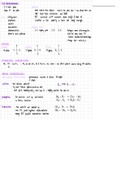
3. 3.3 HALOGEN OALKANES
.
-
C X bond
-
:
polar properties
down ft less polar more reactive than alkanes result of this polar bond attract other
-
→
can ions
-
: -
-
IMF :
dipole dipole
-
attractions and Vdw's
uses
refrigerants BPT increased with increased chain length & down b't
- -
propellants
-
insoluble in tho :
polarity in bond not
large enough
solvents
anaesthetics halogen bond
C ft X d-
pharmaceuticals C t slightly polar : :
halogens more
electronegative
- -
-
to pollution bond less polar down Gt
proven cause
-
how (how fast reaction
4 affects happen
stronger bond reactivity 4
- -
-
STRUCTURE
Mimmo .
. .
a Iiit:p . "
÷ .
.
. titis'm . "
;i÷ .
UNSYMMETRICAL HALOGEN O ALKANES
side , Brd affect products diff reactions
yr
CH , CHIH , CH , CHCH, the other created
during
=
=
on one can
-
-
MAKING HALO GENO ALKANES
(UV
FREE RADICAL SUBSTITUTION photochemical reaction of alkanes light )
-
3 stages
.
initiation -
free radicalsproduced a , Mimi a .
+ Cl .
-
Ch bond broken photo dissociation : luv)
bond
splits hemolytically each keep le highly reactive free radical
-
=
-
-
free radicals and created ( th Cl CH , HCl
propagation used t .
→ • t
up
-
in chain reaction Ctb .
t Ck →
CH , Cl t Cl .
termination free radicals are mopped
•
CH t Cl . → CH , Cl
up
-
,
-
two FR
joined together
-
-
stable molecule .
Ah t.CH, → CH, CH ,
diff possible termination reactions
many
-
, 3. 3. 3.1 . NUCLEOPHILIC SUBSTITUTION
nucleophile reagent that possesses at least one lone pair and is attached to the
partially ⑤ C atom
rt
yr
.
( -
-
LH :]
-
-
neg .
charged ion l atom with a
partial charge Crt key nucleophiles : OH -
hydroxide ion
i. CN f. ⇐ ng
-
has lone pair of e- cyanide
.
-
X electronegative
: NH , "
Ii H
-
ammonia
-
more
-
-
-
substitution reaction reflux :
mixture heated to BPT
halogen atom is
exchanged for another NO loss OF REACTANTS l PRODUCTS
by evaporation
of atoms alkanes
atom or
groups in
halogen reactants rise
up equipment cooled icon dense back
H
HYDROXIDE ION
① '
ft f -
R t R C t
- -
t
OH →
ROH t t - -
-
'
t replaced by OH H i. OH
reagent :
NaOH KOH H
conditions NaOH HOH ② '
both bonded
:
aqueous
-
R -
C - X
be temp (slow) refluxed too
many
bonds
-
warm -
can room .
→ in
H
small amount of ethanol (NaOH HOH doesn't dissolve in tho) .
.
OH
fr )
-
alcohol formed ③
fifer: Yang
-
"
hydrolysis reaction
-
.
and t separates
important : Partial
charges µ,
lone pair ① "
,
(Nat spectator ion)
double headed R C OH
-
-
arrow
ay
-
-
'
mark scheme ! made
'
- H -
halide ion
3
stages
"
mechanism C t bond
-
polar C attracts lone of e- from OH
-
-
:
pair
. -
;
cot
-
•
OH ion attacks
&
-
•
new bond formed between C OH
-
-
alcohol
C X breaks heterolytic both
ally e- to t
making halide
-
°
-
ion
.
-
C X bond
-
:
polar properties
down ft less polar more reactive than alkanes result of this polar bond attract other
-
→
can ions
-
: -
-
IMF :
dipole dipole
-
attractions and Vdw's
uses
refrigerants BPT increased with increased chain length & down b't
- -
propellants
-
insoluble in tho :
polarity in bond not
large enough
solvents
anaesthetics halogen bond
C ft X d-
pharmaceuticals C t slightly polar : :
halogens more
electronegative
- -
-
to pollution bond less polar down Gt
proven cause
-
how (how fast reaction
4 affects happen
stronger bond reactivity 4
- -
-
STRUCTURE
Mimmo .
. .
a Iiit:p . "
÷ .
.
. titis'm . "
;i÷ .
UNSYMMETRICAL HALOGEN O ALKANES
side , Brd affect products diff reactions
yr
CH , CHIH , CH , CHCH, the other created
during
=
=
on one can
-
-
MAKING HALO GENO ALKANES
(UV
FREE RADICAL SUBSTITUTION photochemical reaction of alkanes light )
-
3 stages
.
initiation -
free radicalsproduced a , Mimi a .
+ Cl .
-
Ch bond broken photo dissociation : luv)
bond
splits hemolytically each keep le highly reactive free radical
-
=
-
-
free radicals and created ( th Cl CH , HCl
propagation used t .
→ • t
up
-
in chain reaction Ctb .
t Ck →
CH , Cl t Cl .
termination free radicals are mopped
•
CH t Cl . → CH , Cl
up
-
,
-
two FR
joined together
-
-
stable molecule .
Ah t.CH, → CH, CH ,
diff possible termination reactions
many
-
, 3. 3. 3.1 . NUCLEOPHILIC SUBSTITUTION
nucleophile reagent that possesses at least one lone pair and is attached to the
partially ⑤ C atom
rt
yr
.
( -
-
LH :]
-
-
neg .
charged ion l atom with a
partial charge Crt key nucleophiles : OH -
hydroxide ion
i. CN f. ⇐ ng
-
has lone pair of e- cyanide
.
-
X electronegative
: NH , "
Ii H
-
ammonia
-
more
-
-
-
substitution reaction reflux :
mixture heated to BPT
halogen atom is
exchanged for another NO loss OF REACTANTS l PRODUCTS
by evaporation
of atoms alkanes
atom or
groups in
halogen reactants rise
up equipment cooled icon dense back
H
HYDROXIDE ION
① '
ft f -
R t R C t
- -
t
OH →
ROH t t - -
-
'
t replaced by OH H i. OH
reagent :
NaOH KOH H
conditions NaOH HOH ② '
both bonded
:
aqueous
-
R -
C - X
be temp (slow) refluxed too
many
bonds
-
warm -
can room .
→ in
H
small amount of ethanol (NaOH HOH doesn't dissolve in tho) .
.
OH
fr )
-
alcohol formed ③
fifer: Yang
-
"
hydrolysis reaction
-
.
and t separates
important : Partial
charges µ,
lone pair ① "
,
(Nat spectator ion)
double headed R C OH
-
-
arrow
ay
-
-
'
mark scheme ! made
'
- H -
halide ion
3
stages
"
mechanism C t bond
-
polar C attracts lone of e- from OH
-
-
:
pair
. -
;
cot
-
•
OH ion attacks
&
-
•
new bond formed between C OH
-
-
alcohol
C X breaks heterolytic both
ally e- to t
making halide
-
°
-
ion


