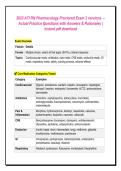
2023 ATI RN Pharmacology Proctored Exam 2 versions –
Actual Practice Questions with Answers & Rationales |
instant pdf download
Exam Overview
Feature Details
Format Multiple choice, select all that apply (SATA), ordered response
Topics Cardiovascular meds, antibiotics, pain meds, CNS meds, endocrine meds, GI
meds, respiratory meds, safety, nursing process, adverse effects
🎯 Core Medication Categories Tested
Category Examples
Cardiovascular Digoxin, amiodarone, warfarin, heparin, enoxaparin, clopidogrel,
lisinopril, losartan, metoprolol, furosemide, HCTZ, spironolactone,
atorvastatin
Antibiotics Penicillins, cephalosporins, tetracyclines, macrolides,
aminoglycosides, fluoroquinolones, vancomycin, sulfonamides,
metronidazole
Pain & Morphine, hydromorphone, fentanyl, meperidine, naloxone,
Inflammation acetaminophen, ibuprofen, naproxen, celecoxib
CNS Benzodiazepines (lorazepam, diazepam), antidepressants
(fluoxetine, sertraline), antipsychotics, anticonvulsants
Endocrine Insulin (rapid, short, intermediate, long), metformin, glipizide,
levothyroxine, methimazole, prednisone
GI Omeprazole, pantoprazole, metoclopramide, ondansetron,
promethazine, lactulose, rifaximin
Respiratory Albuterol, ipratropium, fluticasone, montelukast, theophylline
, Safety & Misc Labs to monitor, adverse effects, contraindications, patient
teaching, antidotes
Cardiovascular Medications (Questions 1–25)
1. A nurse is caring for a client with heart failure who is prescribed digoxin. Which
finding requires immediate intervention?
a) Heart rate of 62 bpm
b) *Serum potassium level of 3.2 mEq/L*
c) Blood pressure of 118/72 mm Hg
d) Respiratory rate of 18/min
*Explanation: Hypokalemia (K+ <3.5 mEq/L) increases the risk of digoxin toxicity. Digoxin
binds to the same cardiac receptor sites as potassium, and low potassium levels increase
receptor sensitivity, leading to toxicity symptoms like nausea, vomiting, visual changes, and
dysrhythmias .*
2. A nurse is administering warfarin to a client with atrial fibrillation. Which laboratory
test should the nurse monitor to evaluate therapeutic effect?
a) aPTT
b) INR
c) Platelet count
d) Bleeding time
*Explanation: Warfarin is monitored using the INR (International Normalized Ratio) and PT
(Prothrombin Time). Therapeutic INR for atrial fibrillation is typically 2.0-3.0. aPTT is used to
monitor heparin therapy .*
3. A client receiving heparin IV reports burning at the IV site and the nurse notes
redness and swelling. What is the priority action?
a) Slow the infusion rate
b) Apply a warm compress
c) Discontinue the infusion and notify the provider
d) Document the finding and continue monitoring
Explanation: Redness, swelling, and burning at the IV site indicate thrombophlebitis or
infiltration. Heparin can cause tissue damage if infiltrated. The infusion should be
discontinued immediately, and the provider should be notified .
,4. A nurse is administering enoxaparin (Lovenox) subcutaneously. Which technique
is correct?
a) Aspirate before injecting
b) Inject into the abdomen while holding a skin fold
c) Massage the site after injection
d) Expel the air bubble before injection
Explanation: Enoxaparin is given subcutaneously in the abdomen, using a skin fold. Do
NOT aspirate (risk of hematoma) and do NOT expel the air bubble (helps clear the needle
and prevents drug loss). Do NOT massage the site .
5. A nurse is providing discharge teaching to a client prescribed warfarin. Which
statement by the client indicates understanding?
a) "I will take ibuprofen for headaches."
b) "I will eat the same amount of green leafy vegetables each week."
c) "I will stop taking warfarin if I see bruising."
d) "I will take my warfarin in the morning with my multivitamin."
Explanation: Green leafy vegetables contain vitamin K, which antagonizes warfarin.
Consistency in vitamin K intake is essential to maintain a stable INR. Ibuprofen increases
bleeding risk. Multivitamins may contain vitamin K .
6. A client prescribed amiodarone reports coughing and shortness of breath. What
adverse effect should the nurse suspect?
a) Heart failure
b) Pulmonary toxicity
c) Liver failure
d) Thyroid dysfunction
Explanation: Amiodarone can cause pulmonary toxicity, which presents as dry cough,
dyspnea, and decreased exercise tolerance. This is a serious adverse effect that requires
immediate evaluation and possible discontinuation of the medication .
7. A nurse is administering furosemide (Lasix) IV push. Which finding indicates the
medication is having the desired effect?
a) Blood pressure increases
b) Urine output increases
c) Heart rate decreases
d) Respiratory rate increases
, Explanation: Furosemide is a loop diuretic used to reduce fluid overload in heart failure,
renal disease, and hypertension. The desired effect is increased urine output (diuresis),
which reduces edema and preload .
8. A client taking lisinopril develops a persistent dry cough. What should the nurse
do?
a) Administer an antitussive medication
b) Notify the provider; the client may need an ARB instead
c) Tell the client to take the medication with food
d) Reassure the client that the cough will resolve
Explanation: A persistent dry cough is a common adverse effect of ACE inhibitors
(lisinopril) due to accumulation of bradykinin. The provider may switch to an ARB (losartan,
valsartan), which does not cause cough .
9. A nurse is administering metoprolol to a client with hypertension. Which finding
should the nurse report immediately?
a) Heart rate of 58 bpm
b) Heart rate of 48 bpm with dizziness
c) Blood pressure of 118/76 mm Hg
d) Respiratory rate of 16/min
*Explanation: Symptomatic bradycardia (HR <50 with dizziness, hypotension, fatigue)
indicates excessive beta-blockade. The medication may need to be withheld and the
provider notified. A HR of 58 without symptoms may be acceptable .*
10. A client taking atorvastatin reports muscle pain and weakness. Which lab value
should the nurse check?
a) ALT/AST
b) Creatine kinase (CK)
c) BUN and creatinine
d) Electrolytes
Explanation: Muscle pain and weakness in a client taking a statin (atorvastatin) suggests
rhabdomyolysis. Elevated creatine kinase (CK) confirms muscle breakdown. ALT/AST
monitor liver function, not muscle damage .
11. A nurse is teaching a client about spironolactone. Which statement indicates
understanding?
a) "I should increase my intake of bananas and oranges."
b) "I should avoid salt substitutes containing potassium."
Actual Practice Questions with Answers & Rationales |
instant pdf download
Exam Overview
Feature Details
Format Multiple choice, select all that apply (SATA), ordered response
Topics Cardiovascular meds, antibiotics, pain meds, CNS meds, endocrine meds, GI
meds, respiratory meds, safety, nursing process, adverse effects
🎯 Core Medication Categories Tested
Category Examples
Cardiovascular Digoxin, amiodarone, warfarin, heparin, enoxaparin, clopidogrel,
lisinopril, losartan, metoprolol, furosemide, HCTZ, spironolactone,
atorvastatin
Antibiotics Penicillins, cephalosporins, tetracyclines, macrolides,
aminoglycosides, fluoroquinolones, vancomycin, sulfonamides,
metronidazole
Pain & Morphine, hydromorphone, fentanyl, meperidine, naloxone,
Inflammation acetaminophen, ibuprofen, naproxen, celecoxib
CNS Benzodiazepines (lorazepam, diazepam), antidepressants
(fluoxetine, sertraline), antipsychotics, anticonvulsants
Endocrine Insulin (rapid, short, intermediate, long), metformin, glipizide,
levothyroxine, methimazole, prednisone
GI Omeprazole, pantoprazole, metoclopramide, ondansetron,
promethazine, lactulose, rifaximin
Respiratory Albuterol, ipratropium, fluticasone, montelukast, theophylline
, Safety & Misc Labs to monitor, adverse effects, contraindications, patient
teaching, antidotes
Cardiovascular Medications (Questions 1–25)
1. A nurse is caring for a client with heart failure who is prescribed digoxin. Which
finding requires immediate intervention?
a) Heart rate of 62 bpm
b) *Serum potassium level of 3.2 mEq/L*
c) Blood pressure of 118/72 mm Hg
d) Respiratory rate of 18/min
*Explanation: Hypokalemia (K+ <3.5 mEq/L) increases the risk of digoxin toxicity. Digoxin
binds to the same cardiac receptor sites as potassium, and low potassium levels increase
receptor sensitivity, leading to toxicity symptoms like nausea, vomiting, visual changes, and
dysrhythmias .*
2. A nurse is administering warfarin to a client with atrial fibrillation. Which laboratory
test should the nurse monitor to evaluate therapeutic effect?
a) aPTT
b) INR
c) Platelet count
d) Bleeding time
*Explanation: Warfarin is monitored using the INR (International Normalized Ratio) and PT
(Prothrombin Time). Therapeutic INR for atrial fibrillation is typically 2.0-3.0. aPTT is used to
monitor heparin therapy .*
3. A client receiving heparin IV reports burning at the IV site and the nurse notes
redness and swelling. What is the priority action?
a) Slow the infusion rate
b) Apply a warm compress
c) Discontinue the infusion and notify the provider
d) Document the finding and continue monitoring
Explanation: Redness, swelling, and burning at the IV site indicate thrombophlebitis or
infiltration. Heparin can cause tissue damage if infiltrated. The infusion should be
discontinued immediately, and the provider should be notified .
,4. A nurse is administering enoxaparin (Lovenox) subcutaneously. Which technique
is correct?
a) Aspirate before injecting
b) Inject into the abdomen while holding a skin fold
c) Massage the site after injection
d) Expel the air bubble before injection
Explanation: Enoxaparin is given subcutaneously in the abdomen, using a skin fold. Do
NOT aspirate (risk of hematoma) and do NOT expel the air bubble (helps clear the needle
and prevents drug loss). Do NOT massage the site .
5. A nurse is providing discharge teaching to a client prescribed warfarin. Which
statement by the client indicates understanding?
a) "I will take ibuprofen for headaches."
b) "I will eat the same amount of green leafy vegetables each week."
c) "I will stop taking warfarin if I see bruising."
d) "I will take my warfarin in the morning with my multivitamin."
Explanation: Green leafy vegetables contain vitamin K, which antagonizes warfarin.
Consistency in vitamin K intake is essential to maintain a stable INR. Ibuprofen increases
bleeding risk. Multivitamins may contain vitamin K .
6. A client prescribed amiodarone reports coughing and shortness of breath. What
adverse effect should the nurse suspect?
a) Heart failure
b) Pulmonary toxicity
c) Liver failure
d) Thyroid dysfunction
Explanation: Amiodarone can cause pulmonary toxicity, which presents as dry cough,
dyspnea, and decreased exercise tolerance. This is a serious adverse effect that requires
immediate evaluation and possible discontinuation of the medication .
7. A nurse is administering furosemide (Lasix) IV push. Which finding indicates the
medication is having the desired effect?
a) Blood pressure increases
b) Urine output increases
c) Heart rate decreases
d) Respiratory rate increases
, Explanation: Furosemide is a loop diuretic used to reduce fluid overload in heart failure,
renal disease, and hypertension. The desired effect is increased urine output (diuresis),
which reduces edema and preload .
8. A client taking lisinopril develops a persistent dry cough. What should the nurse
do?
a) Administer an antitussive medication
b) Notify the provider; the client may need an ARB instead
c) Tell the client to take the medication with food
d) Reassure the client that the cough will resolve
Explanation: A persistent dry cough is a common adverse effect of ACE inhibitors
(lisinopril) due to accumulation of bradykinin. The provider may switch to an ARB (losartan,
valsartan), which does not cause cough .
9. A nurse is administering metoprolol to a client with hypertension. Which finding
should the nurse report immediately?
a) Heart rate of 58 bpm
b) Heart rate of 48 bpm with dizziness
c) Blood pressure of 118/76 mm Hg
d) Respiratory rate of 16/min
*Explanation: Symptomatic bradycardia (HR <50 with dizziness, hypotension, fatigue)
indicates excessive beta-blockade. The medication may need to be withheld and the
provider notified. A HR of 58 without symptoms may be acceptable .*
10. A client taking atorvastatin reports muscle pain and weakness. Which lab value
should the nurse check?
a) ALT/AST
b) Creatine kinase (CK)
c) BUN and creatinine
d) Electrolytes
Explanation: Muscle pain and weakness in a client taking a statin (atorvastatin) suggests
rhabdomyolysis. Elevated creatine kinase (CK) confirms muscle breakdown. ALT/AST
monitor liver function, not muscle damage .
11. A nurse is teaching a client about spironolactone. Which statement indicates
understanding?
a) "I should increase my intake of bananas and oranges."
b) "I should avoid salt substitutes containing potassium."