

Written by students who passed Immediately available after payment Read online or as PDF Wrong document? Swap it for free 4.6 TrustPilot
logo-home
Document preview thumbnail
Preview 2 out of 9 pages
Exam (elaborations)

WSET Level 3 Award in Wines 2026 Expert Verified Questions and Answers (250+ Q&A) | Viticulture, German Wines, Loire Valley, Burgundy, Rhône & Spain

Document preview thumbnail
Preview 2 out of 9 pages

This comprehensive WSET Level 3 Award in Wines 2026 study guide contains more than 250 expertly compiled exam questions and verified answers designed to help candidates excel in the WSET Level 3 Award in Wines examination. Presented in an easy-to-review "Ace-the-Text" question-and-answer format, this resource focuses on high-yield facts, definitions, regional classifications, and essential concepts that frequently appear in WSET assessments. Covering viticulture fundamentals, vineyard management, winemaking terminology, major European wine regions, and appellation systems, this study guide strengthens recall, improves exam efficiency, and enhances confidence during both revision and examination settings. This accelerated review begins with core viticulture concepts essential for WSET Level 3 success. Students will master the vine growth cycle from dormancy through budburst, flowering, fruit set, véraison, and ripening. The guide explains continentality, diurnal range, climate classifications, growing seasons, frost protection techniques, irrigation systems, soil composition, vine nutrition, humus, loam, and the environmental factors influencing grape development and wine quality. Additional topics include bloom, hydric stress, phylloxera, and the practical application of vineyard management techniques used worldwide. The resource provides detailed coverage of winemaking science and production terminology. Learners will review anaerobic winemaking, clarification methods, inert vessels, aromatic grape varieties, secondary aroma development, carbonic maceration, cold soaking, cap management techniques, and the sensory outcomes associated with different production choices. The guide also examines training and pruning systems including head training, cordon training, goblet training, spur pruning, replacement cane pruning, Vertical Shoot Positioning (VSP), and the benefits of trellising for sunlight exposure, airflow, and mechanisation. German wine regions and classifications receive significant emphasis throughout this review. Students will identify key Mosel villages including Piesport, Bernkastel, and Wehlen, alongside important villages in Rheingau, Pfalz, Nahe, and Rheinhessen. The material reinforces understanding of regional geography and highlights the villages most commonly referenced during examinations. These concise memory aids enable candidates to confidently answer location-based questions frequently encountered in WSET assessments. The Loire Valley section provides a structured review of the region's major subdivisions, including the Central Vineyards, Touraine, Anjou-Saumur, and Nantais. Students will explore each area's principal appellations, climates, soil types, and signature wine styles. The guide further reviews Muscadet, Vouvray, Sancerre, Pouilly-Fumé, Chinon, Bourgueil, and the region's most important sweet wine appellations, helping candidates compare styles and regional characteristics with precision. Burgundy and Rhône Valley concepts are presented in an accessible exam-focused format. Candidates will review climatic hazards affecting Burgundy, the key villages of Côte de Nuits, Côte de Beaune, Côte Chalonnaise, Mâconnais, and the leading Beaujolais crus. Northern and Southern Rhône topics include the effects of co-fermenting Syrah with white varieties, major grape varieties, regional appellations, and vineyard adaptations used to mitigate the impact of the Mistral wind. The guide concludes with essential Spanish and Italian classification knowledge, including Spain's principal wine-producing regions and Barolo and Barbaresco ageing requirements. These concise facts support rapid memorisation and reinforce the theoretical knowledge necessary to achieve examination success. By integrating viticulture, winemaking terminology, regional geography, and appellation systems into a streamlined question-and-answer format, this resource provides an efficient and highly effective revision tool for candidates pursuing the WSET Level 3 Award in Wines. The concepts presented throughout this study guide align with authoritative wine education references and internationally recognised educational standards commonly utilised in professional wine training, including: • Wine & Spirit Education Trust (WSET). Level 3 Award in Wines Specification. • Johnson H, Robinson J. The World Atlas of Wine. • Robinson J, Harding J, Vouillamoz J. Wine Grapes: A Complete Guide to 1,368 Vine Varieties, Including Their Origins and Flavours. • Stevenson T. The Sotheby's Wine Encyclopedia. • Jackson RS. Wine Science: Principles and Applications. • Peynaud E. The Taste of Wine: The Art and Science of Wine Appreciation. Relevant Students: This document is ideal for WSET Level 3 candidates, aspiring sommeliers, wine educators, hospitality students, beverage professionals, restaurant managers, retail wine consultants, wine merchants, tasting room staff, culinary students, tourism professionals, wine judges in training, and wine enthusiasts seeking a concise yet comprehensive revision resource for professional wine certification examinations. Keywords: WSET Level 3, WSET Level 3 Award in Wines, WSET Level 3 exam questions, WSET Level 3 answers, WSET Ace the Text, WSET revision guide, viticulture, vine growth cycle, continentality, diurnal range, spring frost protection, irrigation, humus, loam, vine nutrients, bloom, hydric stress, phylloxera, anaerobic winemaking, clarification, inert vessels, aromatic grape varieties, secondary aromas, cold soaking, carbonic maceration, cap management, head training, cordon training, goblet training, spur pruning, cane pruning, VSP, trellising, Mosel villages, Rheingau, Pfalz, Nahe, Rheinhessen, Loire Valley, Sancerre, Pouilly Fumé, Vouvray, Chinon, Muscadet, Burgundy villages, Côte de Nuits, Côte de Beaune, Beaujolais crus, Northern Rhône, Southern Rhône, Mistral, Spain wine regions, Rioja, Ribera del Duero, Priorat, Rías Baixas, Barolo ageing rules, Barbaresco ageing rules, sommelier preparation, wine certification preparation

Content preview

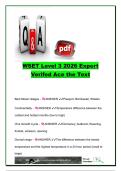
WSET Level 3 2026 Expert
Verifed Ace the Text


Best Mosel villages - ANSWER ✔✔Piesport, Bernkastel, Whelen


Continentality - ANSWER ✔✔Temperature difference between the

coldest and hottest months (low to high)


Vine Growth Cycle - ANSWER ✔✔Dormancy, budburst, flowering,

fruitset, véraison, ripening


Diurnal range - ANSWER ✔✔The difference between the lowest

temperature and the highest temperature in a 24 hour period (small to

large)

, Spring frost protection (4 methods) - ANSWER ✔✔Heaters, wind

machines, sprinklers, vineyard design


Types of irrigation (3) - ANSWER ✔✔Drip irrigation, sprinklers, flood

irrigation


Growing season - ANSWER ✔✔April to October (or October to April)


Climate temperatures - ANSWER ✔✔Cool (below 16.5), moderate

(16.5-18.5), warm (18.5-21), hot (abowe 21)


Climate categories - ANSWER ✔✔Mediterranean (Tuscany,

California), Continental (Chablis, Champagne, Austria) and Maritime

(Bordeaux, Rias Baixas)


Humus - ANSWER ✔✔Material formed from decaying leaves and

other organic matter


Loam - ANSWER ✔✔Soil made up of clay and sand


Nutrients for a vine (3) - ANSWER ✔✔Nitrogen, phospherous,

potassium


Bloom - ANSWER ✔✔Waxy surface covering grapeskins and

containing yeast

Document information

Uploaded on
June 11, 2026
Number of pages
9
Written in
2025/2026
Type
Exam (elaborations)
Contains
Questions & answers
$18.99

Wrong document? Swap it for free Within 14 days of purchase and before downloading, you can choose a different document. You can simply spend the amount again.
Written by students who passed
Immediately available after payment
Read online or as PDF

Seller avatar
Reputation scores are based on the amount of documents a seller has sold for a fee and the reviews they have received for those documents. There are three levels: Bronze, Silver and Gold. The better the reputation, the more your can rely on the quality of the sellers work.
JOSHCLAY
3.5
(84)
Sold
392
Followers
15
Items
20577
Last sold
1 day ago


Why students choose Stuvia

Created by fellow students, verified by reviews

Quality you can trust: written by students who passed their tests and reviewed by others who've used these notes.

Didn't get what you expected? Choose another document

No worries! You can instantly pick a different document that better fits what you're looking for.

Pay as you like, start learning right away

No subscription, no commitments. Pay the way you're used to via credit card and download your PDF document instantly.

Student with book image

“Bought, downloaded, and aced it. It really can be that simple.”

Alisha Student

Working on your references?

Create accurate citations in APA, MLA and Harvard with our free citation generator.

Working on your references?

Frequently asked questions

