H/W 23rd February 2017
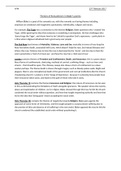
Themes of Romanticism in Blake’s poems
William Blake is a poet of the romantic era, with the romantic era having themes including
emphasis on emotional and imaginative spontaneity, individuality, religion and nature.
For example, The Tyger has a connection to the themes Religion; Blake questions who ‘created’ the
Tyger, whilst ignoring the idea that someone or something is omnipotent. He then challenges who
‘dares forge the Tyger’, and shows how he isn’t afraid to question God’s supremacy – particularly in
a time when religious individuals had a great sway over people.
The Sick Rose has themes of Mortality, Violence, Love and Sex; mortality in terms of how long the
Rose has before death, associated with Love, which doesn’t help the rose, but instead diseases and
infects the rose; Violence due to how the rose is destroyed by the ‘worm’; and Sex due to how the
worm penetrates a ‘bed of crimson joy’, and how the rose has a ‘dark secret love’.
London contains themes of Freedom and Confinement, Death, and Innocence; this is a poem about
literal forms of confinement: chartering, methods of control, confining things – such as rivers and
streets – that should be open. The chimney sweep also shows a form of confinement as a slave
worker perhaps. The theme death is shown through imagery such as bloody palace walls, blight and
plagues; there is also metaphorical death of the government and corrupt institutions like the Church
(‘blackening church’). London is in the ‘Songs of Experience’, because it is showing how people have
their innocence taken away, and leads to the guilt of those who take it away.
Holy Thursday (I) contains the themes Innocence and Religion; the nature of innocence can be seen
in this as demonstrating the limitations of itself, alongside ignorance. The speaker shows the naivety,
abuse and exploitation of children. As for religion, Blake showed through this how he felt the Church
condoned the social order without question, and how they taught respecting authority and how that
led to the idea that ‘being good’ meant accepting the social order.
Holy Thursday (E) contains the themes of negativity towards Religion; Blake goes against the
approach of some forms of Christianity, and this taught people to accept present suffering due to
the promise of bliss and absence of all suffering in the next world. Blake opposed the way he felt the
church condoned the established social order without questioning it.
Themes of Romanticism in Blake’s poems
William Blake is a poet of the romantic era, with the romantic era having themes including
emphasis on emotional and imaginative spontaneity, individuality, religion and nature.
For example, The Tyger has a connection to the themes Religion; Blake questions who ‘created’ the
Tyger, whilst ignoring the idea that someone or something is omnipotent. He then challenges who
‘dares forge the Tyger’, and shows how he isn’t afraid to question God’s supremacy – particularly in
a time when religious individuals had a great sway over people.
The Sick Rose has themes of Mortality, Violence, Love and Sex; mortality in terms of how long the
Rose has before death, associated with Love, which doesn’t help the rose, but instead diseases and
infects the rose; Violence due to how the rose is destroyed by the ‘worm’; and Sex due to how the
worm penetrates a ‘bed of crimson joy’, and how the rose has a ‘dark secret love’.
London contains themes of Freedom and Confinement, Death, and Innocence; this is a poem about
literal forms of confinement: chartering, methods of control, confining things – such as rivers and
streets – that should be open. The chimney sweep also shows a form of confinement as a slave
worker perhaps. The theme death is shown through imagery such as bloody palace walls, blight and
plagues; there is also metaphorical death of the government and corrupt institutions like the Church
(‘blackening church’). London is in the ‘Songs of Experience’, because it is showing how people have
their innocence taken away, and leads to the guilt of those who take it away.
Holy Thursday (I) contains the themes Innocence and Religion; the nature of innocence can be seen
in this as demonstrating the limitations of itself, alongside ignorance. The speaker shows the naivety,
abuse and exploitation of children. As for religion, Blake showed through this how he felt the Church
condoned the social order without question, and how they taught respecting authority and how that
led to the idea that ‘being good’ meant accepting the social order.
Holy Thursday (E) contains the themes of negativity towards Religion; Blake goes against the
approach of some forms of Christianity, and this taught people to accept present suffering due to
the promise of bliss and absence of all suffering in the next world. Blake opposed the way he felt the
church condoned the established social order without questioning it.