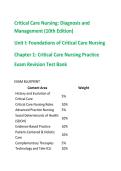
Critical Care Nursing: Diagnosis and
Management (10th Edition)
Unit I: Foundations of Critical Care Nursing
Chapter 1: Critical Care Nursing Practice
Exam Revision Test Bank
EXAM BLUEPRINT
Content Area Weight
History and Evolution of
5%
Critical Care
Critical Care Nursing Roles 10%
Advanced Practice Nursing 5%
Social Determinants of Health
10%
(SDOH)
Evidence-Based Practice 10%
Patient-Centered & Holistic
10%
Care
Complementary Therapies 5%
Technology and Tele-ICU 10%
,Interprofessional
10%
Collaboration
Rapid Response Teams 10%
Quality & Safety 10%
Healthy Work Environment 5%
MCQ | Recall | Difficulty: Easy
Question: Which statement best describes the primary goal of
contemporary critical care nursing?
A. To provide task-focused care only during periods of
hemodynamic instability
B. To deliver highly specialized, evidence-based, patient-
centered care to critically ill patients
C. To replace physician-led management in all ICU decision-
making
D. To limit interventions to life support measures only
Correct Answer: B
Rationale: Contemporary critical care nursing integrates
advanced clinical judgment, evidence-based practice,
coordination, and holistic patient-centered care.
Distractor Analysis:
,A: Too narrow; critical care includes ongoing assessment and
management.
C: Incorrect because care is interprofessional, not replacement-
based.
D: Incorrect because critical care includes prevention,
monitoring, education, and recovery support.
Learning Objective: Define the purpose of modern critical care
nursing.
Chapter Reference: Unit I, Chapter 1: Critical Care Nursing
Practice
Clinical Significance: Clarifies the nurse’s role in comprehensive
ICU care delivery.
SATA | Recall | Difficulty: Moderate
Question: Which organizations are most directly associated
with critical care nursing practice? Select all that apply.
A. Society of Critical Care Medicine (SCCM)
B. American Association of Critical-Care Nurses (AACN)
C. American Nurses Association (ANA)
D. Joint Commission
E. Centers for Disease Control and Prevention (CDC)
Correct Answers: A, B
, Rationale: SCCM and AACN are major professional
organizations specifically linked to critical care practice,
education, and standards.
Distractor Analysis:
C: ANA is a major nursing organization but not critical-care
specific.
D: The Joint Commission is a regulatory/accrediting body, not a
professional organization.
E: CDC influences infection prevention and public health, but is
not a critical care nursing organization.
Learning Objective: Identify key professional organizations
relevant to critical care nursing.
Chapter Reference: Unit I, Chapter 1: Critical Care Nursing
Practice
Clinical Significance: Supports professional development,
evidence access, and standards-based practice.
MCQ | Comprehension | Difficulty: Moderate
Question: Why are social determinants of health (SDOH)
important in critical care nursing?
A. They affect only discharge planning, not ICU outcomes
B. They influence baseline health, access to care, and recovery
outcomes
Management (10th Edition)
Unit I: Foundations of Critical Care Nursing
Chapter 1: Critical Care Nursing Practice
Exam Revision Test Bank
EXAM BLUEPRINT
Content Area Weight
History and Evolution of
5%
Critical Care
Critical Care Nursing Roles 10%
Advanced Practice Nursing 5%
Social Determinants of Health
10%
(SDOH)
Evidence-Based Practice 10%
Patient-Centered & Holistic
10%
Care
Complementary Therapies 5%
Technology and Tele-ICU 10%
,Interprofessional
10%
Collaboration
Rapid Response Teams 10%
Quality & Safety 10%
Healthy Work Environment 5%
MCQ | Recall | Difficulty: Easy
Question: Which statement best describes the primary goal of
contemporary critical care nursing?
A. To provide task-focused care only during periods of
hemodynamic instability
B. To deliver highly specialized, evidence-based, patient-
centered care to critically ill patients
C. To replace physician-led management in all ICU decision-
making
D. To limit interventions to life support measures only
Correct Answer: B
Rationale: Contemporary critical care nursing integrates
advanced clinical judgment, evidence-based practice,
coordination, and holistic patient-centered care.
Distractor Analysis:
,A: Too narrow; critical care includes ongoing assessment and
management.
C: Incorrect because care is interprofessional, not replacement-
based.
D: Incorrect because critical care includes prevention,
monitoring, education, and recovery support.
Learning Objective: Define the purpose of modern critical care
nursing.
Chapter Reference: Unit I, Chapter 1: Critical Care Nursing
Practice
Clinical Significance: Clarifies the nurse’s role in comprehensive
ICU care delivery.
SATA | Recall | Difficulty: Moderate
Question: Which organizations are most directly associated
with critical care nursing practice? Select all that apply.
A. Society of Critical Care Medicine (SCCM)
B. American Association of Critical-Care Nurses (AACN)
C. American Nurses Association (ANA)
D. Joint Commission
E. Centers for Disease Control and Prevention (CDC)
Correct Answers: A, B
, Rationale: SCCM and AACN are major professional
organizations specifically linked to critical care practice,
education, and standards.
Distractor Analysis:
C: ANA is a major nursing organization but not critical-care
specific.
D: The Joint Commission is a regulatory/accrediting body, not a
professional organization.
E: CDC influences infection prevention and public health, but is
not a critical care nursing organization.
Learning Objective: Identify key professional organizations
relevant to critical care nursing.
Chapter Reference: Unit I, Chapter 1: Critical Care Nursing
Practice
Clinical Significance: Supports professional development,
evidence access, and standards-based practice.
MCQ | Comprehension | Difficulty: Moderate
Question: Why are social determinants of health (SDOH)
important in critical care nursing?
A. They affect only discharge planning, not ICU outcomes
B. They influence baseline health, access to care, and recovery
outcomes