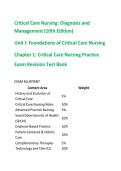
Critical Care Nursing: Diagnosis and
Management (10th Edition)
Unit I: Foundations of Critical Care Nursing
Chapter 1: Critical Care Nursing Practice
Exam Revision Test Bank
EXAM BLUEPRINT
Content Area Weight
History and Evolution of
5%
Critical Care
Critical Care Nursing Roles 10%
Advanced Practice Nursing 5%
Social Determinants of Health
10%
(SDOH)
Evidence-Based Practice 10%
Patient-Centered & Holistic
10%
Care
Complementary Therapies 5%
Technology and Tele-ICU 10%
,Interprofessional
10%
Collaboration
Rapid Response Teams 10%
Quality & Safety 10%
Healthy Work Environment 5%
Question 1
Type: MCQ
Bloom Level: Recall
Learning Objective: Identify a key historical development in
critical care nursing.
Chapter Reference: Unit I, Critical Care Nursing Practice —
History of Critical Care
Clinical Significance: Recognizing the origins of ICU care
supports understanding of modern system design and staffing
models.
A major catalyst for the development of modern critical care
units was the need to:
A. replace general medical-surgical wards with specialty clinics
B. concentrate monitoring and life-support resources for
unstable patients
C. reduce the use of interprofessional collaboration
D. eliminate the need for advanced hemodynamic monitoring
,Correct Answer: B
Rationale: Critical care developed to centralize intensive
monitoring, ventilatory support, vasoactive medication
management, and rapid intervention for unstable patients.
Distractor Analysis:
A. Incorrect; critical care did not replace all general wards.
C. Incorrect; critical care depends on collaboration.
D. Incorrect; advanced monitoring became more necessary, not
less.
Difficulty Rating: Easy
Question 2
Type: MCQ
Bloom Level: Recall
Learning Objective: Distinguish professional organizations that
support critical care nursing practice.
Chapter Reference: Unit I, Critical Care Nursing Practice —
Professional Organizations
Clinical Significance: Membership in specialty organizations
supports competency, education, and practice standards.
Which organization is most directly associated with critical care
nursing standards and certification support?
, A. American Association of Critical-Care Nurses (AACN)
B. American Nurses Association (ANA)
C. National League for Nursing (NLN)
D. American Medical Association (AMA)
Correct Answer: A
Rationale: AACN is a central professional organization for
critical care nurses and provides practice resources,
certification, and standards.
Distractor Analysis:
B. Incorrect; ANA is a broader nursing organization.
C. Incorrect; NLN focuses on nursing education.
D. Incorrect; AMA represents physicians.
Difficulty Rating: Easy
Question 3
Type: SATA
Bloom Level: Recall
Learning Objective: Identify domains of social determinants of
health (SDOH).
Chapter Reference: Unit I, Social Determinants of Health
Clinical Significance: SDOH assessment improves equity,
discharge planning, and ICU transitions of care.
Management (10th Edition)
Unit I: Foundations of Critical Care Nursing
Chapter 1: Critical Care Nursing Practice
Exam Revision Test Bank
EXAM BLUEPRINT
Content Area Weight
History and Evolution of
5%
Critical Care
Critical Care Nursing Roles 10%
Advanced Practice Nursing 5%
Social Determinants of Health
10%
(SDOH)
Evidence-Based Practice 10%
Patient-Centered & Holistic
10%
Care
Complementary Therapies 5%
Technology and Tele-ICU 10%
,Interprofessional
10%
Collaboration
Rapid Response Teams 10%
Quality & Safety 10%
Healthy Work Environment 5%
Question 1
Type: MCQ
Bloom Level: Recall
Learning Objective: Identify a key historical development in
critical care nursing.
Chapter Reference: Unit I, Critical Care Nursing Practice —
History of Critical Care
Clinical Significance: Recognizing the origins of ICU care
supports understanding of modern system design and staffing
models.
A major catalyst for the development of modern critical care
units was the need to:
A. replace general medical-surgical wards with specialty clinics
B. concentrate monitoring and life-support resources for
unstable patients
C. reduce the use of interprofessional collaboration
D. eliminate the need for advanced hemodynamic monitoring
,Correct Answer: B
Rationale: Critical care developed to centralize intensive
monitoring, ventilatory support, vasoactive medication
management, and rapid intervention for unstable patients.
Distractor Analysis:
A. Incorrect; critical care did not replace all general wards.
C. Incorrect; critical care depends on collaboration.
D. Incorrect; advanced monitoring became more necessary, not
less.
Difficulty Rating: Easy
Question 2
Type: MCQ
Bloom Level: Recall
Learning Objective: Distinguish professional organizations that
support critical care nursing practice.
Chapter Reference: Unit I, Critical Care Nursing Practice —
Professional Organizations
Clinical Significance: Membership in specialty organizations
supports competency, education, and practice standards.
Which organization is most directly associated with critical care
nursing standards and certification support?
, A. American Association of Critical-Care Nurses (AACN)
B. American Nurses Association (ANA)
C. National League for Nursing (NLN)
D. American Medical Association (AMA)
Correct Answer: A
Rationale: AACN is a central professional organization for
critical care nurses and provides practice resources,
certification, and standards.
Distractor Analysis:
B. Incorrect; ANA is a broader nursing organization.
C. Incorrect; NLN focuses on nursing education.
D. Incorrect; AMA represents physicians.
Difficulty Rating: Easy
Question 3
Type: SATA
Bloom Level: Recall
Learning Objective: Identify domains of social determinants of
health (SDOH).
Chapter Reference: Unit I, Social Determinants of Health
Clinical Significance: SDOH assessment improves equity,
discharge planning, and ICU transitions of care.