

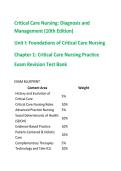
Critical Care Nursing: Diagnosis and
Management (10th Edition)
Unit I: Foundations of Critical Care Nursing
Chapter 1: Critical Care Nursing Practice
Exam Revision Test Bank
EXAM BLUEPRINT
Content Area Weight
History and Evolution of
5%
Critical Care
Critical Care Nursing Roles 10%
Advanced Practice Nursing 5%
Social Determinants of Health
10%
(SDOH)
Evidence-Based Practice 10%
Patient-Centered & Holistic
10%
Care
Complementary Therapies 5%
Technology and Tele-ICU 10%
,Interprofessional
10%
Collaboration
Rapid Response Teams 10%
Quality & Safety 10%
Healthy Work Environment 5%
1. Question (Recall | MCQ)
Which development most directly led to the emergence of
modern critical care units?
A. Home health nursing expansion
B. Mechanical ventilation and continuous physiologic
monitoring
C. Increased use of hospice services
D. Decline in postoperative care needs
Correct Answer: B
Rationale: Critical care units developed as technology advanced
to support patients requiring close hemodynamic, respiratory,
and neurologic monitoring, especially mechanical ventilation
and continuous bedside surveillance.
Distractor Analysis:
A. Home health nursing is unrelated to ICU formation.
C. Hospice services reflect end-of-life care, not ICU
development.
D. Postoperative care needs did not decline; they became more
,complex.
Difficulty: Easy
Learning Objective: Identify the historical drivers of critical care
nursing.
Chapter Reference: Unit I, Critical Care Nursing Practice
Clinical Significance: Understanding ICU origins explains why
technology, monitoring, and rapid intervention remain central
to practice.
2. Question (Recall | MCQ)
Which organization is most closely associated with
promoting critical care nursing standards and specialty
certification?
A. WHO
B. AACN
C. AMA
D. ANA only
Correct Answer: B
Rationale: The American Association of Critical-Care Nurses
(AACN) is a major professional organization supporting critical
care standards, education, and certification.
Distractor Analysis:
A. WHO is a global health agency, not a critical care nursing
specialty body.
C. AMA represents physicians.
, D. ANA supports nursing broadly but is not the primary critical
care specialty organization.
Difficulty: Easy
Learning Objective: Recognize key professional organizations in
critical care nursing.
Chapter Reference: Unit I, Critical Care Nursing Practice
Clinical Significance: Membership in specialty organizations
supports evidence-based practice and professional growth.
3. Question (Recall | MCQ)
Which of the following is an example of a social
determinant of health (SDOH) domain?
A. Blood type
B. Access to safe housing
C. Serum sodium level
D. Genetic mutation
Correct Answer: B
Rationale: Safe housing is a social and environmental factor
that can influence health outcomes and access to care.
Distractor Analysis:
A. Blood type is a biologic characteristic.
C. Serum sodium is a physiologic laboratory value.
D. Genetic mutation is a biologic factor, not an SDOH domain.
Difficulty: Easy
Learning Objective: Define social determinants of health and
Management (10th Edition)
Unit I: Foundations of Critical Care Nursing
Chapter 1: Critical Care Nursing Practice
Exam Revision Test Bank
EXAM BLUEPRINT
Content Area Weight
History and Evolution of
5%
Critical Care
Critical Care Nursing Roles 10%
Advanced Practice Nursing 5%
Social Determinants of Health
10%
(SDOH)
Evidence-Based Practice 10%
Patient-Centered & Holistic
10%
Care
Complementary Therapies 5%
Technology and Tele-ICU 10%
,Interprofessional
10%
Collaboration
Rapid Response Teams 10%
Quality & Safety 10%
Healthy Work Environment 5%
1. Question (Recall | MCQ)
Which development most directly led to the emergence of
modern critical care units?
A. Home health nursing expansion
B. Mechanical ventilation and continuous physiologic
monitoring
C. Increased use of hospice services
D. Decline in postoperative care needs
Correct Answer: B
Rationale: Critical care units developed as technology advanced
to support patients requiring close hemodynamic, respiratory,
and neurologic monitoring, especially mechanical ventilation
and continuous bedside surveillance.
Distractor Analysis:
A. Home health nursing is unrelated to ICU formation.
C. Hospice services reflect end-of-life care, not ICU
development.
D. Postoperative care needs did not decline; they became more
,complex.
Difficulty: Easy
Learning Objective: Identify the historical drivers of critical care
nursing.
Chapter Reference: Unit I, Critical Care Nursing Practice
Clinical Significance: Understanding ICU origins explains why
technology, monitoring, and rapid intervention remain central
to practice.
2. Question (Recall | MCQ)
Which organization is most closely associated with
promoting critical care nursing standards and specialty
certification?
A. WHO
B. AACN
C. AMA
D. ANA only
Correct Answer: B
Rationale: The American Association of Critical-Care Nurses
(AACN) is a major professional organization supporting critical
care standards, education, and certification.
Distractor Analysis:
A. WHO is a global health agency, not a critical care nursing
specialty body.
C. AMA represents physicians.
, D. ANA supports nursing broadly but is not the primary critical
care specialty organization.
Difficulty: Easy
Learning Objective: Recognize key professional organizations in
critical care nursing.
Chapter Reference: Unit I, Critical Care Nursing Practice
Clinical Significance: Membership in specialty organizations
supports evidence-based practice and professional growth.
3. Question (Recall | MCQ)
Which of the following is an example of a social
determinant of health (SDOH) domain?
A. Blood type
B. Access to safe housing
C. Serum sodium level
D. Genetic mutation
Correct Answer: B
Rationale: Safe housing is a social and environmental factor
that can influence health outcomes and access to care.
Distractor Analysis:
A. Blood type is a biologic characteristic.
C. Serum sodium is a physiologic laboratory value.
D. Genetic mutation is a biologic factor, not an SDOH domain.
Difficulty: Easy
Learning Objective: Define social determinants of health and


